I will continue to use "Anthropogenic Global Warming" (AGW) to describe this ideology. Although atmospheric CO2 concentrations continue to increase, global temperatures have more or less plateaued in the past decade. Since the plateau occurred at a warm average temperature, we've been treated to innumerable accounts of the fact that recent years have been among the warmest in recent history. So, despite the use of the term "climate change", it's clear that proponents are invested in creating the public perception that the earth is continuing to warm (and that such warming will soon accelerate out of control).
Climate change really is a term of art, because it allows CoGW adherents to insist that all weather -- wet or dry, hot or cold -- validates the AGW orthodoxy.
Floods in China: check. Drought in China: check. More hurricanes: check. Fewer hurricanes: check. Summer ice melt in the Arctic: check. Winter refreezing of Arctic ice that exceeds that which originally melted: check. Collapse of the West Antarctica Ice Shelf: check. Net increase in Antarctic ice: check. Record warm winter in 2006-2007: check. Record cold winter in 2007-2008: check.
And so on.
This leads me to ask a question of those of you who believe that human activity is negatively and catastrophically impacting the earth's climate:
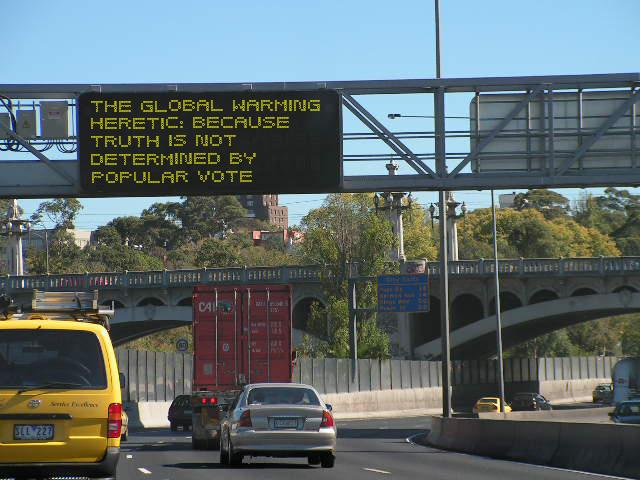
Is the anthropogenic climate change hypothesis falsifiable?
I am asking this within the context of the scientific method. Integrity demands that a scientist, when proposing a hypothesis, list the conditions whereby the hypothesis would fall apart:
We believe that this hypothesis sufficiently describes the reality we are studying, but if anybody can demonstrate any of conditions a, b, c, d or e, our hypothesis is fatally compromised and it's back to the drawing board.So, AGW folks: can you name any condition (series of weather events, temperature trends, etc.) that would make you doubt the current orthodoxy, or are we witnessing the most bulletproof hypothesis ever?
UPDATE: After a quick Google search, I was pleased to discover that this question has already occurred to minds much greater than mine. As I composed this post earlier today, I had the folks at RealClimate in mind (among others). It turns out that Roger Pielke, Jr. tossed the following rhetorical grenade into the midst of a RealClimate discussion about how awfully cold Antarctica is right now:
The ensuing debate is pretty interesting.There are a vast number of behaviors of the climate system that are consistent with climate model predictions, along the lines of your conclusion: “A cold Antarctica and Southern Ocean do not contradict our models of global warming.”
I have asked many times and never received an answer here: What behavior of the climate system would contradict models of global warming? Specifically what behavior of what variables over what time scales? This should be a simple question to answer.
Thanks!
Pielke followed up on the question in his own blog. The debate is pretty lively in the comment section over there as well.
(Found via: Seeker Blog)





 Headlines via e-mail


