Showing posts with label AGW_Blame_Game. Show all posts

Monday, January 4, 2010

Global warming update

Times Online (UK), January 4:

Arctic air and record snow falls gripped the northern hemisphere today, inflicting hardship and havoc from China, across Russia to Western Europe and over the US plains.

There were few precedents for the global sweep of extreme cold and ice that killed dozens in India, paralysed life in Beijing and threatened the Florida orange crop. Chicagoans sheltered from a potentially killer freeze, Paris endured sunny Siberian cold, Italy dug itself out of snowdrifts and Poland counted at least 13 deaths in record low temperatures of about minus 25C (-13F).

The article goes on with example after example demonstrating that we’re currently experiencing the worst winter in many decades.

The reason? Global warming, of course:

Guo Hu, the head of the Beijing Meteorological Bureau, linked this week’s conditions to unusual atmospheric patterns caused by global warming.

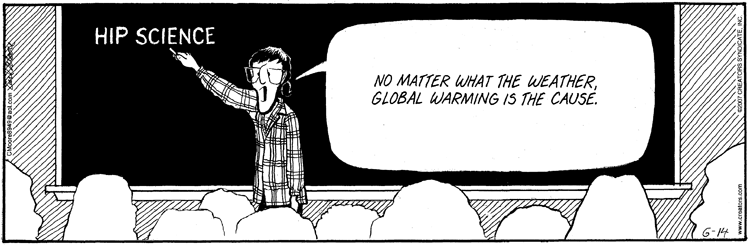
Folks, it doesn’t matter what kind of weather we have — it’s all because of global warming.  No evidence required, because the meme is firmly entrenched.

Tuesday, February 17, 2009

Planet-hating beef eaters, cont'd.


Sigh. Another day, another article informing us that our meat consumption -- especially western beef consumption -- is killing the planet. This February 16 AFP article even manages to drag in a comparison with the Hitler of the automotive world:
When it comes to global warming, hamburgers are the Hummers of food, scientists say.

Simply switching from steak to salad could cut as much carbon as leaving the car at home a couple days a week.

That's because beef is such an incredibly inefficient food to produce and cows release so much harmful methane into the atmosphere, said Nathan Pelletier of Dalhousie University in Canada.

Pelletier is one of a growing number of scientists studying the environmental costs of food from field to plate.

By looking at everything from how much grain a cow eats before it is ready for slaughter to the emissions released by manure, they are getting a clearer idea of the true costs of food.

The livestock sector is estimated to account for 18 percent of global greenhouse gas emissions and beef is the biggest culprit.

Even though beef only accounts for 30 percent of meat consumption in the developed world it's responsible for 78 percent of the emissions, Pelletier said Sunday at a meeting of the American Association for the Advancement of Science.

That's because a single kilogram of beef produces 16 kilograms carbon dioxide equivalent emissions: four times higher than pork and more than ten times as much as a kilogram of poultry, Pelletier said.
By the way, that 1:16 ratio of beef to CO2 emissions cited in the last paragraph seriously undermines the 1:36 ratio claimed by Japanese alarmists in another AFP article we highlighted back in July of 2007.

Kind of makes me wonder if they're just making stuff up.

Monday, March 3, 2008

Update on the indoctrination of our youth

WJBF-TV in Atlanta brings us this February 28 story of a boy who appears to have a fine future in politics:
Governor Arnold Schwarzenegger helped a student who fainted at a speech in Sacramento.

[...]

The boy and the Governor got a chance to talk later in the nurse's office. The student told the Governor he blames global warming for the incident.

Monday, January 7, 2008

Everything's connected, even when it isn't

Here's the scenario that is laid out in a January 6th article:
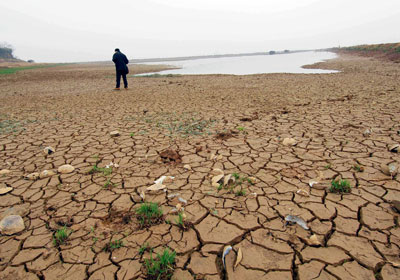
  • China's largest freshwater lake, Poyang Lake in Jiangxi Province, appears to be drying up.
  • The lake, which is fed by the Yangtze River, has an enormous seasonal variability in its surface area, with a minimum occurring every winter.
  • This winter's minimum is about 10% of last winter's minimum.

Okay, this is pretty straightforward and statistical, but (apart from the devastating human impact) not that interesting. So what title did Forbes columnist Chris O'Brien choose to draw the reader's interest? Global Warming Hits China.

Is there anything in the essay that might support this notion? We learn that the cause of Poyang's predicament is threefold:
  • The Yangtze River basin is suffering a crippling drought. Worst ever? No, its worst in the last 50 years. In other words, this is a drought which, while severe, is neither unprecedented nor rare.
  • Upriver hydroelectric projects (including the infamous Three Gorges Dam) have significantly affected the Yangtze's flow downriver.
  • The government has embarked on a monumental effort to divert some of the Yangtze's water to the Yellow River.
In light of the above facts, Jiang Tong, a member of the Chinese Academy of Sciences and an expert on Poyang Lake, summarized:
Both the stream flows into the river and the Yangtze River water to replenish the lake will be insufficient in dry seasons in the future, because of climate change and the exploitation of water resources.
As I remarked above, there doesn't seem to be any particular scientific reason to tie China's drought to "climate change" (a term of art that is increasingly used in place of "global warming", although Mr. O'Brien apparently hasn't yet received the memo), but there are plenty of political reasons to do so.

Given his position, Jiang Tong can be forgiven for minimizing the significance of the government's "exploitation of water resources", but Forbes has no such excuse.

Wednesday, December 12, 2007

The sun gets dissed again

Despite credible evidence that solar influences on earth's climate trump anthropogenic influences, The Daily Green decided the sun wasn't worth mentioning as a possible culprit in their online poll:


Given that the environmental left has invested everything in persuading us that climate change is -- for the first time ever -- human induced, I don't blame the editors of The Daily Green for the oversight.

Monday, December 10, 2007

NY Times repeats the Kilimanjaro lie


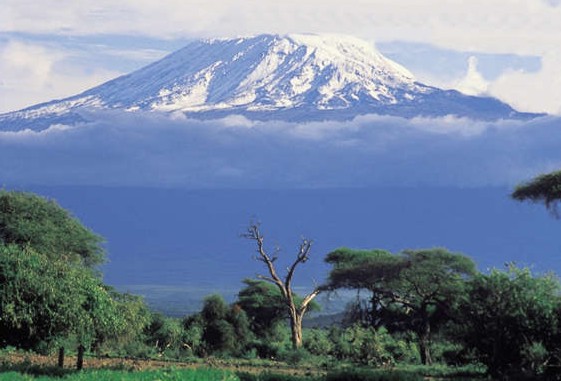
If you watched An Inconvenient Truth (my condolences if you have), or if you have read any one of countless media reports on AGW, you might have gotten the impression that the snowcap on Mount Kilimanjaro in Tanzania is melting.

It's not melting.

It is in fact shrinking, but that's due to sublimation, the process by which something changes from its solid state directly into its gaseous state in below-freezing temperatures without first melting. The temperature atop Kilimanjaro is nowhere near what is needed for melting. Low humidity in the region -- not warming -- is driving the sublimation. And guess what? It's been happening for more than a century.

I suppose I shouldn't expect the New York Times' travel writers to know that, but it still irks me to see such easily-refuted assertions repeated ad nauseam in the media. Here is what the NYT had to say about Kilimanjaro in its feature, The 53 Places to Go in 2008:
42. KILIMANJARO

Time may be running out to see the most famous snows of American literature. The ice-capped peak of Kilimanjaro, Africa's highest mountain, is melting at an alarming rate. Within several decades, scientists predict, the glaciers will have completely disappeared.
But wait! They didn't actually say it was because of global warming. What gives, Mr. Heretic?

True, they didn't mention AGW directly, but they did substitute a code phrase -- "melting at an alarming rate" -- that leave little room for any other interpretation. Why should anyone be "alarmed" about this if they considered it to be a natural process with no human influence?

Thursday, November 29, 2007

Bob and Doug McKenzie, eco-criminals


Perhaps the human race should follow Toni Vernelli's example and just stop reproducing. For some time now, researchers apparently have been scrambling to prove that every human activity and technology -- especially the ones that make life easier or more enjoyable -- is dooming the planet.

Fox News reports that the CoGW's crosshairs have recently come to rest on one of Canada's beloved institutions [emphasis added]:
Scientists have found a new threat to the planet: Canadian beer drinkers.

The government-commissioned study says the old, inefficient "beer fridges" that one in three Canadian households use to store their Molson and Labatt's contribute significantly to global warming by guzzling gas- and coal-fired electricity.

"People need to understand the impact of their lifestyles," British environmental consultant Joanna Yarrow tells New Scientist magazine. "Clearly the environmental implications of having a frivolous luxury like a beer fridge are not hitting home. This research helps inform people — let's hope it has an effect."
Denise Young, who led the study, is not content to allow time for her research to sink into Bob and Doug's beer-addled brains. Instead, she thinks the government should institute a beer-fridge buyback program (or simply confiscate the things), drawing moral equivalence between a kitchen appliance and the Saturday Night Special.

Come to think of it, for many people a beer fridge is a Saturday Night Special.

Wednesday, October 31, 2007

Tuesday, September 18, 2007

Global warming causes upsurge in antisemitism

I showed in the preceding post how AGW alarmism is a potential lifesaver for any cause that is suffering a dearth of popular support. In that case, fear of global warming was being used to gin up opposition to hydroelectric dams.

Now we see a prominent British Member of Parliament using the AGW crisis in an attempt to increase international opposition to..... Israel. It seems that Israel's very existence is hindering the fight against climate change. As reported in the September 13 Daily Telegraph:

Former Blair Government minister Clare Short made the absurd claim last month that no progress was possible on climate change treaties because Israel "undermines the international community's reaction to global warming".

Ms Short, who resigned from the Blair Government over the war in Iraq, explained that man-made climate change continues because Israel's conflict with the Palestinians and its Arab neighbours is distracting world leaders from devising a response to global warming.

Glad to see that the Telegraph is having none of that.

Maybe we should have a contest to come up with the most ridiculous connection between climate change and something else. Why bother, though? We already have a winner!

Wednesday, September 12, 2007

Hydroelectric dams cause earthquakes, volcanoes, severe thunderstorms, and heart attacks

Okay, try to follow along on this one.

Again we return to the observation that the AGW 'crisis' is ideally suited to the aims of the radical environmental movement. Global warming (or "climate change", if you insist) is flexible enough to encompass virtually all of their pet causes of the past four decades (with the exception of nuclear power, which keeps stubbornly popping up as the most earth-friendly energy source capable of completely replacing coal).

For example, the enviros have long opposed the damming of rivers because of the inconvenience such projects cause to snail darters and the like. They have not, however, been able to swing public support in their favor, because on the whole people like their televisions and their power tools more than they like snail darters.

That's why the AGW thing is a stroke of good luck for the environmentalists. Like just about everything else, someone has been able to suggest a connection between the damming of rivers and global warming. A September 4 article in Australia's news.com reported:
International Rivers Network executive director Patrick McCully today told Brisbane's Riversymposium rotting vegetation and fish found in dams produced surprising amounts of methane - 25 times stronger than carbon dioxide.

"Often it's accepted that hydropower is a climate friendly technology but in fact probably all reservoirs around the world emit greenhouse gases and some of them, especially some of the ones in the tropics, emit very high quantities of greenhouse gases even comparable to, in some cases even much worse than, fossil fuels like coal and gas," Mr McCully said.

He said when water flow was stopped, vegetation and soil in the flooded area and from upstream was left to rot, as well as fish and other animals which died in the dam.

They then released carbon dioxide, methane and nitrous oxide into the air.

"Basically they're factories for converting carbon into methane and methane is a very powerful greenhouse gas - it's less known than carbon dioxide but it's actually about 25 times stronger than carbon dioxide in terms of trapping heat in the atmosphere."

Mr McCully said global estimates blamed dams for about a third of all methane emissions worldwide.
Now we're on to something. Dams cause global warming. That's just evil.

Still no groundswell of public opposition to dams.... So, let's bring this a bit closer to home. We've mentioned some of the things said to be caused by or enhanced by AGW (such as flooding rains, amorous cats, genocide, super poison ivy, higher pizza prices, and megacryometeors). To this list we must add earthquakes and volcanoes, as we are told in this August 30 LiveScience article:

Earthquakes, volcanic eruptions, tsunamis and landslides are some of the additional catastrophes that climate change and its rising sea levels and melting glaciers could bring, a geologist says.

The impact of human-induced global warming on Earth's ice and oceans is already noticeable: Greenland's glaciers are melting at an increasing rate, and sea level rose by a little more than half a foot (0.17 meters) globally in the 20th century, according to the Intergovernmental Panel on Climate Change.

[...]

One particular feature that can change the balance of forces in Earth's crust is ice, in the form of glaciers and ice sheets that cover much of the area around Earth's poles plus mountains at all latitudes. The weight of ice depresses the crust on which it sits.

As the ice melts, the crust below no longer has anything sitting on top of it, and so can rebound fairly rapidly (by geological standards). (This rebounding is actually occurring now as a result of the end of the last Ice Age: The retreat of massive ice sheets from the northern United States and Canada has allowed the crust in these areas to bounce back.)

Areas of rebounding crust could change the stresses acting on earthquake faults and volcanoes in the crust.

(Thanks to Newsbusters)

Earthquakes and volcanoes are bad. But you're still okay with hydroelectric power, are you? Willing to play the odds that a volcano won't pop up in your back yard, eh? Let's up the ante a little more. Here's another August 30 article from LiveScience:
Global warming will make severe thunderstorms and tornadoes a more common feature of U.S. weather, NASA scientists said today.

Climate models have previously shown that Earth will see more heavy rainstorms as the atmosphere warms, but a new climate model developed by NASA researchers is the first to show the difference in strength between storms that occur over land and those over the ocean and how storms strengths will change in general.

The models don't directly simulate thunderstorms and lightning, but look for conditions that are ripe for severe storms to form.
Thunderstorms! Tornadoes! Those are real threats where I live. In fact, as I mentioned in the post before this, my PC was zapped by lightning three weeks ago. I was at work at the time, and I heard a single thunderclap -- apparently the one that got my motherboard at home. A thunderstorm with only one significant lightning strike, but it was a doozy. That's just creepy enough to blame on global warming (never mind the fact that we're experiencing the coolest summer in the 30 years I've lived in Texas). But is it enough to make me give up the hydroelectric dam? Hey, I need power to run my PC once I get it fixed (as well as the new one I have on order).

Since you haven't listened to reason yet, it's time to get personal. Global warming is coming for you. Yes, you. Here's an Associated Press dispatch from September 5:

Doctors warn that the warmer weather expected with climate change might also produce more heart problems.

"If it really is a few degrees warmer in the next 50 years, we could definitely have more cardiovascular disease," said Dr. Karin Schenck-Gustafsson, of the department of cardiology at Sweden's Karolinska Institute.

[...] In higher temperatures, we sweat to get rid of heat. During that process, blood is sent to the skin where temperatures are cooler, which opens up the blood vessels. In turn, the heart rate rises and blood pressure drops. That combination can be dangerous for older people and those with weakened cardiovascular systems.

So now you're dead. If that doesn't turn you against hydroelectric dams, I don't know what will.

Friday, July 27, 2007

Global warming can be a homewrecker

In recent years there have been numerous stories of large chunks of ice falling from a clear sky. AP reports today that it happened again July 26 in Dubuque, Iowa, where a chunk that may have weighed 50 pounds crashed through the roof of a woman's house.

In the past, media coverage has focused on the likelihood that such ice chunks originate from an airplane (either accumulated on the outside of the craft, or ejected from the lavatories), but now a more sinister suspect is starting to ooze into the reporting. We get an early warning in the second paragraph (emphasis added):
Authorities are unsure of the ice's origin but have theorized the chunks either fell from an airplane or naturally accumulated high in the atmosphere — both rare occurrences.
How can a 50-pound chunk of ice accumulate naturally in the atmosphere? What malevolent force can suspend ice long enough to grow that large on a clear day, when even the most violent of thunderstorms could never sustain the necessary updrafts?

You guessed it -- climate change!

Enter Dr. David Travis, expert on earthbound phenomena, but not necessarily atmospheric science:
David Travis, a professor of geography and geology and an associate dean at the University of Wisconsin-Whitewater, has studied the phenomenon of large chunks of ice falling from a clear sky. He said it's possible the ice could have been a megacryometeor — "similar to a hailstone, but without the thunderstorm."

[...] Most megacryometeor sightings have occurred in coastal areas, where atmospheric turbulence helps keep ice suspended long enough to grow into large chunks.

Travis' research team speculates the phenomenon could be linked with global warming, suggesting that climate change might make the tropopause portion of the atmosphere colder, moister and more turbulent.

A total guess, based on zero evidence, in other words.

Maybe I'm the one who's weak on the atmospheric science, so I'm open to being educated here. What kind of updraft is necessary to suspend an ice chunk of that weight, and how long must that updraft be sustained to allow the chunk to grow to that weight? Do such updrafts actually occur in nature?

Monday, July 23, 2007

Britain's floods and the virtual reality of climate science

U.K.'s The Independent reported breathlessly today that the extraordinary flooding now underway in Britain is happening because George W. Bush withdrew the United States from the Kyoto Treaty.

Well, not really. I should really stop exaggerating like that. I wouldn't be surprised, though, if somewhere out there someone has blamed Bush for this.

What The Independent did report is the claim that "scientists" have "confirmed" a link between Britain's summer floods and "man-made global warming".

Let's look at the opening paragraphs of the article, which is riddled with superlatives:

It's official: the heavier rainfall in Britain is being caused by climate change, a major new scientific study will reveal this week, as the country reels from summer downpours of unprecedented ferocity.

More intense rainstorms across parts of the northern hemisphere are being generated by man-made global warming, the study has established for the first time ­ an effect which has long been predicted but never before proved.

The study's findings will be all the more dramatic for being disclosed as Britain struggles to recover from the phenomenal drenching of the past few days, during which more than a month's worth of rain fell in a few hours in some places, and floods forced thousands from their homes.

So, how were the scientists able to pin the blame so unambiguously on AGW? Not by the hopelessly old-fashioned method of empirical data collection and analysis, but through the use of -- you guessed it! -- computer simulations. Climate models -- which supposedly are not useful for predicting individual weather events (the article admits as much) -- allegedly yielded something akin to this summer's individual weather events when simulations both with and without greenhouse gases were run.

The article turns out to be quite confusing. In places we are confidently assured that AGW Did It, and then in other places the confidence wavers (emphasis added):
Meteorologists agree that the miserably wet British summer of 2007 has generally been caused by a southward shift towards Britain of the jetstream, the high-level airflow that brings depressions eastwards across the Atlantic. This is fairly normal. But debate is going on about whether climate change may be responsible for the intensity of the two freak rainfall episodes, which have caused flooding the like of which has never been seen in many places.
So, rainfall events enabled by a normal shift in the jet stream are now the fault of AGW because of "unprecedented" flooding that resulted. Remember, no empirical link has been established -- just computer simulations and human inferences.

The new study, carried out jointly by several national climate research institutes using their supercomputer climate models, including the Hadley Centre of the UK Met Office, does not prove that any one event, including the rain of the past few days in Britain, is climate-change related.

But it certainly supports the idea, by showing that in recent decades rainfall has increased over several areas of the world, including the mid-latitudes of the northern hemisphere, and linking this directly, for the first time, to global warming caused by human emissions of greenhouse gases.

In other words, "It looks awfully like what we think might happen." More:
"Some people would argue that you can't take a single event and pin that on climate change, but what happened in Britain last Friday fits quite easily with these conclusions. It does seem to have a certain resonance with what they're finding in this research."
Yikes! This is what passes for the scientific method among adherents of the CoGW.

The study, to be published in the journal Nature later this week, may end up being a lot less sloppy than the reporting here presents it to be, but I'm not willing to bet money on that.

Thursday, July 19, 2007

Hope you choke on your steak, you planet murderer

I've mentioned before how nicely the growing list of dos and don'ts prescribed to help us deal with climate change coincides with the longtime agenda of the environmentalist left. Want to leave virtually no "carbon footprint"? Become a vegan Luddite.

A July 18 AFP story fits the template, relating a study that purports to calculate how much closer the Earth came to the brink of catastrophe, just so you could have that steak for dinner:

A kilogram (2.2 pounds) of beef causes more greenhouse-gas and other pollution than driving for three hours while leaving all the lights on back home, according to a Japanese study.

[...] Producing a kilo (2.2 pounds) of beef causes the equivalent of 36.4 kilos (80.08 pounds) in carbon dioxide (CO2), the principal greenhouse gas, Ogino found.

Most of these greenhouse-gas emissions take the form of methane, released from the cow's digestive system.

That one kilo (2.2 pounds) of beef also requires energy equivalent to lighting a 100-watt bulb for nearly 20 days. The energy is needed to produce and transport the animals' feed.

The article ends by noting another study that claims organic beef (apparently defined as: the cow ate grass instead of commercial feed) reduces cattle flatulence by 40% and requires 85% less energy consumption.

But don't think they'll be satisfied with getting you to switch to grass-fed cattle. All cattle raised for food are considered to be a nonessential source of greenhouse gases, so there's really no way to eat steak guilt-free, so you might as well give it up. Sigh...pass the tofu, willya?

Monday, July 2, 2007

The Six Degrees of Global Warming

I thought I had posted this idea at my old blog a long time ago, but maybe not. Many others have taken off with the idea, though, so I don't think I can take credit.

Here are the simple rules for the game called The Six Degrees of Global Warming.
  1. Start with any Bad Thing or Undesirable Effect.
  2. Connect it to global warming in six or fewer steps.
You can see the game in action in this blog post by AccuWeather's Brett Anderson:
Many people are promoting the use of ethanol (alcohol made from corn) as a possible partial solution to global warming. A whyfile.org article (Alcohol: Cool Solution to Global Warming?) explains the logic. Not everyone agrees that ethanol will not help to ease any global warming concerns as is explained in this Reuters article (Ethanol May Not Ease Global Warming: UN) that was found in the Sydney Morning Herald indicates; however, more ethanol is being produced.

According to a recent article on ABC News (How More Ethanol Means Pricier Pizza), an increase in production of ethanol has resulted in higher dairy prices since more corn is being used for fuel rather than food for cattle. So, there you have it: more ethanol to try to combat global warming means higher dairy prices, which means more expensive cheese and more expensive pizza. That's right--global warming is causing higher pizza prices!!
Global warming >> shift to ethanol production >> higher feed prices >> higher dairy prices >> higher pizza prices. Congratulations, Mr. Anderson. You made it in four steps!

It appears that Mr. Anderson is having fun here, but far too many out there are in deadly earnest.

Thursday, June 28, 2007

Why the Darfur genocide is America's fault

Back on June 18 I commented on UN Secretary General Ban Ki-Moon's nonsensical assertion that climate change is ultimately to blame for the ongoing wholesale slaughter in Darfur, Sudan. If only you hadn't bought that SUV, none of this would have happened.

Fred "I'm gonna announce any day now" Thompson, on his daily commentary on ABC Radio, explains that the historical realities of the area are more than sufficient to explain what is happening:
Sudan straddles the line between Christian African and Muslim Arabic cultures, bordering Egypt and Libya on the north. Bloody regional warfare stretches back centuries but, in modern times, the country has been in pretty much of a constant state of war since the 1950s. It's safe to say that millions have died in wars that are often aimed at control of the rich oil fields in the South. Today, however, the vastly reduced African Christian population isn't even involved. Two Muslim factions, divided along racial lines, are fighting for control of Darfur.

Now it’s true that the return of cyclical droughts has made agriculture and life more and more difficult for the people in the region. The impact of the weather, however, doesn’t approach the destruction that generations of warfare have worked on the land and the people. With peace and freedom, the economy of Darfur could have easily adapted to any climate change – no matter the cause.

Thompson suggests that the SecGen's assertion really boils down to a time-honored UN tradition: anti-Americanism.

Blaming the Islamic government and groups that have manipulated events in Sudan will get him nothing but enemies. Blaming global warming, however, is basically the same thing as blaming America. America is by no means the only major source of greenhouse gases, but we've taken the most political heat. The reason is that congress rightfully balked at ratifying the Kyoto international climate treaties during the Clinton presidency.

There is simply no downside to blaming America, because Americans don't punish their ideological foes. From the UN, we don't even require sanity sometimes. And there might even be an upside to blaming us, since there are Americans who suffer from such ingrained feelings of guilt, they’ll support increased aid to both the UN and Sudan.

If the blame ultimately rests on America, the UN can absolve itself of any responsibility to act.

Speaking of rash conclusions...

In my post on the poison ivy study I criticized the researchers for drawing unjustified Real World conclusions based on what amounted to a lab simulation. I thought they should have at least gone out to see if poison ivy -- or any other plant, for that matter -- has shown any sign of biologically adapting to rising CO2 concentrations. Otherwise, all we have is what-if alarmism, on a par with a B-grade science fiction movie (like what we saw in The Day After Tomorrow).

In fairness, I need to admit that some researchers do try to come a little closer to Real World experimentation when speculating on the effects of rising CO2.

A reader on Free Republic brought to my attention a study conducted by the Marine Biological Laboratory of Woods Hole, Massachusetts that actually went through the trouble of conducting its simulation outside (in a North Carolina forest owned by Duke University). As summarized by Nature.com, May 30, 2006:
In the study, Mohan and her co-workers pumped extra CO2 over three large circular plots of North Carolina pine forest. For six years, the plants inside were exposed to an extra 200 parts per million of CO2 over today's atmospheric concentration of about 380 parts per million, roughly what we might expect from pollution by the middle of this century.

Other research has suggested that vines tend to grow particularly fast in response to higher CO2 levels, and that vines are increasing in abundance all over the planet. Unlike trees, which use extra carbon to grow more wood, vines use it to produce more leaves. The extra leaves help the plant to harvest even more CO2, the cycle continues and the vines flourish.

Mohan's experiment sought to check whether the plants shoot up in the wild, as they do in greenhouse experiments. "Yes, dramatically," was the answer. The poisonous ivies grew at double the rate of plants grown under regular CO2 levels, whereas woody species on average tend to grow around 31% faster. The elevated CO2 also created a nastier version of urushiol poison, the team showed.

[...] By extracting urushiol from the plant's leaves, the researchers found that poison ivy grown in high CO2 churned out more than 150% more of one nasty, unsaturated form of urushiol and around 60% less of the mild, saturated form.

The researchers aren't sure why this chemical shift took place, but one idea is that the increased availability of carbon somehow favours the chemical reactions that produce the unsaturated forms of urushiol.
I think this team did a much better job of trying to approximate natural conditions than did the team in the other study. But... two thoughts come to my mind pretty quickly:
  1. The study was premised on the IPCC guesstimate that atmospheric CO2 would rise from the current 380-ish ppm to 570-ish ppm by mid-century. As much of IPCC's work has given me reason for skepticism, I decline to swallow this prediction uncritically.
  2. The planet's ecosystem is so complex, I don't think a study performed in this manner can authoritatively tell us what would happen in the Real World if atmospheric CO2 did rise to this level.
I'm open to being educated on this, if you care to give it a whirl.

Tuesday, June 26, 2007

Poison ivy study leads to rash conclusions

Tara Parker-Pope, writing today in the Wall Street Journal, leads off with an ominous pronouncement:
Poison ivy, the scourge of summer campers, hikers and gardeners, is getting worse.

New research shows the rash-inducing plant appears to be growing faster and producing more potent oil compared with earlier decades.
There's a word in the second sentence that should set off alarm bells, but let's set that aside for a moment and move along to the fingering of the culprit.
The reason? Rising ambient carbon-dioxide levels create ideal conditions for the plant, producing bigger leaves, faster growth, hardier plants and oil that's even more irritating.
Our old friend CO2! It is indeed a fact that CO2 levels have generally increased over the past century or two, and we know that plants love the stuff. The conclusion should be foregone.

So what did these researchers do? Did they send teams of scientists into the forests of America, collecting samples of increasingly aggressive poison ivy? No, of course not, silly! Climate researchers can form their conclusions based on computer simulations, so why should plant researchers have to go out into the field and actually observe the phenomenon their research purports to demonstrate?

No, what they did was gas a bunch of plants in a lab to see what would happen, and then used the results to assume what was happening in nature.
Although the data on poison ivy come from controlled studies, they suggest the vexing plant is more ubiquitous than ever.
The plant appears to be growing faster. The data suggest the plant is more ubiquitous. Unless I missed it, there's nothing in the article to indicate that the researchers have found a CO2-enhanced poison ivy plant in the Real World.

So why are they insulting us with the headline, Climate Changes Are Making Poison Ivy More Potent? Because AGW alarmism is not actually about science.

UPDATE: Here's a followup.

Monday, June 18, 2007

Why the Darfur genocide is your fault

In a June 16 Washington Post editorial, UN Secretary General Ban Ki Moon outlines a chain of events connecting the genocide in Darfur to.... your SUV.

Well, he doesn't actually connect the final dot, but the implication is certainly there.

Because you in particular, and the US and the rest of the industrial world in general, have been emitting far too much CO2, the Indian Ocean has warmed, leading to a drought-inducing monsoon disruption in Sudan. As the water supplies dried up, local farmers and nomadic herdsmen started fighting over resources. One thing led to another, and here we are.

Oh, and Somalia's your fault also.

I hope you can rest well knowing this.

UPDATE: Fred Thompson comments on the SecGen's assertion.

Handy guide to understanding our weather

(Click to view full-sized image)

Wednesday, June 6, 2007

Blame it on AGW: Shelters overwhelmed with cats and kittens

I suspect I'll see enough of this type of article that it's worth launching a series with the title "Blame it on AGW". John Brignell has documented the fact that just about every modern ill is being blamed on global warming; LiveScience brings us another example:
Droves of cats and kittens are swarming into animal shelters nationwide, and global warming is to blame, according to one pet adoption group.

Several shelters operated by a national adoption organization called Pets Across America reported a 30 percent increase in intakes of cats and kittens from 2005 to 2006, and other shelters across the nation have reported similar spikes of stray, owned and feral cats.

The cause of this feline flood is an extended cat breeding season thanks to the world’s warming temperatures, according to the group, which is one of the country’s oldest and largest animal welfare organizations.

“Cats are typically warm-weather, spring-time breeders,” said the group’s president, Kathy Warnick. “However, states that typically experience primarily longer and colder winters are now seeing shorter, warmer winters, leading to year-round breeding.”
We've had maybe a one degree Celsius increase in temperature in the past century, and the majority of that increase happened early in the century. Apparently our feline friends have just now gotten around to noticing that.