Showing posts with label IPCC. Show all posts

Sunday, January 17, 2010

What was that they were saying about the science being settled?

The UN’s Intergovernmental Panel on Climate Change (IPCC), which didn’t seem to mind being seen as the final word on all things climate change, appears to have based some of their conclusions on information taken from the back of a cereal box.

Well, maybe not, but we now know of at least one instance where a major IPCC doomsday prediction was based on information taken not from the vaunted peer-reviewed literature, but rather from an organization whose stock in trade is exaggerating perceived environmental threats.

The Sunday Times (UK) reports today:

Two years ago the Intergovernmental Panel on Climate Change (IPCC) issued a benchmark report that was claimed to incorporate the latest and most detailed research into the impact of global warming. A central claim was the world's glaciers were melting so fast that those in the Himalayas could vanish by 2035.

In the past few days the scientists behind the warning have admitted that it was based on a news story in the New Scientist, a popular science journal, published eight years before the IPCC's 2007 report.

It has also emerged that the New Scientist report was itself based on a short telephone interview with Syed Hasnain, a little-known Indian scientist then based at Jawaharlal Nehru University in Delhi.

Hasnain has since admitted that the claim was "speculation" and was not supported by any formal research. If confirmed it would be one of the most serious failures yet seen in climate research. The IPCC was set up precisely to ensure that world leaders had the best possible scientific advice on climate change.

[…]

The New Scientist report was apparently forgotten until 2005 when WWF cited it in a report called An Overview of Glaciers, Glacier Retreat, and Subsequent Impacts in Nepal, India and China. The report credited Hasnain's 1999 interview with the New Scientist. But it was a campaigning report rather than an academic paper so it was not subjected to any formal scientific review. Despite this it rapidly became a key source for the IPCC when Lal and his colleagues came to write the section on the Himalayas.

When finally published, the IPCC report did give its source as the WWF study but went further, suggesting the likelihood of the glaciers melting was "very high". The IPCC defines this as having a probability of greater than 90%.

The report read: "Glaciers in the Himalaya are receding faster than in any other part of the world and, if the present rate continues, the likelihood of them disappearing by the year 2035 and perhaps sooner is very high if the Earth keeps warming at the current rate."

So the WWF report didn’t even pretend to be an academic paper, but instead was a “campaign” report from start to finish.  Instead of following the trail to the source of the assertion, they swallowed WWF’s interpretation whole, and even went further by assigning a “very high” likelihood that the glacial disappearance would occur in the specified timeframe.  All ultimately based on a speculative remark in a phone conversation.

Given the fact that the IPCC’s conclusions have been used by organizations and governments to pursue a fundamental reordering of civilization, this is negligence and arrogance of the first order.  We skeptics can be forgiven for wondering how much of the IPCC’s assessments are fueled by incompetence or personal biases.

Monday, December 7, 2009

There was a time when erosion was just erosion

The media are quite deft at taki ng some phenomenon that has been occurring since time immemorial and suddenly attributing it to some alleged climate change consequence that hasn’t even happened yet.
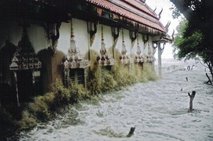
AFP tells the sad story of  Thai fishing villages that are slowly falling into the sea.  This much is real. But what could be causing this?

She is one of 25 million people under threat in Thailand's vast Chao Phraya river delta, which is sinking because of river damming and the clearing of mangrove forests, as climate change pushes up sea levels.

Which of these things doesn’t go with the others?  River damming, forest clearing, rising sea levels: which of these isn’t actually happening today?

The article doesn’t bother to present evidence that the sea levels are actually rising. Every reference to this afterwards is speculation about future sea level increases. 

In other words, there was no legitimate reason to mention climate change at all – except as part of a drip-drip-drip campaign of public scaremongering, most likely coordinated with the ongoing Copenhagen Chicken Little Confab.

Memo to the AGW boosters in the scientific community: you’d get a lot more respect from the skeptics if you would lift a finger now and then to denounce such fraudulent reporting on this issue that is so dear to you.

Then again, as we dig deeper and deeper into the muck of CRU correspondence, we get the impression that the AGW boosters in the scientific community might be too ideologically (or financially) invested in the world they’ve created.  There’s too much at stake – they can’t let the truth get in the way.

Tuesday, November 13, 2007

IPCC expert reviewer: Panel is 'fundamentally corrupt'

Dr. Vincent Gray, long-time expert reviewer for the UN's Intergovernmental Panel on Climate Change, has little good to say about the work of the panel [excerpt]:
I have been an "Expert Reviewer" for the IPCC right from the start and I have submitted a very large number of comments on their drafts. It has recently been revealed that I submitted 1,898 comments on the Final Draft of the current Report. Over the period I have made an intensive study of the data and procedures used by IPCC contributors throughout their whole study range. I have a large library of reprints, books and comments and have published many comments of my own in published papers, a book, and in my occasional newsletter, the current number being 157.

I began with a belief in scientific ethics, that scientists would answer queries honestly, that scientific argument would take place purely on the basis of facts, logic and established scientific and mathematical principles.

Right from the beginning I have had difficulty with this procedure. Penetrating questions often ended without any answer. Comments on the IPCC drafts were rejected without explanation, and attempts to pursue the matter were frustrated indefinitely.

Over the years, as I have learned more about the data and procedures of the IPCC I have found increasing opposition by them to providing explanations, until I have been forced to the conclusion that for significant parts of the work of the IPCC, the data collection and scientific methods employed are unsound. Resistance to all efforts to try and discuss or rectify these problems has convinced me that normal scientific procedures are not only rejected by the IPCC, but that this practice is endemic, and was part of the organisation from the very beginning. I therefore consider that the IPCC is fundamentally corrupt. The only "reform" I could envisage, would be its abolition.

Wednesday, July 25, 2007

There's something familiar about that graph...

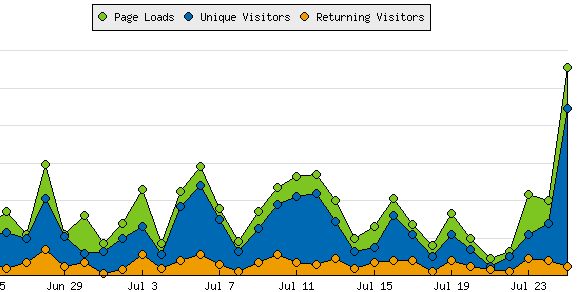
Thanks to Newsbusters, which today highlighted my Jack Bauer post, the visitor graph for this blog now looks like this (no, I won't embarrass myself by including the part showing the actual numbers):

(Click image to enlarge)

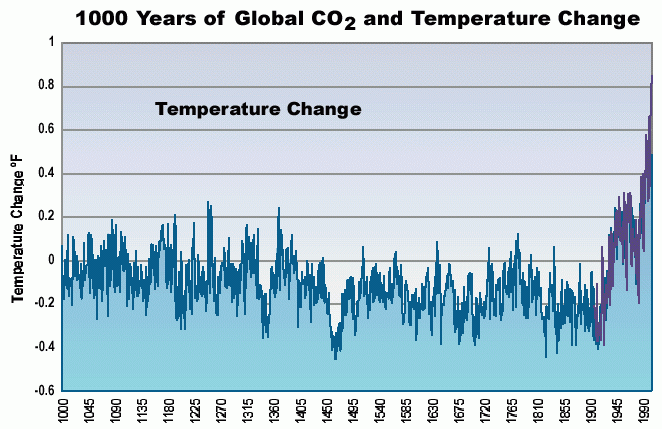
Hey! Using random data, I just reproduced the infamous "hockey stick"!

(Thanks to John-Daly.com. Click image to enlarge)

Friday, June 29, 2007

More cracks in the wall of the so-called scientific 'consensus'

Remember the IPCC climate change assessment reports, in which the scientists of the world (the credible ones, anyway) united in the opinion that the debate over climate change is finished? For a long time we've been led to believe (by the media and by the IPCC itself) that the reports themselves represented the consensus of the "2500+" scientists that contributed their expert reviews to the assessment.

The IPCC has now released the reviewer comments on the Fourth Assessment Report, which is the most recent. Read for yourself whether or not a consensus exists.

As the Heartland Institute notes in a press release:
Many of the comments by the reviewers are strongly critical of claims contained in the final report, and they are directly at odds with the so-called "scientific consensus" touted by Gore and others calling for immediate government action. For example, the following comment by Eric Steig appears in Second Order Draft Comments, Chapter 6; section 6-42:
In general, the certainty with which this chapter presents our understanding of abrupt climate change is overstated. There is confusion between hypothesis and evidence throughout the chapter, and a great deal of confusion on the differences between an abrupt "climate change" and possible, hypothetical causes of such climate changes.
Any document coming out of the United Nations can't help being tainted by political agendas, and the IPCC's Fourth Assessment Report is no exception.


(Thanks to: NewsBusters)