Friday, June 29, 2007

More cracks in the wall of the so-called scientific 'consensus'

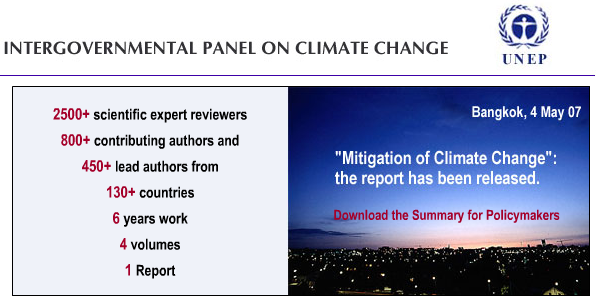
Remember the IPCC climate change assessment reports, in which the scientists of the world (the credible ones, anyway) united in the opinion that the debate over climate change is finished? For a long time we've been led to believe (by the media and by the IPCC itself) that the reports themselves represented the consensus of the "2500+" scientists that contributed their expert reviews to the assessment.

The IPCC has now released the reviewer comments on the Fourth Assessment Report, which is the most recent. Read for yourself whether or not a consensus exists.

As the Heartland Institute notes in a press release:
Many of the comments by the reviewers are strongly critical of claims contained in the final report, and they are directly at odds with the so-called "scientific consensus" touted by Gore and others calling for immediate government action. For example, the following comment by Eric Steig appears in Second Order Draft Comments, Chapter 6; section 6-42:
In general, the certainty with which this chapter presents our understanding of abrupt climate change is overstated. There is confusion between hypothesis and evidence throughout the chapter, and a great deal of confusion on the differences between an abrupt "climate change" and possible, hypothetical causes of such climate changes.
Any document coming out of the United Nations can't help being tainted by political agendas, and the IPCC's Fourth Assessment Report is no exception.


(Thanks to: NewsBusters)

Thursday, June 28, 2007

Why the Darfur genocide is America's fault

Back on June 18 I commented on UN Secretary General Ban Ki-Moon's nonsensical assertion that climate change is ultimately to blame for the ongoing wholesale slaughter in Darfur, Sudan. If only you hadn't bought that SUV, none of this would have happened.

Fred "I'm gonna announce any day now" Thompson, on his daily commentary on ABC Radio, explains that the historical realities of the area are more than sufficient to explain what is happening:
Sudan straddles the line between Christian African and Muslim Arabic cultures, bordering Egypt and Libya on the north. Bloody regional warfare stretches back centuries but, in modern times, the country has been in pretty much of a constant state of war since the 1950s. It's safe to say that millions have died in wars that are often aimed at control of the rich oil fields in the South. Today, however, the vastly reduced African Christian population isn't even involved. Two Muslim factions, divided along racial lines, are fighting for control of Darfur.

Now it’s true that the return of cyclical droughts has made agriculture and life more and more difficult for the people in the region. The impact of the weather, however, doesn’t approach the destruction that generations of warfare have worked on the land and the people. With peace and freedom, the economy of Darfur could have easily adapted to any climate change – no matter the cause.

Thompson suggests that the SecGen's assertion really boils down to a time-honored UN tradition: anti-Americanism.

Blaming the Islamic government and groups that have manipulated events in Sudan will get him nothing but enemies. Blaming global warming, however, is basically the same thing as blaming America. America is by no means the only major source of greenhouse gases, but we've taken the most political heat. The reason is that congress rightfully balked at ratifying the Kyoto international climate treaties during the Clinton presidency.

There is simply no downside to blaming America, because Americans don't punish their ideological foes. From the UN, we don't even require sanity sometimes. And there might even be an upside to blaming us, since there are Americans who suffer from such ingrained feelings of guilt, they’ll support increased aid to both the UN and Sudan.

If the blame ultimately rests on America, the UN can absolve itself of any responsibility to act.

House passes bill affirming moon made of green cheese

Okay, they didn't do that, but such a pronouncement would have had as much effect on reality as what they actually did, as reported in the opening sentence of a June 27 Reuters article:
House passes bill affirming global warming exists

The U.S. House of Representatives on Wednesday, aiming to put an end to the debate over whether global warming is actually occurring, passed legislation recognizing the "reality" of climate change[...]
Well, all righty, then. That really does settle it.

Later, we see that (to nobody's surprise) the language was aimed at the White House:
By inserting a declaration in the bill that climate change is a "reality," the Democratic-controlled House was trying to move U.S. policy-makers beyond a debate, long stimulated by the Bush administration, over whether there was scientific proof that global warming really is occurring.
Did the Bush administration actually dispute that "global warming" (Hey, Reuters, didn't you get the memo? The correct term is now "climate change") is occurring, or did they dispute that human activity is the cause? The ground for the latter objection is a lot more solid than that for the former.

Speaking of rash conclusions...

In my post on the poison ivy study I criticized the researchers for drawing unjustified Real World conclusions based on what amounted to a lab simulation. I thought they should have at least gone out to see if poison ivy -- or any other plant, for that matter -- has shown any sign of biologically adapting to rising CO2 concentrations. Otherwise, all we have is what-if alarmism, on a par with a B-grade science fiction movie (like what we saw in The Day After Tomorrow).

In fairness, I need to admit that some researchers do try to come a little closer to Real World experimentation when speculating on the effects of rising CO2.

A reader on Free Republic brought to my attention a study conducted by the Marine Biological Laboratory of Woods Hole, Massachusetts that actually went through the trouble of conducting its simulation outside (in a North Carolina forest owned by Duke University). As summarized by Nature.com, May 30, 2006:
In the study, Mohan and her co-workers pumped extra CO2 over three large circular plots of North Carolina pine forest. For six years, the plants inside were exposed to an extra 200 parts per million of CO2 over today's atmospheric concentration of about 380 parts per million, roughly what we might expect from pollution by the middle of this century.

Other research has suggested that vines tend to grow particularly fast in response to higher CO2 levels, and that vines are increasing in abundance all over the planet. Unlike trees, which use extra carbon to grow more wood, vines use it to produce more leaves. The extra leaves help the plant to harvest even more CO2, the cycle continues and the vines flourish.

Mohan's experiment sought to check whether the plants shoot up in the wild, as they do in greenhouse experiments. "Yes, dramatically," was the answer. The poisonous ivies grew at double the rate of plants grown under regular CO2 levels, whereas woody species on average tend to grow around 31% faster. The elevated CO2 also created a nastier version of urushiol poison, the team showed.

[...] By extracting urushiol from the plant's leaves, the researchers found that poison ivy grown in high CO2 churned out more than 150% more of one nasty, unsaturated form of urushiol and around 60% less of the mild, saturated form.

The researchers aren't sure why this chemical shift took place, but one idea is that the increased availability of carbon somehow favours the chemical reactions that produce the unsaturated forms of urushiol.
I think this team did a much better job of trying to approximate natural conditions than did the team in the other study. But... two thoughts come to my mind pretty quickly:
  1. The study was premised on the IPCC guesstimate that atmospheric CO2 would rise from the current 380-ish ppm to 570-ish ppm by mid-century. As much of IPCC's work has given me reason for skepticism, I decline to swallow this prediction uncritically.
  2. The planet's ecosystem is so complex, I don't think a study performed in this manner can authoritatively tell us what would happen in the Real World if atmospheric CO2 did rise to this level.
I'm open to being educated on this, if you care to give it a whirl.

Tuesday, June 26, 2007

Poison ivy study leads to rash conclusions

Tara Parker-Pope, writing today in the Wall Street Journal, leads off with an ominous pronouncement:
Poison ivy, the scourge of summer campers, hikers and gardeners, is getting worse.

New research shows the rash-inducing plant appears to be growing faster and producing more potent oil compared with earlier decades.
There's a word in the second sentence that should set off alarm bells, but let's set that aside for a moment and move along to the fingering of the culprit.
The reason? Rising ambient carbon-dioxide levels create ideal conditions for the plant, producing bigger leaves, faster growth, hardier plants and oil that's even more irritating.
Our old friend CO2! It is indeed a fact that CO2 levels have generally increased over the past century or two, and we know that plants love the stuff. The conclusion should be foregone.

So what did these researchers do? Did they send teams of scientists into the forests of America, collecting samples of increasingly aggressive poison ivy? No, of course not, silly! Climate researchers can form their conclusions based on computer simulations, so why should plant researchers have to go out into the field and actually observe the phenomenon their research purports to demonstrate?

No, what they did was gas a bunch of plants in a lab to see what would happen, and then used the results to assume what was happening in nature.
Although the data on poison ivy come from controlled studies, they suggest the vexing plant is more ubiquitous than ever.
The plant appears to be growing faster. The data suggest the plant is more ubiquitous. Unless I missed it, there's nothing in the article to indicate that the researchers have found a CO2-enhanced poison ivy plant in the Real World.

So why are they insulting us with the headline, Climate Changes Are Making Poison Ivy More Potent? Because AGW alarmism is not actually about science.

UPDATE: Here's a followup.

Friday, June 22, 2007

Carbon credits: turning vice into virtue

The Joy of Tech, May 21:

(Click to view full-sized image)

Desperate measures

In today's Wall Street Journal, science writer Robert Lee Hotz asks global warming's burning (pardon the pun) question: What if we aren't able to radically reorder civilization in time to prevent the destruction of the planet?

Apparently, many scientists are already looking ahead in fear and have judged that now is the time to develop geo-engineering contingencies that focus on deflecting incoming sunlight rather than reducing CO2 emissions. Among the ideas being proposed:
One now under more serious scrutiny was inspired by volcanoes. Climate researcher Tom Wigley at the National Center for Atmospheric Research in Boulder, Colo., and Nobel Prize-winning chemist Paul Crutzen at the Max Planck Institute for Chemistry in Mainz, Germany, last year proposed that an overheated planet could be safely cooled by an artificial haze of sulfur particles, which would reflect solar radiation. The 1991 eruption of Mt. Pinatubo spewed enough sulfates to lower the average world temperature by almost one degree Fahrenheit for a year, with no apparent ill effects. A sulfate sunshade might cost $400 million a year.

[...] "Nobody likes geo-engineering at all," added University of Arizona astronomer Roger Angel. Even so, Prof. Angel proposed a plan in the journal Science last year to cool Earth by orbiting 16 trillion tiny mirrors -- at a cost also in the trillions. "Just as insurance, we ought to be thinking about it," Prof. Angel said.
It's no secret that I am more sympathetic to the idea that solar variability is the driver of climate change, as I posted yesterday. If the AGW alarmists can't be shaken of their notion that humanity is suddenly responsible for climate change -- even though the planet has been warming and cooling without our help since the beginning -- I'd rather they pour a half billion a year into polluting the stratosphere than forcing the population of the world to become Luddite vegans.

Thursday, June 21, 2007

I wonder how Al Gore would score on this quiz?

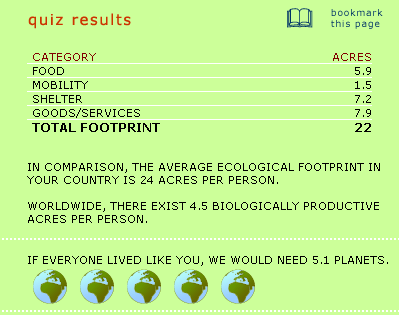
The Ecological Footprint Quiz attempts to answer the question, How many planets would we need to support Earth's current population if everyone lived like you do?

I realize this quiz is aimed at guilt-manipulating the average person into adopting a Luddite vegan lifestyle, but what about the above-average person? I scored a respectable 5.1 planets (which is slightly below the American average). How many planets would we need if everyone lived like eco-savior Al Gore?


The answer is blowing in the (solar) wind

What if it has all been a great big misunderstanding?

What if the AGW scare turned out to be nothing more than mass hysteria driven by leftist environmental zealots, aided and abetted by scientists whose computer simulations led them to the mistaken conclusion that they understood the infinitely complex machinations of our atmosphere and oceans?

What if, despite the ad nauseam claims of the CoGW, climate change really is a natural phenomenon not driven in any way by atmospheric CO2 concentrations?

Dr. Tim Patterson of Carleton University in Canada is among the ever-increasing number of qualified scientists giving the lie to the notion that a consensus exists regarding climate change.

In 2001 Patterson brought a research team to a British Columbia fjord on a government-funded mission to determine why fish populations varied wildly from year to year. Neither the Canadian government nor Patterson's team were thinking about anthropogenic climate change when this project was initiated. The government, in true form, was simply interested in doing a better job of regulating the fishing industry.

As part of their research, Patterson's team took mud core samples from the stillwater bottom of the fjord. The cores contained sediment from about 5,000 years of the fjord's history, and as the team analyzed the core data, they unexpectedly came across information that may help us better understand what's really going on with our climate today. As Dr. Patterson related in a June 20 article in the Financial Post:
Clearly visible in our mud cores are annual changes that record the different seasons: corresponding to the cool, rainy winter seasons, we see dark layers composed mostly of dirt washed into the fjord from the land; in the warm summer months we see abundant fossilized fish scales and diatoms (the most common form of phytoplankton, or single-celled ocean plants) that have fallen to the fjord floor from nutrient-rich surface waters. In years when warm summers dominated climate in the region, we clearly see far thicker layers of diatoms and fish scales than we do in cooler years. Ours is one of the highest-quality climate records available anywhere today and in it we see obvious confirmation that natural climate change can be dramatic. For example, in the middle of a 62-year slice of the record at about 4,400 years ago, there was a shift in climate in only a couple of seasons from warm, dry and sunny conditions to one that was mostly cold and rainy for several decades.
It's clear from Patterson's mud core data that the climate can "flip" quite rapidly, without any help from us.

That's all well and good, but the mud core data had another story to tell that flies directly in the face of what Dr. James Hansen, Al Gore, etc. have been preaching: the climate changes recorded in the 5,000 years of sediment correlate very strongly with the increases and decreases of output from our sun. Patterson notes that his findings corroborate those of "hundreds of other studies" conducted around the world.

However, as Patterson notes, solar output doesn't tell the whole story. Mr. Sun needs a little help to effect the kinds of climate change we've experienced in our planet's history, and CO2 didn't get the job:
Despite this clear and repeated correlation, the measured variations in incoming solar energy were, on their own, not sufficient to cause the climate changes we have observed in our proxies. In addition, even though the sun is brighter now than at any time in the past 8,000 years, the increase in direct solar input is not calculated to be sufficient to cause the past century's modest warming on its own. There had to be an amplifier of some sort for the sun to be a primary driver of climate change.

Indeed, that is precisely what has been discovered. In a series of groundbreaking scientific papers starting in 2002, Veizer, Shaviv, Carslaw, and most recently Svensmark et al., have collectively demonstrated that as the output of the sun varies, and with it, our star's protective solar wind, varying amounts of galactic cosmic rays from deep space are able to enter our solar system and penetrate the Earth's atmosphere. These cosmic rays enhance cloud formation which, overall, has a cooling effect on the planet. When the sun's energy output is greater, not only does the Earth warm slightly due to direct solar heating, but the stronger solar wind generated during these "high sun" periods blocks many of the cosmic rays from entering our atmosphere. Cloud cover decreases and the Earth warms still more.

The opposite occurs when the sun is less bright. More cosmic rays are able to get through to Earth's atmosphere, more clouds form, and the planet cools more than would otherwise be the case due to direct solar effects alone. This is precisely what happened from the middle of the 17th century into the early 18th century, when the solar energy input to our atmosphere, as indicated by the number of sunspots, was at a minimum and the planet was stuck in the Little Ice Age. These new findings suggest that changes in the output of the sun caused the most recent climate change.
In other words, Dr. Patterson's research supports the idea that as solar output varies, so does the amount of cosmic radiation reaching the earth. Weaker solar output means more cosmic radiation, leading to more cloud cover, leading to a cooler earth. Stronger solar output means less cosmic radiation, leading to less cloud cover, leading to a warmer earth.

In case the implications for the current non-debate debate aren't abundantly clear, Patterson adds:
By comparison, CO2 variations show little correlation with our planet's climate on long, medium and even short time scales.
If you want to know what is driving the changes in our climate, don't look to the sky -- look beyond the sky.

Patterson closes by relating another profound implication of his research which is sure to be completely ignored:
Solar scientists predict that, by 2020, the sun will be starting into its weakest Schwabe solar cycle of the past two centuries, likely leading to unusually cool conditions on Earth. Beginning to plan for adaptation to such a cool period, one which may continue well beyond one 11-year cycle, as did the Little Ice Age, should be a priority for governments. It is global cooling, not warming, that is the major climate threat to the world, especially Canada.
Tuesday, June 19, 2007

Al Gore & co. aren't really serious about saving the planet

Otherwise, they'd be doing more.

Dilbert, June 19
(Click to view full-sized image)

P.S. Just kidding, sort of. The definition of "Earth hater" varies, depending on which green you ask. But there is a general rule of thumb, taking the stereotypical Mr. Green as an example: an "Earth hater" is anybody who does less than Mr. Green does on behalf of the environment.

Monday, June 18, 2007

Why the Darfur genocide is your fault

In a June 16 Washington Post editorial, UN Secretary General Ban Ki Moon outlines a chain of events connecting the genocide in Darfur to.... your SUV.

Well, he doesn't actually connect the final dot, but the implication is certainly there.

Because you in particular, and the US and the rest of the industrial world in general, have been emitting far too much CO2, the Indian Ocean has warmed, leading to a drought-inducing monsoon disruption in Sudan. As the water supplies dried up, local farmers and nomadic herdsmen started fighting over resources. One thing led to another, and here we are.

Oh, and Somalia's your fault also.

I hope you can rest well knowing this.

UPDATE: Fred Thompson comments on the SecGen's assertion.

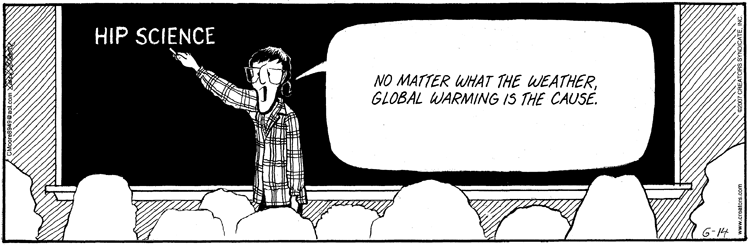
Handy guide to understanding our weather

(Click to view full-sized image)

Friday, June 15, 2007

The Al Gore Youth Corps

This article (called "Pending Doom"!) in the Portland (Maine) Press Herald reveals more about the teacher than it does about the fourth graders who supposedly wrote it. Near the end of the article the kids state:
All the facts we have presented are true, real, and will shape our future unless decisive action is taken.
Given that their recommended sites for further education are Stop Global Warming and An Inconvenient Truth, it's not surprising that some of the 'facts' they present are exaggerated apocalyptic predictions (such as the Greenland ice sheet and the "Arctic ice shelf" completely melting, leading to Manhattan soaking in 40 feet of water), anecdotal (warm temperatures in March) or simply untrue (such as the notion that the Atlantic/Gulf hurricane breeding grounds are unusually warm, leading to storms like Katrina).

One thing seems to be certain -- the kids aren't being taught critical thinking skills. By the time they graduate from high school they should be completely immunized against contrary data.

Thursday, June 14, 2007

There is no silver lining without a cloud

NASA chief Michael Griffin brought up an excellent point when he asked how we know our current climate is optimal. Even though the earth's climate has varied naturally throughout its existence, virtually all prognostications of the AGW alarmists promise The End Of The World As We Know It.

It is, therefore, surprising when an article comes along in the major media admitting that a one or two degree temperature increase won't lead to human extinction.

Associated Press, June 14:
It's not in Al Gore's PowerPoint presentation, but there are some upsides to global warming.

Northern homes could save on heating fuel. Rust Belt cities might stop losing snowbirds to the South. Canadian farmers could harvest bumper crops. Greenland may become awash in cod and oil riches. Shippers could count on an Arctic shortcut between the Atlantic and Pacific. Forests may expand. Mongolia could see a go-go economy.

This is all speculative, even a little facetious, and any gains are not likely to make up for predicted frightening upheavals elsewhere. But still ... might there be a silver lining for the frigid regions of Canada and Russia?

"It's not that there won't be bad things happening in those countries. There will be _ things like you'll lose polar bears," said economic professor Robert O. Mendelsohn of the Yale School of Forestry & Environmental Studies. "But the idea is that they will get such large gains, especially in agriculture, that they will be bigger than the losses."

Mendelsohn looked at how gross domestic product around the world would be affected under different warming scenarios though 2100. Canada and Russia tend to come out as gainers, as does much of northern Europe and Mongolia.

This is largely because of projected gains in agricultural production in those areas. Many researchers believe that if the world warms up, the sweet spots for growing crops will migrate toward the poles. Some people claim the phenomenon is already manifesting itself in bountiful forsythia blooms in Vermont and maple sap flowing in upstate New York in January.

Mendelsohn's study is summarized with an interactive map here.

Of course, the article's author can't let the topic go without reminding us that there wouldn't be a silver lining if there wasn't a cloud:

Of course, the caveats are significant when trying to make any long-term global forecast. There are so many variables.

A longer growing season does a farmer no good if resulting rain patterns bring a drought. Mendelsohn said northern residents saving on winter heating fuel will end up spending more than that to keep cool in the summer. Great Lakes cities might enjoy balmier weather, but could suffer if lower lake levels cut off shipping lanes. And global warming could present deadly new opportunities for parasites and disease.

Some researchers stress there aren't really any winners in global warming because the planet will be such a big loser. Marginal gains in limited areas can't be stacked up on one side of the ledger, they say, when the negatives can include planet-wide food and water shortages, mass flooding and extinction.

"In the end, you don't find really large, really significant benefits," said Michael MacCracken, chief scientist at the nonpartisan Climate Institute in Washington. "I mean, loss of biodiversity is an irreversible thing for the planet. Saving a little money on heating in winter areas is a small economic gain for some people. How do you compare that?"

P.S. The Climate Institute may be nonpartisan, but that's hardly relevant to the AGW debate.

One last observation before moving on. As the AP article's author transitions from the good news to the YeahBut part of the article, we see the following:
While oceanfront cities might have to build seawalls to hold back the ocean in a warming world, some researchers believe the freshwater Great Lakes will evaporate a bit. But a projected 11-degree boost at the turn of the next century could be a boon for chillier cities like Cleveland, Milwaukee, Detroit and Buffalo, even knocking them into the "optimal" holiday range.
Eleven degrees? Where did that number come from? An increase of 11F (6C) is even higher than the IPCC's worst-case prediction. I guess we really are headed for extinction.

Meanwhile, Agence France-Presse manages to spin this news using socialist class rhetoric in this June 8 article:
Climate change is expected to have disastrous consequences for Earth but some areas will profit, notably wealthy nations in the northern parts of Europe, Russia and the US, scientists say.

On Thursday the leaders of the Group of Eight club of wealthy nations agreed to pursue substantial cuts to greenhouse gas emissions that cause global warming and said they would seriously consider halving emissions by 2050.

But they will remain the main beneficiaries of climate change, with the agriculture, shipping, and oil, gas and mining sectors among those that are expected to prosper as snow and ice melts in the north.

"The rich countries of the north are going to be winners of climate change, while the poor countries of the south are going to be losers," Jann-Gunnar Winther, director of the Norwegian Polar Institute, told AFP during a global warming conference held in the Arctic town of Tromsoe this week.

Wednesday, June 13, 2007

The scourge of 'green' fuel

Surprise, surprise.

Ethanol, touted from sea to shining sea as a 'green' fuel, has a dirty secret. CNSNews, June 13:
Call it green pollution. The ethanol industry, which is marketed as environmentally friendly and has been called a "cornerstone of America's energy policy," is dirtying air and water supplies across the heartland, according to a Cybercast News Service investigation.

And industry watchers said pollution is going to get worse.

"There seems to be this mad rush toward expansion of the alternative fuels industry without sufficient due diligence," said Bill Becker, executive director of the National Association of Clean Air Agencies (NACAA).

[...] A Cybercast News Service analysis of EPA records found 73 biorefineries - more than 60 percent of those operating - were cited by state or federal agencies for environmental violations in the last three years. The vast majority involve state or federal clean air laws.

"They've brought the enforcement actions against a number of ethanol companies and refineries for essentially sidestepping the law," said Frank O'Donnell, president of the non-partisan Clean Air Watch. "Ethanol refineries have the potential to pollute quite a bit."

Most of the companies have not been fined by state or federal government agencies, though some of the biggest ownership groups have been forced to pay millions for cleanup and anti-pollution devices.

"Ethanol has been dramatically oversold as a green energy source," said O'Donnell.
I don't know how I missed this, since a quick Google search reveals that the ethanol pollution problem has been known for a long time. For example:
  • May 3, 2002 -- EPA Finds Worrisome Levels Of Toxic Air Pollutants At Ethanol Plants
  • September 2000 -- Does Ethanol Use Result in More Air Pollution?
  • 1997 -- Ethanol Causes Pollution, Too, Argonne Scientists Say
An NPR story from April of this year shows that many environmentalists are not very happy with this situation. There are cleaner ways to make ethanol, but right now corn is the most economically viable source. As long as this remains so, this may be another case of the cure being worse than the disease. Here is an extended quote from the NPR story:
Dan Becker, director of the Sierra Club's Global Warming and Energy Program, and Elizabeth Marshall, senior economist at the World Resources Institute, share their concerns:

Corn Vs. Cellulosic

Corn ethanol is presently the only commercially viable means of ethanol fuel production. It's made by distilling fermented simple sugars derived from corn. The problem is, it's still an environmentally taxing process.

"With ethanol, the devil is in the details," says Dan Becker. "There are ways of making it that are quite clean, but that's not the way we're doing it."

Becker backs cellulosic ethanol. If researchers can streamline what's still an experimental process, then ethanol could be made from a variety of plant materials.

The benefit of that, Elizabeth Marshall says, is that cellulosic ethanol production would allow farmers to grow crops that work in their area, rather than forcing corn on lands that are not well-suited to support it.

A Decrease in Greenhouse Gases?

Some environmentalists also question whether corn ethanol will ultimately help combat global warming. Dan Becker says it's necessary to take into account the energy expended to produce the fuel.

"The way we make ethanol now," Becker says, involves "seven passes over the field with a diesel tractor, heating the corn to convert it into ethanol, and transporting the fuel in diesel-guzzling trucks."

Marshall estimates that producing 15 billion gallons of corn ethanol – less than half of Bush's projected goal for 2017 – would increase greenhouse gas emissions from agricultural production by almost 8 percent.

Furthermore, Becker states, ethanol has a lower energy content than gasoline, so to meet the same energy demands, more gallons of ethanol would have to be produced.

A problem often cited with ethanol is that, when the production process is taken into account, it will ultimately release more greenhouse gas than gasoline. Becker says more recent studies show that's not the case. Overall, he says, corn ethanol isn't a loser but, "it's not a big winner, either. The best thing that we can say about ethanol is that it is not gasoline – and that is damning with faint praise."

The Environmental Footprint

Elizabeth Marshall worries that attempting to curb greenhouse gases with increased corn ethanol production will ultimately come at the cost of the country's water and soil.

"Soil erosion, nutrient runoff, and pulling new land into corn production are all concerns," she says.

To meet the increased demand for ethanol, many farmers want to bring into use lands that are currently protected. Marshall also predicts that higher corn prices will give farmers incentive to revert to environmentally unfriendly practices.

Farming's environmental footprint has always been a concern, says Marshall. "Increased demand for ethanol will only exacerbate existing problems."
Back to the CNSNews article, there's at least one group that sees ethanol pollution through rose-colored glasses: The National Corn Growers Association. Referring to association spokesman Geoff Cooper:
Cooper said any problems with pollution are offset by the environmental benefits of renewable fuels being used in U.S. vehicles.
In other words, the polluted community surrounding the ethanol plant should be proud that it is sacrificing itself for the greater good of the planet.