Tom at Radio Free New Jersey has a tall, beautiful oak tree in his yard. He found that the tree was casting a shadow on the solar heater for his pool, so he planned to cut the tree down.
Then he had in inspiration: Why not leave the tree alone, and sell its carbon sequestration services to someone out there who was feeling guilty about their lifestyle? He would do a good deed, and for that he would be willing to put up with a slightly cooler swimming pool.
So, he put an ad on eBay, hoping to get a bid of $420 based on his calculation of how much carbon the tree would end up sequestering.
Alas, eBay yanked the auction after a few days without really explaining why. Tom speculates that eBay secretly knows that carbon credits are a scam, and thus is not willing for them to be sold on its site.
In my opinion, it is equally likely that the eBay folks accept the concept of carbon credits, and saw Tom's auction as mockery of the concept. Which it was, of course.
Bravo, Tom, for giving it a try. Perhaps you could find a way to contact the Gore estate; it seems that they could use a little feel-good P.R. right now.
When I think of all of the trees I've cut down on my property for one reason or another, and think about people who are more than willing to part with their money in the belief that the act frees them to maintain their wasteful lifestyles...... sigh...... what could have been.
Showing posts with label Carbon_Offsets. Show all posts
Showing posts with label Carbon_Offsets. Show all posts
Thursday, June 19, 2008
If only we commoners could afford Al Gore's carbon footprint...
A year ago we saw that Al Gore was investing a lot of money in his Tennessee mansion to help it comply with U.S. Green Building Council standards.
You would think that after all of those improvements, we would see the efficiency improvements reflected in an overall decrease in the amount of energy consumed in Gore's home. You would be wrong.
The Tennessee Center for Policy Research has been watching Gore's energy usage for a long time. It was their first press release about his wasteful lifestyle that appears to have prompted last year's renovations.
TCPR issued another report this week letting us know how things are going at the Gore estate:
What he has really done is prove that reliance on carbon offsets tends to lead to an increase in wasteful consumption. This makes sense, because carbon offsets amount to doing penance for your bad behavior without actually making an effort to modify the bad behavior.
June 20 UPDATE: Although the numbers in TCPR's June 17th press release are internally consistent, it is true that, as detractor Tim Lambert observes, the numbers are not consistent with TCPR's 2007 press release about Gore's 2006 consumption (linked above). It appears to boil down to a misstated number in the 2007 press release -- which to my knowledge TCPR has never corrected. I have asked them for an official clarification, and will post an update if and when I hear back from them.
You would think that after all of those improvements, we would see the efficiency improvements reflected in an overall decrease in the amount of energy consumed in Gore's home. You would be wrong.
The Tennessee Center for Policy Research has been watching Gore's energy usage for a long time. It was their first press release about his wasteful lifestyle that appears to have prompted last year's renovations.
TCPR issued another report this week letting us know how things are going at the Gore estate:
In the year since Al Gore took steps to make his home more energy-efficient, the former Vice President’s home energy use surged more than 10%, according to the Tennessee Center for Policy Research.In addition to efficiency improvements, Gore relies on the purchase of carbon offsets to somehow make his off-the-charts consumption (both at home and in his extensive travel by private jet) okay.
[...]In the past year, Gore’s home burned through 213,210 kilowatt-hours (kWh) of electricity, enough to power 232 average American households for a month.
What he has really done is prove that reliance on carbon offsets tends to lead to an increase in wasteful consumption. This makes sense, because carbon offsets amount to doing penance for your bad behavior without actually making an effort to modify the bad behavior.
June 20 UPDATE: Although the numbers in TCPR's June 17th press release are internally consistent, it is true that, as detractor Tim Lambert observes, the numbers are not consistent with TCPR's 2007 press release about Gore's 2006 consumption (linked above). It appears to boil down to a misstated number in the 2007 press release -- which to my knowledge TCPR has never corrected. I have asked them for an official clarification, and will post an update if and when I hear back from them.


Friday, March 7, 2008
The planet will be better off if you stay in bed
Reader Kevin J. pointed me to the story of Dutch student Yde Van Deutekom, who is inviting webcam viewers to pay him to stay in bed all day. The wonderfully-named environmentalist site TreeHugger notes the similarity of Yde's quest with this classic Joy of Tech cartoon (click link to see the whole thing), which shows how laziness can be repackaged as an ecological virtue.

Monday, January 28, 2008
Shocker: Congress throws taxpayer money into black hole, gets nothing in return
I guess I missed this when it first happened, but in November the Democrat-led House of Representatives voted to set aside nearly $90,000 to offset carbon emissions associated with our esteemed legislators' activities.
[Insert your own joke here regarding Congress and emissions]
Today the WaPo (via MSNBC) reports that our congressfolks have been taught a lesson about the nature of the carbon offset industry:
[Insert your own joke here regarding Congress and emissions]
Today the WaPo (via MSNBC) reports that our congressfolks have been taught a lesson about the nature of the carbon offset industry:
Yes, they've been taught a lesson, but to paraphrase our current president, Is our congressfolks learning? Not likely, if they justify their behavior using the logic offered by the Chicago Climate Exchange:The House of Representatives has presumably learned that money cannot buy love or happiness. Now, it turns out it's not a sure solution to climate guilt, either.
In November, the Democratic-led House spent about $89,000 on so-called carbon offsets. This purchase was supposed to cancel out greenhouse-gas emissions from House buildings -- including half of the U.S. Capitol -- by triggering an equal reduction in emissions elsewhere.
Some of the money went to farmers in North Dakota, for tilling practices that keep carbon buried in the soil. But some farmers were already doing this, for other reasons, before the House paid a cent.
Other funds went to Iowa, where a power plant had been temporarily rejiggered to burn more cleanly. But that test project had ended more than a year before the money arrived.
The House's purchase provides a view into the confusing world of carbon offsets, a newly popular commodity with few rules. Analysts say some offsets really do cause new reductions in pollution. But others seem to change very little.
To environmentalists, the House's experience is a powerful lesson about a market where pure intentions can produce murky results.
"It didn't change much behavior that wasn't going to happen anyway," said Joseph Romm, a senior fellow at the Center for American Progress who writes a blog calling for more aggressive action on climate change. "It just, I think, demonstrated why offsets are controversial and possibly pointless. . . . This is a waste of taxpayer money."
The House bought its offsets through the Chicago Climate Exchange, a five-year-old commodities market where greenhouse-gas credits are traded like pork bellies.
Read Sandor's comment carefully. Carbon offsets, ostensibly meant by their purchasers to offset current emissions, do not necessarily go to people or organizations currently engaged in offsetting activities. Rather, offset money can be used to reward people that had "done things that had environmental good in the past". Even better, the money can be used to "incentivize" these good folks to do environmental good in the future. No obligation, it appears.This month, officials at the exchange vigorously defended the sale, saying the House's money had done a great deal of good by funneling money to those who were helping to combat climate change.
"It basically rewards people for having done things that had environmental good in the past and incentivizes people to do things that have environmental good in the future," said Richard Sandor, the exchange's chairman and chief executive.
Friday, September 21, 2007
A wonderful illustration of the absurdity of carbon offsets
The website CheatNeutral will allow you to pay someone to remain faithful to his or her partner in order to allow you to continue your cheating ways.
Of course it's satire, but it makes the point beautifully.
Of course it's satire, but it makes the point beautifully.
Wednesday, August 22, 2007
Kill a moose to offset your SUV
 Some disturbing news from Norway, as reported by Germany's Spiegel Online yesterday:
The poor old Scandinavian moose is now being blamed for climate change, with researchers in Norway claiming that a grown moose can produce 2,100 kilos of carbon dioxide a year -- equivalent to the CO2 output resulting from a 13,000 kilometer car journey.Let's see, now... 13,000 metric miles (also known as kilometers) translates to about 8,078 American miles. I live in a small city, and drive just a little farther than that each year in my Honda Civic. So, if I can arrange for Norwegian hunters to off an additional moose in my name each year, I can drive guilt-free.
(Thanks to: Limbaugh, NewsBusters)
Friday, July 27, 2007
There's gold in them thar offsets!
I had not heard of the comic Sherman's Lagoon before last week, but I already know I like their sense of humor. Here are selections from a series that ran from July 17 to 24. The reality is not far removed from what we see here:


 (Click each image to enlarge)
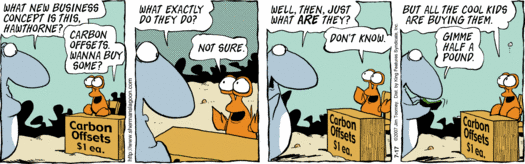
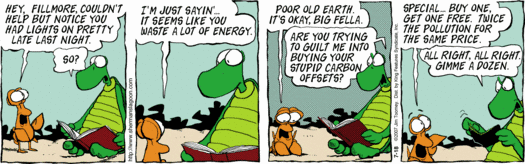

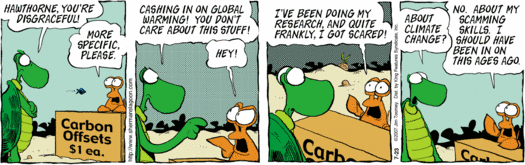
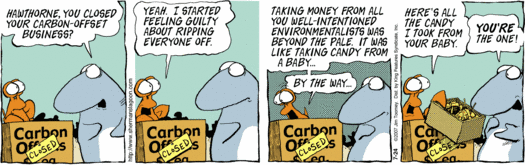 (Click each image to enlarge)
Wednesday, July 25, 2007
The feds want a piece of the carbon offset action
A July 25 AP story reports that the U.S. Forest Service is ready to take advantage of the environmental guilt of American citizens:
The U.S. Forest Service is teaming with a nonprofit foundation to allow consumers to participate in a voluntary program to "offset'' their carbon dioxide emissions.I think reforestation is a worthy cause in and of itself -- totally apart from the global warming issue. If playing on people's guilt is the only way to raise the necessary money, then who am I to criticize?Under the agreement to be announced Wednesday, the Forest Service and the National Forest Foundation will allow individuals or groups to make charitable contributions that will be used to plant trees and do other work to improve national forests.
The Forest Service estimates that the nation's 155 national forests offset about 10 percent of carbon emissions in the United States. Forest Service scientists believe that figure can be raised to as much as 25 percent by doing such things as planting more trees in urban areas or reforesting old cropland.
Oh, wait -- those credit cards are petroleum-based, aren't they?
From a July 25 Reuters story:
GE's offset program will almost certainly lead to more consumption by environment-conscious customers, which will lead to more manufacturing of goods, which will lead to ... more emissions than there might have been without this program.
So... the customer's conscience is soothed, GE reaps the financial and P.R. rewards, and pollution increases. About par for the carbon offset industry.
General Electric Co. issued a credit card on Wednesday it says will be the first to cut help U.S. cardholders voluntarily cut emissions linked to global warming.
The card, called GE Money Earth Rewards Platinum Mastercard, allows users the option of automatically contributing up to one percent of their card purchases to buy greenhouse emissions offsets.
In voluntary emissions markets, consumers who feel guilty about their greenhouse emissions can buy offsets, or credits, designed to represent emissions reductions that took place somewhere else, like a solar or wind power farm.
"Earth Rewards cardholders will now have a new tool to complement the ways they are already reducing their emissions," Tom Gentile, an executive at GE Money said in a release. "They can turn everyday purchases into extraordinary rewards."
GE's offset program will almost certainly lead to more consumption by environment-conscious customers, which will lead to more manufacturing of goods, which will lead to ... more emissions than there might have been without this program.
So... the customer's conscience is soothed, GE reaps the financial and P.R. rewards, and pollution increases. About par for the carbon offset industry.
Tuesday, July 24, 2007
Jack Bauer gets a new mission in upcoming season
Details are still sketchy, but certain clues have been leaked about the plotline of the upcoming season of the hit TV series 24. According to the anonymous source:
By the way, Kiefer Sutherland has already filmed an AGW public service announcement, and Fox helpfully links to it in the press release. In order to establish a tenuous link between the original premise of the show and the show's new crusade, Sutherland begins:
So, maybe the show won't drift as far as the scenario given at the beginning of this post, but given the ideological commitment of everyone involved in the show, I wouldn't be surprised if we see something like this in the near future.
(Thanks to Newsbusters: 1, 2)
- The administration of Wayne Palmer and Noah Daniels is out, and the new president is ideologically similar to Al Gore.
- The definition of terrorism has been expanded to include actions by individuals, corporations or other organizations that "unnecessarily" increase greenhouse gases in the atmosphere.
- CTU, naturally, has been tasked with enforcing the new regulations in the Los Angeles area.
- Early-season incidents include hero Jack Bauer kneecapping an SUV driver and interrogating a homeowner who failed to offset his air conditioner usage.
- Midway through the season, Middle East radicals murder all of the students in a biological attack on an elementary school, but because the attackers manage to pull off their operation with a minimal carbon footprint, the incident ends up being left for local law enforcement to handle.
How exciting! They'll even pretend to become carbon neutral via the scam of carbon offsets! No telling how they intend to offset the electricity expended by fans watching the show (seems like a bit of a conflict of interest there).Beginning with production on Season 7, “24” intends to implement the following carbon emission reduction techniques and important initiatives:
- Introducing the use of biodiesel fuels to power generators and production vehicles;
- Running all on-stage production activities on “green power”;
- Rewiring an entire stage to use electric, rather than diesel-generated, power;
- Integrating fuel-saving and low-emission hybrid vehicles into the production fleet;
- Creating a series of PSAs about the issue starring Kiefer Sutherland and key cast members;
- When appropriate, incorporating the issue of global warming and the importance of carbon emission reduction into storylines;
- Accruing enough carbon reduction savings through these and other innovations to render production of the entire final episode officially “carbon neutral.”
By the way, Kiefer Sutherland has already filmed an AGW public service announcement, and Fox helpfully links to it in the press release. In order to establish a tenuous link between the original premise of the show and the show's new crusade, Sutherland begins:
Global warming is a crime for which we are all guilty.Get it? Crime? 24 is about criminal activity! Global warming is criminal! Got it. Jack Bauer is the perfect spokesman for the cause, then.
So, maybe the show won't drift as far as the scenario given at the beginning of this post, but given the ideological commitment of everyone involved in the show, I wouldn't be surprised if we see something like this in the near future.
(Thanks to Newsbusters: 1, 2)
Friday, July 13, 2007
PB&J: The edible carbon offset
Ordinarily, I pay no attention to the efforts by vegetarian and vegan food scolds (such as PETA and CSPI) to get me to forswear meat. However, Bernard Brown's campaign to get people to switch from meat to peanut butter and jelly is attractive enough that I might go along for the ride (for at least one meal, anyway). Although I disagree with Brown's no-meat philosophy, I commend him for presenting his case in a winsome fashion, unlike the aforementioned scolds.
Brown is diligent to remind us that by eating a PB&J sandwich instead of a deli sandwich, we're not only helping to save the life of an animal, we're also helping to save the planet:
Brown is diligent to remind us that by eating a PB&J sandwich instead of a deli sandwich, we're not only helping to save the life of an animal, we're also helping to save the planet:
A PB&J will slow global warming.So does this mean I can count my PB&J sandwich as a carbon offset?
Next time you have one you'll reduce your carbon footprint by saving the equivalent of 2.5 pounds of carbon dioxide emissions over an average animal-based lunch like a hamburger, a tuna sandwich, grilled cheese, or chicken nuggets.
That's about forty percent of what you'd save driving around for the day in a hybrid instead of a standard sedan.
If you were going to have a ham sandwich or a hamburger, you save the equivalent almost 3.5 pounds of greenhouse gas emissions.
Thursday, July 12, 2007
The perverse incentive of Kyoto's carbon credits
There is a lot of money flowing around in the carbon credits / carbon offsets industry, what with so many guilt-ridden environmentalists and PR-sensitive corporations funding massive tree-plantings and other projects around the world. At least one nation's leader has noticed that in order for his country to get a piece of the action, it might first have to engage in behavior that is supposedly offensive to those who are driving the credit/offset industry in the first place.
AFP reports in this July 12 dispatch:
The environmental left's push for biofuels is leading to the clear-cutting of Amazon forests, and their beloved Kyoto Protocol may lead to the destruction of even more.
AFP reports in this July 12 dispatch:
Guyana's President Bharrat Jagdeo on Thursday criticized the Kyoto Protocol on climate change for failing to allow countries like his nation with pristine unharvested forests to earn carbon credits.So, if Guyana decided to clear-cut some of its forests, it would qualify for Kyoto's carbon credit program to fund the replant."The Kyoto Protocol is limited in that sense, and it's short-sighted in that it encourages bad behaviour basically among countries; if you cut down trees and you plant them back you get money, if you preserve them, you don't get anything," Jagdeo told a forum on agro-energy.
The Guyanese leader noted that Guyana would reap "miniscule" assistance under the Clean Development Mechanism of the Kyoto Protocol when the South American country begins large-scale production of ethanol and other types of agro-based energy.
He said Guyana has decided to get into the production of bio-fuels such as ethanol and biodiesel. But "assistance is miniscule through the Clean Development Mechanism as compared to the carbon credits we could get from standing forests," said Jagdeo, a Russian-trained economist.
The environmental left's push for biofuels is leading to the clear-cutting of Amazon forests, and their beloved Kyoto Protocol may lead to the destruction of even more.
Saturday, July 7, 2007
Live Earth: CO2 for me, but not for thee
Today's the big day, the unofficial kickoff of the Gore 2008 presidential campaign (unless, of course, he's aiming for something higher).
Gore's political aspirations aside (besides, he coyly denies having any political aspirations), Live Earth is an entertainment event designed to attract the attention of the masses in the name of the most noble Cause of our time: enabling the political and entertainment elites to continue their lavish lifestyles.
During Live Earth, we'll hear those who can afford so-called carbon offsets tell those who can't afford them how to live.
You may think I'm just being cynical, but I'm open to evidence that my cynicism is unjustified. I'm open to hearing the pledges of these elites to give up their private jets, or to give up jet travel altogether. I'm open to hearing the pledges of these elites to give up their fleets of armored SUVs in favor of Toyota Priuses. I'm open to hearing the pledges of these elites to give up their mansions that -- even if they use nothing but compact fluorescent bulbs -- have a huge "carbon footprint" that would beggar people living in more modest neighborhoods. I'm open to hearing the pledges of these elites to eat only locally-grown food -- even better, food grown organically on their own property. Use waterless toilets. Give up the hot water heater. Give up the swimming pool.
I could go on and on, but my point is that those who will be lecturing us on our lifestyle today have no intention of giving up their own.
The U.K.'s Daily Mail has a marvelous rant today on the hypocrisy of the elites as well as the hypocrisy of the event itself, considering the gargantuan carbon footprint it will leave. Entertainers flying themselves, their retinues and their equipment by private jet, often halfway across the globe. Travel by music fans to the various concert venues. Electricity expended at the events. Electricity expended by 2 billion music fans (at least, that's how many Al Gore says there will be) watching for multiple hours on TV. Countless tons of trash left behind by concertgoers (how many trees will end up sacrificing themselves for the Cause?).
Here's how the Daily Mail article describes the environmental impact of the event:
7/12 UPDATE: Some post-event 'toon reactions (click each to view the full-sized image):
Gore's political aspirations aside (besides, he coyly denies having any political aspirations), Live Earth is an entertainment event designed to attract the attention of the masses in the name of the most noble Cause of our time: enabling the political and entertainment elites to continue their lavish lifestyles.
During Live Earth, we'll hear those who can afford so-called carbon offsets tell those who can't afford them how to live.
You may think I'm just being cynical, but I'm open to evidence that my cynicism is unjustified. I'm open to hearing the pledges of these elites to give up their private jets, or to give up jet travel altogether. I'm open to hearing the pledges of these elites to give up their fleets of armored SUVs in favor of Toyota Priuses. I'm open to hearing the pledges of these elites to give up their mansions that -- even if they use nothing but compact fluorescent bulbs -- have a huge "carbon footprint" that would beggar people living in more modest neighborhoods. I'm open to hearing the pledges of these elites to eat only locally-grown food -- even better, food grown organically on their own property. Use waterless toilets. Give up the hot water heater. Give up the swimming pool.
I could go on and on, but my point is that those who will be lecturing us on our lifestyle today have no intention of giving up their own.
The U.K.'s Daily Mail has a marvelous rant today on the hypocrisy of the elites as well as the hypocrisy of the event itself, considering the gargantuan carbon footprint it will leave. Entertainers flying themselves, their retinues and their equipment by private jet, often halfway across the globe. Travel by music fans to the various concert venues. Electricity expended at the events. Electricity expended by 2 billion music fans (at least, that's how many Al Gore says there will be) watching for multiple hours on TV. Countless tons of trash left behind by concertgoers (how many trees will end up sacrificing themselves for the Cause?).
Here's how the Daily Mail article describes the environmental impact of the event:
I'll do my part for the planet today by declining to watch the TV coverage. Then again, I'll probably offset the savings by mowing the lawn. Sigh.The total carbon footprint of the event, taking into account the artists' and spectators' travel to the concert, and the energy consumption on the day, is likely to be at least 31,500 tonnes of carbon emissions, according to John Buckley of Carbonfootprint.com, who specialises in such calculations.
Throw in the television audience and it comes to a staggering 74,500 tonnes. In comparison, the average Briton produces ten tonnes in a year.
The concert will also generate some 1,025 tonnes of waste at the concert stadiums - much of which will go directly into landfill sites.
7/12 UPDATE: Some post-event 'toon reactions (click each to view the full-sized image):

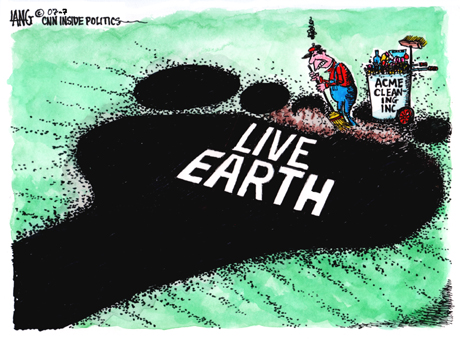
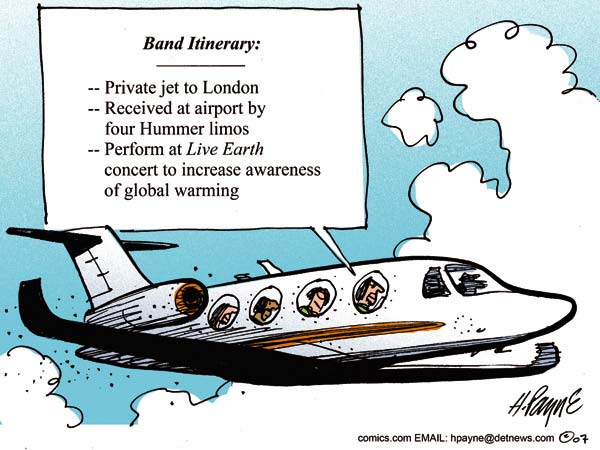
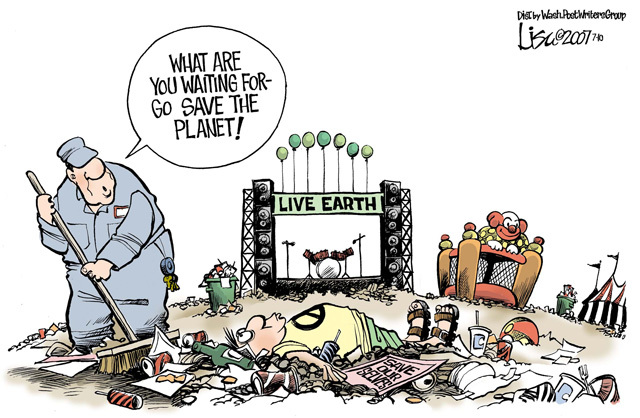
Thursday, July 5, 2007
Humor: Al Gore III's unique carbon offset strategy
From the incomparable Scott Ott, July 5:
Ott also managed to get in a dig at Gore 's upcoming presidential campaign kickoff:
Al Gore, the concert organizer and former U.S. vice president, today defended his son, Al III, after the younger Gore’s arrest for speeding and drug possession, applauding his use of the hybrid Toyota Prius to offset the carbon emissions of his smoking marijuana.
“Even at 100 miles per hour,” said the elder Mr. Gore, “the Prius produces less deadly greenhouse gas than a Lincoln Navigator or a Hummer. While I don’t condone getting caught with marijuana, I would venture to say that my boy’s total carbon footprint is still substantially smaller than the median for his socioeconomic and age brackets.”
Ott also managed to get in a dig at Gore 's upcoming presidential campaign kickoff:
Mr. Gore helped organize LIVE EARTH to dramatize the plight of the planet by having hundreds of thousands of people burn millions of gallons of carbon-based fuel to travel to eight locations worldwide where they’ll communally exhale billions of cubic yards of carbon dioxide, generate hundreds of tons of human and artificial waste and expend untold kilowatt hours of electricity.
Friday, June 22, 2007

Wednesday, June 13, 2007
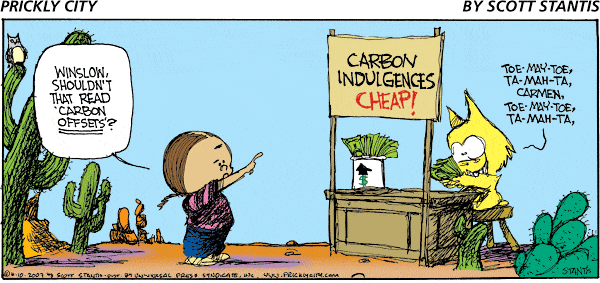
Monday, June 11, 2007
Rolling Stone pretends to be carbon neutral
NY Times, June 11:
Catalyst Paper, the mill mentioned in the article, does an admirable job of being less wasteful of the wood fibers used to make pulp -- instead of buying freshly-cut trees, they buy sawdust, "waste" wood, etc. from other mills that would normally send the debris to landfills. Catalyst also tries to ensure that its suppliers are selling wood products harvested from "sustainably managed forests". All well and good -- about as much as can be expected from a paper producer.
The term "sustainably managed forests" usually means massive replanting to replace the trees that are harvested. Perhaps someone can answer this for me, because I don't know -- how many young trees are planted to replace each mature tree that is harvested? If the replacements aren't as much of a carbon dioxide sink as the trees they replaced, the process can't be considered "carbon neutral" in the short term.
If the climate "tipping point" is only 10 years away as the AGW alarmists warn, these trees won't stop it from happening.
Just about every major magazine has made some sort of nod to global warming, and Rolling Stone plans to do so in its June 28 issue: on top of the requisite interview with former Vice President Al Gore and an essay by the environmentalist Robert F. Kennedy Jr., the magazine will start printing on paper that is said to have less of a negative impact on the environment.The article goes on to say that RS is drawing fire from the CoGW because of the fact that the magazine refuses to use recycled paper (which, they say, doesn't reproduce photos very well).
But as Rolling Stone and others try to be green, they draw criticism from environmentalists who think that if this is walking the walk, it is doing so with a pronounced limp.
Rolling Stone will be printed on what it calls “carbon neutral paper,” because it is made through a process that the magazine claims adds no carbon dioxide to the atmosphere. The paper, which is considerably thinner than what Rolling Stone uses now, is made by a Canadian mill, Catalyst Paper, that the magazine says has reduced greenhouse-gas emissions by 82 percent since 2005 and been cited by the World Wildlife Fund for its conservation efforts.
Catalyst offsets the small amount of carbon released in making the paper by planting trees that will not be harvested for more paper, but rather left standing to help cool the climate, said Lyn Brown, a vice president at Catalyst.
Catalyst Paper, the mill mentioned in the article, does an admirable job of being less wasteful of the wood fibers used to make pulp -- instead of buying freshly-cut trees, they buy sawdust, "waste" wood, etc. from other mills that would normally send the debris to landfills. Catalyst also tries to ensure that its suppliers are selling wood products harvested from "sustainably managed forests". All well and good -- about as much as can be expected from a paper producer.
The term "sustainably managed forests" usually means massive replanting to replace the trees that are harvested. Perhaps someone can answer this for me, because I don't know -- how many young trees are planted to replace each mature tree that is harvested? If the replacements aren't as much of a carbon dioxide sink as the trees they replaced, the process can't be considered "carbon neutral" in the short term.
If the climate "tipping point" is only 10 years away as the AGW alarmists warn, these trees won't stop it from happening.
Wednesday, June 6, 2007
China's one-child policy: the ultimate carbon offset
Further evidence that just about anything can be made virtuous if it can be recast as a carbon offset. From LifeSite, May 4:
(Thanks for the tip, Ray)
Hu Tao of China's State Environmental Protection Administration praised his country’s One Child population control policy for its contribution to the reduction of greenhouse gases. The policy, introduced in the early 1980’s, has been condemned by international human rights agencies for including forced abortion, infanticide and sterilization as well as heavy financial and legal penalties for having children.
Speaking last month at a meeting in Oslo on the UN’s Kyoto Protocol, Hu claimed that the coercive abortion and sterilization policy has had the side effect of slowing “global warming” by limiting the population to 1.3 billion.
“This has reduced greenhouse gas emissions,” he said.
(Thanks for the tip, Ray)
Monday, June 4, 2007
How carbon credits can INCREASE emissions
The incomparable Mark Steyn writes in NRO about an article in The Guardian describing how abuse and incompetence in the carbon credit industry have had the net effect of increasing carbon emissions:
How does a broker verify that emissions reductions have in fact taken place? Lacking sufficient personnel to do the job themselves, brokers will hire specialist companies to conduct inspections of projects in developing countries to ensure that the emissions reductions are in fact taking place.
Some of these specialist companies have been fraudulently certifying the reductions. While the brokers may not be engaging in the fraud themselves, they are putting their name on the certification, which makes them responsible for the results. Brokers like CDM can also be faulted for maintaining that, even though fraud and incompetence has tainted as much as one in five of the credits already sold,
The Guardian article focuses on Clean Development Mechanism (CDM), one of many carbon credit brokers. As a broker, CDM will collect money from those (governments, businesses, Hollywood poseurs, failed presidential candidates) who wish to maintain or increase their carbon emissions, and will then pass the money (minus a commission, of course) to some entity with the capacity to reduce their emissions by an amount at least equal to the amount of the first party's excess.You'd have to have a heart as cold as the pre-globally-warmed Arctic not to be howling with laughter at this, from The Guardian:
I wouldn't be surprised if Katrina was triggered by Al Gore's carbon offsets.One senior figure suggested there may be faults with up to 20% of the carbon credits - known as certified emissions reductions - already sold. Since these are used by European governments and corporations to justify increases in emissions, the effect is that in some cases malpractice at the CDM has added to the net amount of greenhouse gas in the atmosphere.
How does a broker verify that emissions reductions have in fact taken place? Lacking sufficient personnel to do the job themselves, brokers will hire specialist companies to conduct inspections of projects in developing countries to ensure that the emissions reductions are in fact taking place.
Some of these specialist companies have been fraudulently certifying the reductions. While the brokers may not be engaging in the fraud themselves, they are putting their name on the certification, which makes them responsible for the results. Brokers like CDM can also be faulted for maintaining that, even though fraud and incompetence has tainted as much as one in five of the credits already sold,
The chairman of the CDM board, Danish energy consultant Hans Jürgen Stehr, insisted that in the end the problem was not bad enough to require any of the companies to be suspended.Of course, this scandal isn't an argument for or against the scientific merit of AGW, but it does seem fitting that the Great AGW Con is attracting plenty of con artists who want a piece of the action.
Sunday, May 27, 2007
Trees and SUVs
Michael Hill of the Associated Press asks the logical question about carbon offsets:
If you plant some trees, is it OK to drive an Escalade?While countless skeptics have pointed out the hypocrisy of the rich using offsets to assuage their conscience without needing to alter their jet-setting lifestyle, the carbon offset industry has also come under criticism from CoGW true believers -- because too many people who buy offsets believe they've done their part, that no other remedies are necessary to save the planet. In fact, tree planting is woefully inadequate as a carbon dioxide vacuum:
The question isn't as silly as it sounds. People worried about global warming increasingly are trying to "offset" the carbon dioxide — the leading greenhouse gas — they spew into the atmosphere when they drive, fly or flick on a light. One idea popular with the eco-conscious is to have trees planted for them. You get to keep driving and flying, but those trees are supposed to suck in your trail of carbon.
Whole forests have been funded by tree-loving celebrities like Leonardo DiCaprio and Coldplay, and more modest packages tailored to typical consumers are proliferating.
But some researchers say planting trees — while a good thing — is at best a marginal solution to global warming. Still others decry tree planters who continue to jet off to Cannes, drive their SUVs or generally fail to reduce their fuel-hungry lifestyle. To those critics, plantings and other carbon offsets are like the medieval practice of selling indulgences to wash away sins: It may feel good, but it doesn't solve much.
Hill's article also notes one other downside to planting lots of trees -- it can actually lead to more warming:Maybe most importantly, some researchers say it's simply not possible to plant enough trees to have a significant effect on global warming.
Michael MacCracken, chief scientist at the nonpartisan Climate Institute in Washington, said tree-planting has value as a stopgap measure while society attempts to reduce greenhouse gases. But University of Victoria climate scientist Andrew Weaver fears tree offsets could steal the focus of a problem that requires technological advances and behavioral changes.
"The danger is that you could actually think you're solving a problem," Weaver said. "It makes you feel good. It makes you feel warm and fuzzy, like changing a couple of light bulbs. But the reality is it's not going to have a significant effect."
There are other potential problems, however. Some researchers suggest forests in the snowy North might actually increase local warming by absorbing sunlight that would otherwise be reflected into space. And dead, decaying trees release some of that captured carbon back into the atmosphere.I personally have no objection to tree planting -- more power to those who do so, as long as they're wise about where they plant them. As I've mentioned before, my main target are those who set up the scheme where the rich can continue their lavish, wasteful lifestyles while preaching conservation to the rest of us.
Subscribe to:
Posts (Atom)



 Headlines via e-mail


