Showing posts with label Extreme_Weather. Show all posts

Monday, January 4, 2010

Global warming update

Times Online (UK), January 4:

Arctic air and record snow falls gripped the northern hemisphere today, inflicting hardship and havoc from China, across Russia to Western Europe and over the US plains.

There were few precedents for the global sweep of extreme cold and ice that killed dozens in India, paralysed life in Beijing and threatened the Florida orange crop. Chicagoans sheltered from a potentially killer freeze, Paris endured sunny Siberian cold, Italy dug itself out of snowdrifts and Poland counted at least 13 deaths in record low temperatures of about minus 25C (-13F).

The article goes on with example after example demonstrating that we’re currently experiencing the worst winter in many decades.

The reason? Global warming, of course:

Guo Hu, the head of the Beijing Meteorological Bureau, linked this week’s conditions to unusual atmospheric patterns caused by global warming.

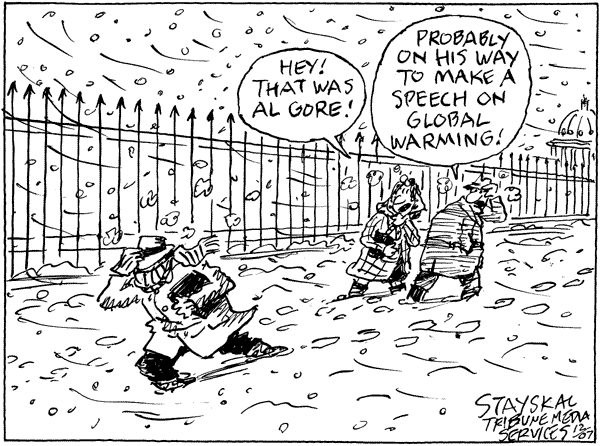
Folks, it doesn’t matter what kind of weather we have — it’s all because of global warming.  No evidence required, because the meme is firmly entrenched.

Thursday, June 12, 2008

Another update on the remarkable winter of 2007-8

Last summer our part of Texas enjoyed one of its coolest summers in living memory, but this year we're roasting at more typical temperatures (mid to upper 90s). A rotten time for our 20-year-old home air conditioning system to give up the ghost, but we finally got that replaced a couple of weeks ago, so we're comfortable again.

Too bad we can't have a summer like they're having up in the Pacific northwest. As reported June 10 in the Seattle Times:

Seattle just experienced the coldest first week of June, according to climate records dating to 1891, said Cliff Mass, University of Washington metrologist. Both 1999 and 2008 share the record, with 1917 falling in second place, he said. "Just wait until tomorrow," he said, when temperatures are going to be even colder.

A heavy snow warning has been issued for the Washington Cascades and Olympics as a storm from the Gulf of Alaska plows into the state tonight.

And on June 11:

It doesn't seem fair, but it's the cold, hard truth — accent on cold: While Seattle hasn't seen a 70-degree day in more than two weeks, Fairbanks, Alaska, has had six of them in the past 10 days.

Just about everyone, it seems, is toastier than we are. You've heard of International Falls, Minn., the self-proclaimed "Icebox of the Nation?"? It's had four days this month in the 70s, topped off with a pleasant 75 on Sunday.

Across the Atlantic, the northern destination of Oslo, Norway, has been passing the 70-degree mark nearly every day recently, while even the Siberian city of Tomsk, Russia, hit the 70s last weekend.

Not that I'm suggesting anything. Highlighting local weather patterns for AGW propaganda purposes is a tricky business, because you have to choose your data points carefully. Chilly in Seattle (global cooling!), but sweltering in New York (global warming!).

This is the purpose of the "proof by anecdote" label for certain posts on this blog. You can prove just about anything anecdotally, if you choose the right anecdote. I try never to commit this fallacy on purpose here (the "proof by anecdote" label is your hint that I'm being facetious), but feel free to call me on it if you think I've let one slip by without admitting it.

(via ICECAP)

Thursday, April 17, 2008

AGW will make hurricanes worse! No it won't! Yes it will! Maybe.

Al Gore used the Katrina disaster to popularize the notion that global warming would make such monsters a routine occurrence. That notion had no scientific merit, but no matter: Gore had successfully injected it into the public discourse, and it took on a life of its own (for example, it was cited by one insurance company as justification for a rate increase request in Florida).

Today Science Daily brings us another exercise in speculative alarmism related to hurricanes (emphasis added):
The Earth's jet streams, the high-altitude bands of fast winds that strongly influence the paths of storms and other weather systems, are shifting--possibly in response to global warming. Scientists at the Carnegie Institution determined that over a 23-year span from 1979 to 2001 the jet streams in both hemispheres have risen in altitude and shifted toward the poles. The jet stream in the northern hemisphere has also weakened. These changes fit the predictions of global warming models and have implications for the frequency and intensity of future storms, including hurricanes.

Cristina Archer and Ken Caldeira of the Carnegie Institution's Department of Global Ecology tracked changes in the average position and strength of jet streams using records compiled by the European Centre for Medium-Range Weather Forecasts, the National Centers for Environmental Protection, and the National Center for Atmospheric Research. The data included outputs from weather prediction models, conventional observations from weather balloons and surface instruments, and remote observations from satellites.
So, how far has the average position of the jet stream shifted over that 23 year span? About 25 miles. That's nothing -- we're talking about the distance from one side of a large metropolitan area to the other -- but the researchers (and/or whoever wrote the press release) do their best to make it sound frightening.
Storm paths in North America are likely to shift northward as a result of the jet stream changes. Hurricanes, whose development tends to be inhibited by jet streams, may become more powerful and more frequent as the jet streams move away from the sub-tropical zones where hurricanes are born.
Here's the equation: Small shift poleward in the average position of the jet stream = more powerful and more frequent hurricanes. Al Gore, call your movie agent.

So, you're still not impressed with the 25-mile shift? Well, the author of the press release doesn't want us to rest easy:
The poleward shift in their average location discovered by the researchers is small, about 19 kilometers (12 miles) per decade in the northern hemisphere, but if the trend continues the impact could be significant. "The jet streams are the driving factor for weather in half of the globe," says Archer. "So, as you can imagine, changes in the jets have the potential to affect large populations and major climate systems."
Some questions for our researchers:
  • Will the trend continue? How do you know?
  • What was the trend before 1979?
  • How long is the current trend likely to continue?
  • How far poleward is the jet likely to go?
  • Are there any natural mechanisms that will limit or halt the poleward march?
Oh, and is this tiny shift the result of global warming?
"At this point we can't say for sure that this is the result of global warming, but I think it is," says Caldeira. "I would bet that the trend in the jet streams' positions will continue. It is something I'd put my money on."
Whatever you may think about this speculation, let's be clear: it's speculation, not science. The study was about the shift in the jet stream, not about the mechanisms of hurricane development. Of course, that doesn't matter. Some scientists said it, and it fits the AGW template, so it will be reported.

Friday, April 11, 2008

Updates on the remarkable winter of 2007-8

Yes, yes, I know. Climate is long-term, and one cold winter does not a trend make. Still, even CoGW adherents ought to take note of the mounting evidence that this winter season is unlike any we've seen since.... since when?

Since this winter has been undeniably extraordinary, those who have much invested in the AGW paradigm have been forced into "Yeah, but" mode: "Yeah, you've never seen this kind of winter in your lifetime, but it's all because of La Niña. Even though we attributed the extraordinarily warm temperatures of El Niño year 1998 to AGW, the extraordinarily cold temperatures of La Niña year 2008 are a routine fluctuation. We expect the doomsday countdown to resume shortly."

Even as Solar Cycle 24 stubbornly refuses to establish itself (despite months of numerous premature announcements that it had started), our planet's northern hemisphere winter has thus far declined to respect the calendar, as is evidenced by the unusually heavy April snowstorm currently working its way across the northern plains of the U.S. and Canada.

How unusual is this winter in the U.S.? Here are just a couple of examples from the past week:

Minneapolis Star-Tribune, April 11:

The latest-ever start to the Mississippi River navigation season in Minnesota is unfolding today.

[...] The average opening date of the navigation season for the past 30 years has been March 20. In 2007, the first tow to make it to St. Paul arrived on March 29.

This year's late start, due to unusually cold spring weather, breaks the previous late record of April 7, set in 1978.

Boston Globe, April 8:
Some Maine syrup producers say the season is off to a late start with delays caused by cold weather and taps and tubing hidden by snow in northern Maine.

Bob Moore of Bob's Sugar House is busy boiling sap this week, but he'd be a lot busier if he could tap all of his trees. He said at least 75 percent of his 5,000 trees are unreachable.

"I have trees that still have 3 feet of snow around them," he said. "It's not looking good right now."

Maine's maple syrup production can start anytime between mid-February and late March. But like most agriculture ventures, the season is subject to the whims of the weather.

"As usual, for some folks, especially in the far south of the state, sugaring season is over," said Kathy Hopkins, a maple expert with the University of Maine Cooperative Extension in Skowhegan.

"But I doubt they'll be done tapping in The County until June," she said in joking reference to the state's northernmost county, Aroostook. "In some places, they just can't get to their trees and all their tubing is buried under snow."

On the other side of the world, southern China got its worst winter in 50 years. At the bottom of the world, the media shrieks whenever a piece of ice breaks off of an ice shelf, but we get nothing about the fact that overall, Antarctica has been cooling in recent decades. In fact, the just-completed antarctic summer has yielded still more extraordinary news: Surface snowmelt there is running about 40% below the average of the previous 20 years.

But never mind all that. Once La Niña subsides, we can get back to TEOTWAWKI.

Friday, February 22, 2008

NOAA, in a fit of common sense, points out the blindingly obvious

The National Oceanic and Atmospheric Administration, often found in the AGW camp, made a surprising admission today:
A team of scientists have found that the economic damages from hurricanes have increased in the U.S. over time due to greater population, infrastructure, and wealth on the U.S. coastlines, and not to any spike in the number or intensity of hurricanes.
More people and more stuff on the coast? Wow, more damage!

“We found that although some decades were quieter and less damaging in the U.S. and others had more land-falling hurricanes and more damage, the economic costs of land-falling hurricanes have steadily increased over time,” said Chris Landsea, one of the researchers as well as the science and operations officer at NOAA’s National Hurricane Center in Miami. “There is nothing in the U.S. hurricane damage record that indicates global warming has caused a significant increase in destruction along our coasts.”

In a newly published paper in Natural Hazards Review, the researchers also found that economic hurricane damage in the U.S. has been doubling every 10 to 15 years. If more people continue to move to the hurricane-prone coastline, future economic hurricane losses may be far greater than previously thought.

Al Gore, call your office.

Tuesday, February 5, 2008

Allstate's prophets seek more profits in Florida

Allstate recently tried to push through a 42% premium rate increase on its Florida customers, using as its justification unscientific wild guess about future weather conditions, as this article reports:
Now we know why Allstate wanted a 42-percent increase in home insurance rates. The company is using an unapproved model that factors the growing threat of global warming.

Last month, company executives objected to a Senate subpoena. The state tried to suspend their license, and Governor Crist threatened to sue them.

Now Allstate executives said they aren't price gouging. They say they're just very concerned about climate change, and trying to make sure they keep rates in tune with the growing threat. The ocean is a hurricane's fuel tank. Warmer waters could mean more and stronger storms (though this is currently a subject of scientific debate).

"It's my professional opinion and others at Allstate, it appears that the increase in sea surface temperatures and the near term effect of hurricanes is something that is real and is a need that we need to consider for the protection of our insurers," said Allstate Floridian's Ryan Michel.

Kudos to the article writer for noting that the link between warmer waters and hurricane frequency and intensity has not been established.

Allstate's Florida customers really ought to ponder whether they really are "in good hands".

Monday, January 7, 2008

Everything's connected, even when it isn't

Here's the scenario that is laid out in a January 6th article:
  • China's largest freshwater lake, Poyang Lake in Jiangxi Province, appears to be drying up.
  • The lake, which is fed by the Yangtze River, has an enormous seasonal variability in its surface area, with a minimum occurring every winter.
  • This winter's minimum is about 10% of last winter's minimum.

Okay, this is pretty straightforward and statistical, but (apart from the devastating human impact) not that interesting. So what title did Forbes columnist Chris O'Brien choose to draw the reader's interest? Global Warming Hits China.

Is there anything in the essay that might support this notion? We learn that the cause of Poyang's predicament is threefold:
  • The Yangtze River basin is suffering a crippling drought. Worst ever? No, its worst in the last 50 years. In other words, this is a drought which, while severe, is neither unprecedented nor rare.
  • Upriver hydroelectric projects (including the infamous Three Gorges Dam) have significantly affected the Yangtze's flow downriver.
  • The government has embarked on a monumental effort to divert some of the Yangtze's water to the Yellow River.
In light of the above facts, Jiang Tong, a member of the Chinese Academy of Sciences and an expert on Poyang Lake, summarized:
Both the stream flows into the river and the Yangtze River water to replenish the lake will be insufficient in dry seasons in the future, because of climate change and the exploitation of water resources.
As I remarked above, there doesn't seem to be any particular scientific reason to tie China's drought to "climate change" (a term of art that is increasingly used in place of "global warming", although Mr. O'Brien apparently hasn't yet received the memo), but there are plenty of political reasons to do so.

Given his position, Jiang Tong can be forgiven for minimizing the significance of the government's "exploitation of water resources", but Forbes has no such excuse.

Wednesday, January 2, 2008

An easy prediction for 2008: More AGW hysteria

Well, this was a nice New Year gift from the New York Times. Science writer John Tierney turned his guns on Al Gore and co. in his January 1 column. While he doesn't actually dispute the notion that global warming is occurring, he does challenge the selective reporting of weather and climate events that make it look like AGW is already having catastrophic effects on our planet.

A year ago, British meteorologists made headlines predicting that the buildup of greenhouse gases would help make 2007 the hottest year on record. At year’s end, even though the British scientists reported the global temperature average was not a new record — it was actually lower than any year since 2001 — the BBC confidently proclaimed, “2007 Data Confirms Warming Trend.”

When the Arctic sea ice last year hit the lowest level ever recorded by satellites, it was big news and heralded as a sign that the whole planet was warming. When the Antarctic sea ice last year reached the highest level ever recorded by satellites, it was pretty much ignored. A large part of Antarctica has been cooling recently, but most coverage of that continent has focused on one small part that has warmed.

When Hurricane Katrina flooded New Orleans in 2005, it was supposed to be a harbinger of the stormier world predicted by some climate modelers. When the next two hurricane seasons were fairly calm — by some measures, last season in the Northern Hemisphere was the calmest in three decades — the availability entrepreneurs changed the subject. Droughts in California and Australia became the new harbingers of climate change (never mind that a warmer planet is projected to have more, not less, precipitation over all).

Tierney attributes this cherrypicking of data to a species of animal called the availability entrepreneur: "the activists, journalists and publicity-savvy scientists who selectively monitor the globe looking for newsworthy evidence of a new form of sinfulness, burning fossil fuels."

One person who has made a handsome living from cherrypicking the data is, of course, Al Gore. Tierney ends his essay with this parting shot:
“In the last few months,” Mr. Gore said [in his Nobel prize acceptance speech], “it has been harder and harder to misinterpret the signs that our world is spinning out of kilter.” But he was being too modest. Thanks to availability entrepreneurs like him, misinterpreting the weather is getting easier and easier.

Tuesday, December 18, 2007

Just think how bad it would have been without global warming


I haven't played the proof-by-anecdote game in a while, so today seemed like a good opportunity to present a single weather event as proof that Al Gore & co. are full of hot air. From Today's edition of The Ottawa (Canada) Citizen:
Ottawa will continue to crawl out from a record-breaking snowfall Tuesday as crews tackle one of the biggest snow removal operations in the city's history.

"It's no Academy Award, but it was the snowiest December day ever in the capital," said Environment Canada meteorologist David Phillips.

In total, 37 centimetres fell in Sunday's storm, setting a record for the most snow in a single December day since Environment Canada started keeping records in 1938. The previous record was 30.4 centimetres, which fell Dec. 21, 1977.

Friday, October 26, 2007

The call of the wild(fire)

Some in the media (perhaps taking a cue from Senate majority leader Harry Reid or the House Select Committee on Energy Independence and Global Warming) seem to have an irresistible urge to tie the southern California wildfires to AGW. See if you can follow the logic in this op-ed by Tom Teepen. He starts by wondering if TEOTWAWKI is near:

Are we leaving our children and grandchildren a failing Earth or a failed one? Is it, in other words, already too late?

That dire question occurs with more chilling plausibility with each new consequence, the subtle to the dramatic equally, from the accelerating biospheric implosion wrought of global warming.

What could possibly turned his mind to such depressing thoughts? The wildfires, of course. Realizing the nonsequitur, he immediately launches into a preemptive "Yeah, yeah, I know":
And, yes, I am going to bring up the wildfires in Southern California and, yes again, I am perfectly aware that weather is not climate. For now, the California fires are the work of weather, an awful convergence of drought and wind and temperature.
But his disclaimer is merely a minor speed bump as he lunges forward with his jeremiad:
But the fires, historic in number, scope and fury, are as well consistent with the catastrophes that computer modeling has long predicted from the warming. We would have to be fools to ignore that.
So. These fires are similar to what some computer models have predicted as an effect of AGW (actually, they're made more likely by drought conditions, which can happen with or without AGW, but never mind that).

Okay. Connection established. Now Mr. Teepen can tear into the "contrarian fringe" that fails to toe the line with the supposed international consensus.

Of course, we are informed, the contrarians are composed almost entirely of political cultists and scientists who have sold their souls to the energy industry.

That reminds me. From the day I started this blog, I have openly solicited cash from the energy industry in exchange for my advocacy (see "About the Heretic" in the sidebar). Alas, nary a penny so far. Where did I go wrong?

Could it be that some of the "contrarian" scientists are offering their views for free as well?

Dr. William Gray, world-renowned hurricane forecaster and perennial burr in Al Gore's saddle, says that there are many more heretics out there than are willing to publicly admit it. If you want to talk about financial incentives, consider that scientists who become vocal in their skepticism tend to lose grant money, so the advocates end up with both the money and the megaphone.

Thus, Mr. Teepen never gets to hear a serious presentation of what the heretics have to say. All he has to go on are Democratic Party and (WhenWillTheyEver)MoveOn.org press releases, so who can blame him?

Wednesday, September 12, 2007

Hydroelectric dams cause earthquakes, volcanoes, severe thunderstorms, and heart attacks

Okay, try to follow along on this one.

Again we return to the observation that the AGW 'crisis' is ideally suited to the aims of the radical environmental movement. Global warming (or "climate change", if you insist) is flexible enough to encompass virtually all of their pet causes of the past four decades (with the exception of nuclear power, which keeps stubbornly popping up as the most earth-friendly energy source capable of completely replacing coal).

For example, the enviros have long opposed the damming of rivers because of the inconvenience such projects cause to snail darters and the like. They have not, however, been able to swing public support in their favor, because on the whole people like their televisions and their power tools more than they like snail darters.

That's why the AGW thing is a stroke of good luck for the environmentalists. Like just about everything else, someone has been able to suggest a connection between the damming of rivers and global warming. A September 4 article in Australia's news.com reported:
International Rivers Network executive director Patrick McCully today told Brisbane's Riversymposium rotting vegetation and fish found in dams produced surprising amounts of methane - 25 times stronger than carbon dioxide.

"Often it's accepted that hydropower is a climate friendly technology but in fact probably all reservoirs around the world emit greenhouse gases and some of them, especially some of the ones in the tropics, emit very high quantities of greenhouse gases even comparable to, in some cases even much worse than, fossil fuels like coal and gas," Mr McCully said.

He said when water flow was stopped, vegetation and soil in the flooded area and from upstream was left to rot, as well as fish and other animals which died in the dam.

They then released carbon dioxide, methane and nitrous oxide into the air.

"Basically they're factories for converting carbon into methane and methane is a very powerful greenhouse gas - it's less known than carbon dioxide but it's actually about 25 times stronger than carbon dioxide in terms of trapping heat in the atmosphere."

Mr McCully said global estimates blamed dams for about a third of all methane emissions worldwide.
Now we're on to something. Dams cause global warming. That's just evil.

Still no groundswell of public opposition to dams.... So, let's bring this a bit closer to home. We've mentioned some of the things said to be caused by or enhanced by AGW (such as flooding rains, amorous cats, genocide, super poison ivy, higher pizza prices, and megacryometeors). To this list we must add earthquakes and volcanoes, as we are told in this August 30 LiveScience article:

Earthquakes, volcanic eruptions, tsunamis and landslides are some of the additional catastrophes that climate change and its rising sea levels and melting glaciers could bring, a geologist says.

The impact of human-induced global warming on Earth's ice and oceans is already noticeable: Greenland's glaciers are melting at an increasing rate, and sea level rose by a little more than half a foot (0.17 meters) globally in the 20th century, according to the Intergovernmental Panel on Climate Change.

[...]

One particular feature that can change the balance of forces in Earth's crust is ice, in the form of glaciers and ice sheets that cover much of the area around Earth's poles plus mountains at all latitudes. The weight of ice depresses the crust on which it sits.

As the ice melts, the crust below no longer has anything sitting on top of it, and so can rebound fairly rapidly (by geological standards). (This rebounding is actually occurring now as a result of the end of the last Ice Age: The retreat of massive ice sheets from the northern United States and Canada has allowed the crust in these areas to bounce back.)

Areas of rebounding crust could change the stresses acting on earthquake faults and volcanoes in the crust.

(Thanks to Newsbusters)

Earthquakes and volcanoes are bad. But you're still okay with hydroelectric power, are you? Willing to play the odds that a volcano won't pop up in your back yard, eh? Let's up the ante a little more. Here's another August 30 article from LiveScience:
Global warming will make severe thunderstorms and tornadoes a more common feature of U.S. weather, NASA scientists said today.

Climate models have previously shown that Earth will see more heavy rainstorms as the atmosphere warms, but a new climate model developed by NASA researchers is the first to show the difference in strength between storms that occur over land and those over the ocean and how storms strengths will change in general.

The models don't directly simulate thunderstorms and lightning, but look for conditions that are ripe for severe storms to form.
Thunderstorms! Tornadoes! Those are real threats where I live. In fact, as I mentioned in the post before this, my PC was zapped by lightning three weeks ago. I was at work at the time, and I heard a single thunderclap -- apparently the one that got my motherboard at home. A thunderstorm with only one significant lightning strike, but it was a doozy. That's just creepy enough to blame on global warming (never mind the fact that we're experiencing the coolest summer in the 30 years I've lived in Texas). But is it enough to make me give up the hydroelectric dam? Hey, I need power to run my PC once I get it fixed (as well as the new one I have on order).

Since you haven't listened to reason yet, it's time to get personal. Global warming is coming for you. Yes, you. Here's an Associated Press dispatch from September 5:

Doctors warn that the warmer weather expected with climate change might also produce more heart problems.

"If it really is a few degrees warmer in the next 50 years, we could definitely have more cardiovascular disease," said Dr. Karin Schenck-Gustafsson, of the department of cardiology at Sweden's Karolinska Institute.

[...] In higher temperatures, we sweat to get rid of heat. During that process, blood is sent to the skin where temperatures are cooler, which opens up the blood vessels. In turn, the heart rate rises and blood pressure drops. That combination can be dangerous for older people and those with weakened cardiovascular systems.

So now you're dead. If that doesn't turn you against hydroelectric dams, I don't know what will.

Friday, July 27, 2007

Global warming can be a homewrecker

In recent years there have been numerous stories of large chunks of ice falling from a clear sky. AP reports today that it happened again July 26 in Dubuque, Iowa, where a chunk that may have weighed 50 pounds crashed through the roof of a woman's house.

In the past, media coverage has focused on the likelihood that such ice chunks originate from an airplane (either accumulated on the outside of the craft, or ejected from the lavatories), but now a more sinister suspect is starting to ooze into the reporting. We get an early warning in the second paragraph (emphasis added):
Authorities are unsure of the ice's origin but have theorized the chunks either fell from an airplane or naturally accumulated high in the atmosphere — both rare occurrences.
How can a 50-pound chunk of ice accumulate naturally in the atmosphere? What malevolent force can suspend ice long enough to grow that large on a clear day, when even the most violent of thunderstorms could never sustain the necessary updrafts?

You guessed it -- climate change!

Enter Dr. David Travis, expert on earthbound phenomena, but not necessarily atmospheric science:
David Travis, a professor of geography and geology and an associate dean at the University of Wisconsin-Whitewater, has studied the phenomenon of large chunks of ice falling from a clear sky. He said it's possible the ice could have been a megacryometeor — "similar to a hailstone, but without the thunderstorm."

[...] Most megacryometeor sightings have occurred in coastal areas, where atmospheric turbulence helps keep ice suspended long enough to grow into large chunks.

Travis' research team speculates the phenomenon could be linked with global warming, suggesting that climate change might make the tropopause portion of the atmosphere colder, moister and more turbulent.

A total guess, based on zero evidence, in other words.

Maybe I'm the one who's weak on the atmospheric science, so I'm open to being educated here. What kind of updraft is necessary to suspend an ice chunk of that weight, and how long must that updraft be sustained to allow the chunk to grow to that weight? Do such updrafts actually occur in nature?

Monday, July 23, 2007

Britain's floods and the virtual reality of climate science

U.K.'s The Independent reported breathlessly today that the extraordinary flooding now underway in Britain is happening because George W. Bush withdrew the United States from the Kyoto Treaty.

Well, not really. I should really stop exaggerating like that. I wouldn't be surprised, though, if somewhere out there someone has blamed Bush for this.

What The Independent did report is the claim that "scientists" have "confirmed" a link between Britain's summer floods and "man-made global warming".

Let's look at the opening paragraphs of the article, which is riddled with superlatives:

It's official: the heavier rainfall in Britain is being caused by climate change, a major new scientific study will reveal this week, as the country reels from summer downpours of unprecedented ferocity.

More intense rainstorms across parts of the northern hemisphere are being generated by man-made global warming, the study has established for the first time ­ an effect which has long been predicted but never before proved.

The study's findings will be all the more dramatic for being disclosed as Britain struggles to recover from the phenomenal drenching of the past few days, during which more than a month's worth of rain fell in a few hours in some places, and floods forced thousands from their homes.

So, how were the scientists able to pin the blame so unambiguously on AGW? Not by the hopelessly old-fashioned method of empirical data collection and analysis, but through the use of -- you guessed it! -- computer simulations. Climate models -- which supposedly are not useful for predicting individual weather events (the article admits as much) -- allegedly yielded something akin to this summer's individual weather events when simulations both with and without greenhouse gases were run.

The article turns out to be quite confusing. In places we are confidently assured that AGW Did It, and then in other places the confidence wavers (emphasis added):
Meteorologists agree that the miserably wet British summer of 2007 has generally been caused by a southward shift towards Britain of the jetstream, the high-level airflow that brings depressions eastwards across the Atlantic. This is fairly normal. But debate is going on about whether climate change may be responsible for the intensity of the two freak rainfall episodes, which have caused flooding the like of which has never been seen in many places.
So, rainfall events enabled by a normal shift in the jet stream are now the fault of AGW because of "unprecedented" flooding that resulted. Remember, no empirical link has been established -- just computer simulations and human inferences.

The new study, carried out jointly by several national climate research institutes using their supercomputer climate models, including the Hadley Centre of the UK Met Office, does not prove that any one event, including the rain of the past few days in Britain, is climate-change related.

But it certainly supports the idea, by showing that in recent decades rainfall has increased over several areas of the world, including the mid-latitudes of the northern hemisphere, and linking this directly, for the first time, to global warming caused by human emissions of greenhouse gases.

In other words, "It looks awfully like what we think might happen." More:
"Some people would argue that you can't take a single event and pin that on climate change, but what happened in Britain last Friday fits quite easily with these conclusions. It does seem to have a certain resonance with what they're finding in this research."
Yikes! This is what passes for the scientific method among adherents of the CoGW.

The study, to be published in the journal Nature later this week, may end up being a lot less sloppy than the reporting here presents it to be, but I'm not willing to bet money on that.

Thursday, May 24, 2007

Study strongly discredits AGW-Hurricane link

Reuters reports on a study that reaffirms an observation that was already well-known in the tropical meteorology community prior to the current AGW hysteria: while Atlantic surface temperatures are important, Atlantic hurricane formation and intensity are driven more by the Pacific's El Niño/Southern Oscillation (ENSO) phenomenon. Note in this article excerpt that its author still holds fast to the basic tenets of CoGW orthodoxy even while reporting on a study that discredits one of the many AGW alarmist talking points of recent years (especially post-Katrina).
Hurricanes over the past 5,000 years appear to have been controlled more by El Nino and an African monsoon than warm sea surface temperatures, such as those caused by global warming, researchers said Wednesday.

The study, published in the journal Nature, adds to the debate on whether seas warmed by greenhouse gas emissions lead to more hurricanes, such as those that bashed the Gulf of Mexico in 2005.

Some researchers say warmer seas appear to have contributed to more intense hurricanes, while others disagree. The U.N. International Panel on Climate Change said this year it was more likely than not that humans contribute to a trend of increasingly intense hurricanes.

Frequent strong hurricanes thrived in the Western Atlantic during times of weak El Ninos, or warming of surface waters of the Eastern Pacific Ocean, and strong West African monsoons even when local seas were cooler than now, the study said.

"Tropical sea surface temperatures as warm as at present are apparently not a requisite condition for increased intense hurricane activity," Jeffrey Donnelly, the lead author and researcher at the Woods Hole Oceanographic Institution, said in the study.

Intense hurricanes made landfall during the latter half of the Little Ice Age, a period of cooling that occurred approximately from the 14th to mid-19th centuries, he said.

Note the phrase "seas warmed by greenhouse gas emissions" in the second paragraph. Are Atlantic surface temperatures warmer than they were 50 years ago? 20 years ago? I actually don't know the answer to that question, and I welcome any information that you, dear reader, can provide.

If there has been warming, what is the source of the warming? Remember, the CoGW has conditioned us to assume AGW whenever some anomaly is observed in nature, but such an approach is scientifically lacking. Of course, this knee-jerk response also assumes that actual atmospheric warming has occurred, and to an extent that it would affect ocean surface temperatures. But has it? I will leave that discussion for another post.

Assuming that there has been ocean warming, could there be other causes? What about underwater volcanic activity? The Mid-Atlantic Ridge is extremely active volcanically -- can it be ruled out as a source of temperature changes?

Consider the ENSO phenomenon in the Pacific, which features the rapid cooling or warming of ocean temperatures, totally independent of the presence or absence of SUVs. Is there really nothing in the Atlantic that could possibly contribute to water temperature changes without our help?

But that's all beside the point. This study shows pretty clearly that ocean surface temperatures have little or no influence over the number or intensity of Atlantic hurricanes, regardless of the atmospheric temperatures over the ocean.

Why are we still talking about Katrina two years later? Is it the fact that it was a Category 5 hurricane? There have been other Category 5 hurricanes in the Gulf before Katrina -- such as Allen in 1980, which was much stronger at its peak than Katrina was.

No, the main fact that makes Katrina memorable is where it made landfall. Hurricane Allen came ashore at a more sparsely populated area of the Gulf coast (near Brownsville, Texas), and because the damage was relatively minor (compared with Katrina), most people don't remember it any more.

Katrina came ashore near a major city, and the strong side of the storm pummeled portions of Mississippi that had a lot of coastal development, so the visible destruction was much greater than that caused by Allen. Even so, Katrina would not have loomed so large in our memory if the retaining wall of one of New Orleans' canals had not collapsed.

So, before the 2007 hurricane season officially begins, we hear the voice of reason on what actually drives hurricane development. I think we can count on the pols and pundits to totally ignore this study when we get the first landfall this summer.