Showing posts with label Nature_Trumps_Human_Influence. Show all posts

Monday, March 30, 2009

100+ scientists call Obama out on his AGW alarmism

The Cato Institute has published a full-page ad in many newspapers politely accusing President Obama of being factually inaccurate in his climate change alarmism.

Over 100 scientists agreed to lend their names to the following statement (View complete statement in HTML | PDF):
"Few challenges facing America and the world are more urgent than combating climate change.The science is beyond dispute and the facts are clear."

— PRESIDENT-ELECT BARACK OBAMA, NOVEMBER 19 , 2008

With all due respect
Mr. President, that is not true.


We, the undersigned scientists, maintain that the case for alarm regarding climate change is grossly overstated. Surface temperature changes over the past century have been episodic and modest and there has been no net global warming for over a decade now. After controlling for population growth and property values, there has been no increase in damages from severe weather-related events. The computer models forecasting rapid temperature change abjectly fail to explain recent climate behavior. Mr. President, your characterization of the scientific facts regarding climate change and the degree of certainty informing the scientific debate is simply incorrect.
Bravo to Cato and to the scientists who put their professional reputations on the line to challenge the "consensus".

Thursday, September 25, 2008

Solar wind theory may get its day in court

Advocates of the idea that solar influences on climate outweigh human influences may finally get their chance to test their theory.

New measurements from the NASA/ESA spacecraft Ulysses show that the sun's current period of low activity goes beyond an extended dearth of sunspots. As AFP reports in a September 24 article:
The intensity of the sun's million-mile-per-hour solar wind has dropped to its lowest levels since accurate records began half a century ago, scientists say.

Measurements of the cosmic blasts of radiation, ejected from the sun's upper atmosphere, were made with the Ulysses spacecraft, a joint mission between NASA and the European Space Agency (ESA).

The solar wind "inflates a protective bubble, or heliosphere, around the solar system," which protects the inner planets against the radiation from other stars, said Dave McComas, Ulysses' solar wind principal investigator and senior executive director at the Southwest Research Institute in San Antonio, Texas.

"With the solar wind at an all-time low, there is an excellent chance the heliosphere will diminish in size and strength," said Ed Smith, NASA's Ulysses project scientist at the Jet Propulsion Laboratory in Pasadena, California.

"If that occurs, more galactic cosmic rays will make it into the inner part of our solar system," added Smith.

As we have noted before, some scientists (such as Svensmark) draw a link between variations in solar wind and variations in cloud formation on our planet. Svensmark argues that increased cosmic radiation acts as a catalyst for cloud formation in earth's atmosphere -- in turn leading to a general cooling of the world's climate if the pattern persists.

If the current lapse in the solar wind continues, Svensmark may soon get all of the data he needs to support or refute his theory.

Friday, April 11, 2008

Updates on the remarkable winter of 2007-8

Yes, yes, I know. Climate is long-term, and one cold winter does not a trend make. Still, even CoGW adherents ought to take note of the mounting evidence that this winter season is unlike any we've seen since.... since when?

Since this winter has been undeniably extraordinary, those who have much invested in the AGW paradigm have been forced into "Yeah, but" mode: "Yeah, you've never seen this kind of winter in your lifetime, but it's all because of La Niña. Even though we attributed the extraordinarily warm temperatures of El Niño year 1998 to AGW, the extraordinarily cold temperatures of La Niña year 2008 are a routine fluctuation. We expect the doomsday countdown to resume shortly."

Even as Solar Cycle 24 stubbornly refuses to establish itself (despite months of numerous premature announcements that it had started), our planet's northern hemisphere winter has thus far declined to respect the calendar, as is evidenced by the unusually heavy April snowstorm currently working its way across the northern plains of the U.S. and Canada.

How unusual is this winter in the U.S.? Here are just a couple of examples from the past week:

Minneapolis Star-Tribune, April 11:

The latest-ever start to the Mississippi River navigation season in Minnesota is unfolding today.

[...] The average opening date of the navigation season for the past 30 years has been March 20. In 2007, the first tow to make it to St. Paul arrived on March 29.

This year's late start, due to unusually cold spring weather, breaks the previous late record of April 7, set in 1978.

Boston Globe, April 8:
Some Maine syrup producers say the season is off to a late start with delays caused by cold weather and taps and tubing hidden by snow in northern Maine.

Bob Moore of Bob's Sugar House is busy boiling sap this week, but he'd be a lot busier if he could tap all of his trees. He said at least 75 percent of his 5,000 trees are unreachable.

"I have trees that still have 3 feet of snow around them," he said. "It's not looking good right now."

Maine's maple syrup production can start anytime between mid-February and late March. But like most agriculture ventures, the season is subject to the whims of the weather.

"As usual, for some folks, especially in the far south of the state, sugaring season is over," said Kathy Hopkins, a maple expert with the University of Maine Cooperative Extension in Skowhegan.

"But I doubt they'll be done tapping in The County until June," she said in joking reference to the state's northernmost county, Aroostook. "In some places, they just can't get to their trees and all their tubing is buried under snow."

On the other side of the world, southern China got its worst winter in 50 years. At the bottom of the world, the media shrieks whenever a piece of ice breaks off of an ice shelf, but we get nothing about the fact that overall, Antarctica has been cooling in recent decades. In fact, the just-completed antarctic summer has yielded still more extraordinary news: Surface snowmelt there is running about 40% below the average of the previous 20 years.

But never mind all that. Once La Niña subsides, we can get back to TEOTWAWKI.

Wednesday, December 12, 2007

The earth itself plays a role in its (perceived) climate


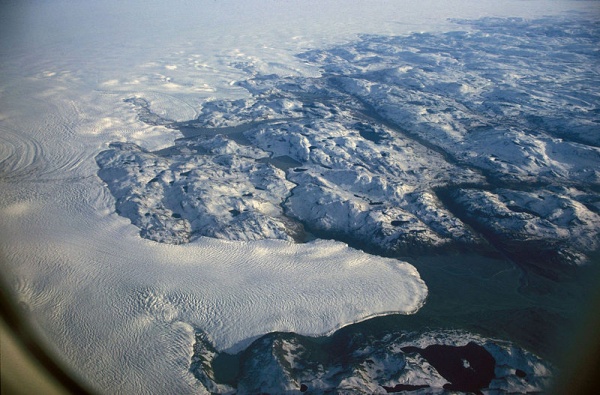
Just after poking some fun at The Daily Green for ignoring the sun as a culprit in climate change, I came across an Ohio State University press release that puts an interesting spin on the changes in the Greenland ice sheet.

CoGW orthodoxy, of course, insists that the Greenland ice sheet is melting (reality: it is melting in some places, but thickening in others), and that the melting is due to global warming, and that global warming is due to George W. Bush's foreign policy. Just kidding on that last part (sort of).

OSU researchers, however, have found that the earth itself joins the sun in contributing to many of the observed phenomena that are so casually attributed to AGW:
Scientists have discovered what they think may be another reason why Greenland 's ice is melting: a thin spot in Earth's crust is enabling underground magma to heat the ice.

They have found at least one “hotspot” in the northeast corner of Greenland -- just below a site where an ice stream was recently discovered.

The researchers don't yet know how warm the hotspot is. But if it is warm enough to melt the ice above it even a little, it could be lubricating the base of the ice sheet and enabling the ice to slide more rapidly out to sea.

“The behavior of the great ice sheets is an important barometer of global climate change,” said Ralph von Frese, leader of the project and a professor of earth sciences at Ohio State University. “However, to effectively separate and quantify human impacts on climate change, we must understand the natural impacts, too.

[...]

The ice sheet in northeast Greenland is especially worrisome to scientists. It had no known ice streams until 1991, when satellites spied one for the first time. Dubbed the Northeastern Greenland Ice Stream, it carries ice nearly 400 miles, from the deepest interior of the island out to the Greenland Sea.

“Ice streams have to have some reason for being there. And it's pretty surprising to suddenly see one in the middle of an ice sheet,” von Frese said.

The newly discovered hotspot is just below the ice stream, and could have caused it to form, the researchers concluded. But what caused the hotspot to form?

“It could be that there's a volcano down there,” he said. “But we think it's probably just the way the heat is being distributed by the rock topography at the base of the ice.”

Dr. von Frese said it well: "[T]o effectively separate and quantify human impacts on climate change, we must understand the natural impacts, too."

Hear, hear.

The sun gets dissed again

Despite credible evidence that solar influences on earth's climate trump anthropogenic influences, The Daily Green decided the sun wasn't worth mentioning as a possible culprit in their online poll:


Given that the environmental left has invested everything in persuading us that climate change is -- for the first time ever -- human induced, I don't blame the editors of The Daily Green for the oversight.