Showing posts with label Ice. Show all posts

Tuesday, September 23, 2008

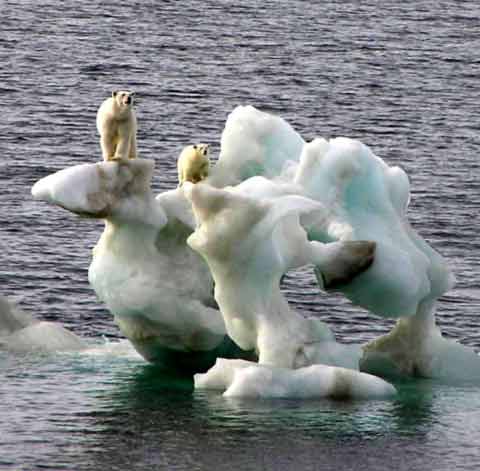
Are polar bears going cannibal?

CNN, in the midst of a boilerplate September 23 article about the allegedly impending disappearance of Arctic ice, brings us an alarming development in the saga of the officially-threatened-but-not-actually-declining-yet polar bear:
"The Arctic sea ice melt is a disaster for the polar bears," according to Kassie Siegel, staff attorney for the Center for Biological Diversity. "They are dependent on the Arctic sea ice for all of their essential behaviors, and as the ice melts and global warming transforms the Arctic, polar bears are starving, drowning, even resorting to cannibalism because they don't have access to their usual food sources."

Scientists have noticed increasing reports of starving Arctic polar bears attacking and feeding on one another in recent years.
Cannibalism! Yikes! Given the extent of the summer melt in the past two seasons, researchers must have a lot of anecdotal evidence of this. Let's read on to learn the gory details:
In one documented 2004 incident in northern Alaska, a male bear broke into a female's den and killed her.
2004? Four years ago? Did the male bear eat the female after killing her? What was the frequency of such behavior in the polar bear population before any significant melting occurred?

Does article author Marsha Walton realize that this one sentence (which, by the way, is the only example given) undermines her alarmist conclusion? Apparently not. Even though the main purpose of the article is to report on the just-ended ice-melt season, her article is entitled:
Polar bears resort to cannibalism as Arctic ice shrinks
Present tense: "resort". If there's evidence of it happening this season, Walton doesn't see fit to present it.

Perhaps because the true story gives no cause for alarm?

Perhaps because researchers have long known about cannibalism among the polar bears.


[P.S. Hello to everyone visiting here from the CNN article page!]

Monday, February 4, 2008

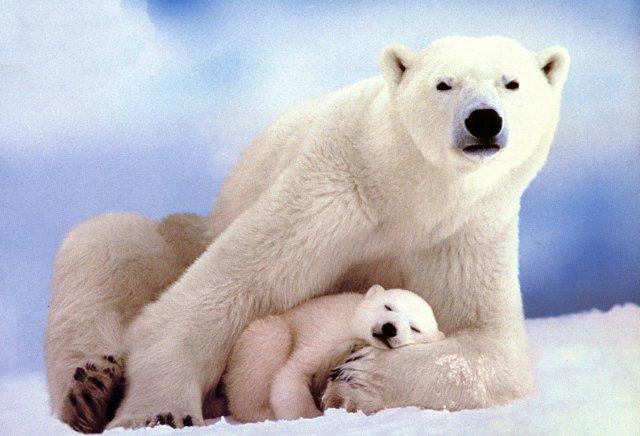
The polar bear: poster child of the environmental left

Sen. Inhofe's EPW staff has gathered a variety of scientific sources indicating that polar bears, the majestic icon of the CoGW, are not declining -- in fact, they are now near record high levels (at least double their population of half a century ago). Many of these extinction scenarios are floated using a raft of scientifically unsound assumptions.

And yet, yesterday we read this in the Los Angeles Times:
The Bush administration is nearing a decision that would officially acknowledge the environmental damage of global warming, and name its first potential victim: the polar bear.

The Interior Department may act as soon as this week on its year-old proposal to make the polar bear the first species to be listed as threatened with extinction because of melting ice due to a warming planet.
The environmental left candidly admits the importance of the polar bear as a cute, cuddly symbol of their cause:
Both sides agree that conservationists finally have the poster species they have sought to use the Endangered Species Act as a lever to force federal limits on the greenhouse gases linked to global warming, and possibly to battle smokestack industry projects far from the Arctic.

"All animals are equal, but some animals are more equal than others," said Kassie Siegel, an attorney with the nonprofit Center for Biological Diversity. "And then there is the polar bear."
Keep in mind that the decline isn't actually occurring right now. The movement to get the polar bear listed as threatened is based on what-if computer scenarios.


But what if the assumptions are wrong, and the projected warming does not occur? No matter. Once the polar bear is listed, environmental law can more easily be used as a bludgeon for The Cause. Just about any human activity can -- with appropriate logical gymnastics -- be tied to climate change, so pretty much no human activity in America would remain beyond the reach of the environmental regulators.

The Times article lists a more obvious example:
Heavy industry has reason to fear. At least one part of the environmental community believes the bear's listing would provide the leverage to stop a coal-fired power plant thousands of miles away from the Arctic.

Sen. Jim Inhofe (R-Okla.), who is known for his skepticism about global-warming measures, asked U.S. Fish and Wildlife Service Director H. Dale Hall last week whether listing the polar bear could be used to halt the construction of a new power plant in Oklahoma City.

"The Endangered Species Act is not the vehicle to reach out and demand all of the things that need to happen to address climate change," Hall said, to Inhofe's apparent satisfaction.

Andrew E. Wetzler, director of the Natural Resources Defense Council's endangered species project, said Hall misunderstands the legal principles underlying the act, which was fortified by a recent U.S. Supreme Court ruling that carbon dioxide can be regulated as a pollutant.

If the builders of a coal-fired plant needed a federal permit, they would probably have to show how its emissions would not erode the polar bear's habitat or jeopardize its survival, Wetzler said.
If the drive to get the polar bear listed succeeds, the opportunity for environmentalist mischief will be boundless.

Friday, January 25, 2008

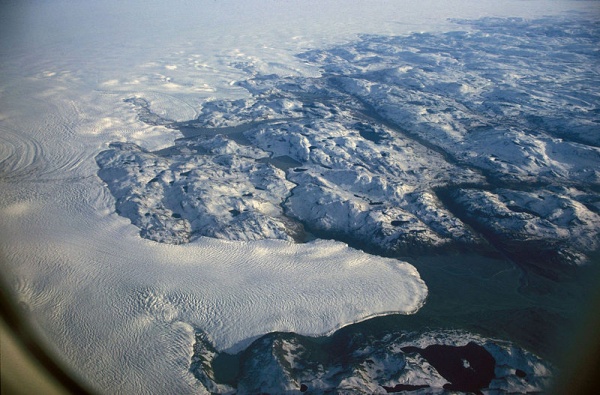
Mixed news from Greenland

From the London Times via Fox News, January 17:
Greenland Ice Sheet Rapidly Melting, Scientists Find

Greenland's ice sheet shrank more rapidly last summer than at any other time in the past 50 years, measurements have shown.

Researchers said the extent of the melt was evidence that the ice sheet was in "inexorable decline" because of global warming.

The researchers found a shift in meteorological patterns over the past 15 years, with a direct correlation being found between Greenland's weather and the generally warmer weather across both the northern and southern hemispheres.

From Icecap.us, January 17:
Ice Returns as Greenland Temps Plummet

On Disko Bay in western Greenland, where a number of prominent world leaders have visited in recent years to get a first-hand impression of climate change, temperatures have dropped so drastically that the water has frozen over for the first time in a decade. “The ice is up to 50cm thick,” said Henrik Matthiesen, an employee at Denmark’s Meteorological Institute who has also sailed the Greenlandic coastline for the Royal Arctic Line. ‘We’ve had loads of northerly winds since Christmas which has made the area miserably cold.’ Matthiesen suggested the cold weather marked a return to the frigid temperatures common a decade ago.

Wednesday, December 12, 2007

The earth itself plays a role in its (perceived) climate


Just after poking some fun at The Daily Green for ignoring the sun as a culprit in climate change, I came across an Ohio State University press release that puts an interesting spin on the changes in the Greenland ice sheet.

CoGW orthodoxy, of course, insists that the Greenland ice sheet is melting (reality: it is melting in some places, but thickening in others), and that the melting is due to global warming, and that global warming is due to George W. Bush's foreign policy. Just kidding on that last part (sort of).

OSU researchers, however, have found that the earth itself joins the sun in contributing to many of the observed phenomena that are so casually attributed to AGW:
Scientists have discovered what they think may be another reason why Greenland 's ice is melting: a thin spot in Earth's crust is enabling underground magma to heat the ice.

They have found at least one “hotspot” in the northeast corner of Greenland -- just below a site where an ice stream was recently discovered.

The researchers don't yet know how warm the hotspot is. But if it is warm enough to melt the ice above it even a little, it could be lubricating the base of the ice sheet and enabling the ice to slide more rapidly out to sea.

“The behavior of the great ice sheets is an important barometer of global climate change,” said Ralph von Frese, leader of the project and a professor of earth sciences at Ohio State University. “However, to effectively separate and quantify human impacts on climate change, we must understand the natural impacts, too.

[...]

The ice sheet in northeast Greenland is especially worrisome to scientists. It had no known ice streams until 1991, when satellites spied one for the first time. Dubbed the Northeastern Greenland Ice Stream, it carries ice nearly 400 miles, from the deepest interior of the island out to the Greenland Sea.

“Ice streams have to have some reason for being there. And it's pretty surprising to suddenly see one in the middle of an ice sheet,” von Frese said.

The newly discovered hotspot is just below the ice stream, and could have caused it to form, the researchers concluded. But what caused the hotspot to form?

“It could be that there's a volcano down there,” he said. “But we think it's probably just the way the heat is being distributed by the rock topography at the base of the ice.”

Dr. von Frese said it well: "[T]o effectively separate and quantify human impacts on climate change, we must understand the natural impacts, too."

Hear, hear.

Thursday, November 29, 2007

"Weekly Reader" on thin ice regarding polar bears

The "polar bears are going extinct" meme is still being peddled wholesale to our children, even though the claim is demonstrably false. Bob Parks writes that GeoTrek, published by the folks who publish the venerable grade-school magazine The Weekly Reader (I remember reading it in the 1960s), recently had a feature article on the subject.

Parks asked Dr. Tim Ball for his comments on the article, and he includes Dr. Ball's response. Here's an excerpt:
Dear Bob,

The exploitation of children is despicable and this is a perfect example. First let me quote Mitch Taylor probably the world expert on polar bears. Here is a comment he made last year. It still holds true today.

"Of the 13 populations of polar bears in Canada, 11 are stable or increasing in number. They are not going extinct, or even appear to be affected at present." – May 2006

Mitch has lived in Nunavut for over 30 years and agreed with the Inuit who were saying the counts by "fly over" scientists were wrong. He said, "The Inuit were right. There aren't just a few more bears. There are a hell of a lot more bears."
Check the first link above for more of Dr. Ball's response.

Friday, August 3, 2007

Is AGW causing the Himalayan glaciers to melt?

There is no doubt that many of the Himilayan glaciers are receding. The alarmists are quick to point to this as proof that human-produced CO2 emissions are warming the planet. A new study, though, indicates that while the alarmists got the "human-produced" part right, the actual culprit in the melting of Asian glaciers is good old-fashioned smog (The Times (UK), August 3):

They call it the Asian Brown Cloud. Anyone who has flown over South Asia has seen it – a vast blanket of smog that covers much of the region.

It is also what colours those sunsets at the Taj Mahal. Now a group of scientists has carried out the first detailed study of the phenomenon and arrived at a troubling conclusion.

They say that it is causing Himalayan glaciers to melt, with potentially devastating consequences for more than two billion people in India, China, Bangladesh and other downstream countries.

In a study published yesterday by Nature, the British journal, they say that black soot particles in the cloud are absorbing the Sun’s heat and pushing up temperatures at the same altitude as most Himalayan glaciers.

Scientists have already observed that two thirds of the 46,000 glaciers in the Himalayas are shrinking, leading to increasingly severe floods downstream and, eventually, to widespread drought. Greenhouse gases were previously thought to be the main cause of the problem, which threatens the sources of Asia’s nine main rivers – including the Indus, the Ganges and the Yangtze.

But the research team from the Scripps Institution of Oceanography in California says that the Asian Brown Cloud – made up of gases and suspended particles known as aerosols – is just as much to blame. “My one hope is that this finding will intensify the focus of Asian scientists and policy makers on the glacier issue,” Veerabhadran Ramanathan, who led the research, told The Times. “These glaciers are the source for major river systems, so at least two billion people are directly involved in this.”

Friday, July 27, 2007

Global warming can be a homewrecker

In recent years there have been numerous stories of large chunks of ice falling from a clear sky. AP reports today that it happened again July 26 in Dubuque, Iowa, where a chunk that may have weighed 50 pounds crashed through the roof of a woman's house.

In the past, media coverage has focused on the likelihood that such ice chunks originate from an airplane (either accumulated on the outside of the craft, or ejected from the lavatories), but now a more sinister suspect is starting to ooze into the reporting. We get an early warning in the second paragraph (emphasis added):
Authorities are unsure of the ice's origin but have theorized the chunks either fell from an airplane or naturally accumulated high in the atmosphere — both rare occurrences.
How can a 50-pound chunk of ice accumulate naturally in the atmosphere? What malevolent force can suspend ice long enough to grow that large on a clear day, when even the most violent of thunderstorms could never sustain the necessary updrafts?

You guessed it -- climate change!

Enter Dr. David Travis, expert on earthbound phenomena, but not necessarily atmospheric science:
David Travis, a professor of geography and geology and an associate dean at the University of Wisconsin-Whitewater, has studied the phenomenon of large chunks of ice falling from a clear sky. He said it's possible the ice could have been a megacryometeor — "similar to a hailstone, but without the thunderstorm."

[...] Most megacryometeor sightings have occurred in coastal areas, where atmospheric turbulence helps keep ice suspended long enough to grow into large chunks.

Travis' research team speculates the phenomenon could be linked with global warming, suggesting that climate change might make the tropopause portion of the atmosphere colder, moister and more turbulent.

A total guess, based on zero evidence, in other words.

Maybe I'm the one who's weak on the atmospheric science, so I'm open to being educated here. What kind of updraft is necessary to suspend an ice chunk of that weight, and how long must that updraft be sustained to allow the chunk to grow to that weight? Do such updrafts actually occur in nature?

Thursday, July 5, 2007

The scourge of SUVs in ancient Greenland

Ker Than of LiveScience reports on a shocking study by researchers at the University of Copenhagen that brazenly implies that the earth's climate can vary dramatically without any help from humans:
The oldest ever recovered DNA samples have been collected from under more than a mile of Greenland ice, and their analysis suggests the island was much warmer during the last Ice Age than previously thought.

The DNA is proof that sometime between 450,000 and 800,000 years ago, much of Greenland was especially green and covered in a boreal forest that was home to alder, spruce and pine trees, as well as insects such as butterflies and beetles.

From the genetic material of these organisms, the researchers infer that Greenland’s temperature once varied from 50 degrees Fahrenheit in summer to 1.4 degrees Fahrenheit in winter—the temperature range that the tree species prefer.

“We have shown for the first time that southern Greenland ... was once very different to the Greenland we see today,” said study leader Eske Willerslev of the University of Copenhagen.

Less glacial cover in ancient Greenland means the global ocean was probably between three and six feet higher during that time compared to current levels, the scientists say.

“To get this site ice free you would’ve had to remove the ice cover from about the southern third of Greenland,” study team member Martin Sharp, a glaciologist at the University of Alberta, Canada, told LiveScience.

Bear in mind that this happened long before President Bush withdrew America's signature from the Kyoto treaty.

Tuesday, June 5, 2007

Why ice core samples are an unreliable proxy for CO2 measurements

An earlier post examined the AGW alarmists' abuse of CO2 data to falsely assert a steady increase in atmospheric concentrations of the gas in the past two centuries. They supposedly validated their conclusions through the analysis of ice core data.

The problem with the use of ice cores as a proxy for CO2 measurements is that the ice is unavoidably contaminated by liquid water. Dr. Zbigniew Jaworowski of the Central Laboratory for Radiological Protection (CLOR) in Warsaw, Poland, in written testimony submitted to a U.S. Senate committee in March 2004 said:
Determinations of CO2 in polar ice cores are commonly used for estimations of the pre-industrial CO2 atmospheric levels. Perusal of these determinations convinced me that glaciological studies are not able to provide a reliable reconstruction of CO2 concentrations in the ancient atmosphere. This is because the ice cores do not fulfill the essential closed system criteria. One of them is a lack of liquid water in ice, which could dramatically change the chemical composition the air bubbles trapped between the ice crystals. This criterion, is not met, as even the coldest Antarctic ice (down to -73°C) contains liquid water. More than 20 physico-chemical processes, mostly related to the presence of liquid water, contribute to the alteration of the original chemical composition of the air inclusions in polar ice.

Tuesday, May 22, 2007

...Or whatever they're calling it this week

Neal Boortz, May 22:
There is a new phrase, you know. Perhaps you didn't get the memo .. but what was once continually referred to as "global warming" is now just becoming "climate change." Why? Well, I suppose a few record cold winters around the world have made it a bit harder for the left and the eco-cultists to push the "warming" bit. Besides, as more and more is written more people come to understand that we're in a period of increased solar activity, and even those educated in government schools understand that increased solar activity might somehow cause a bit of warming here on Earth. So ... now it's "climate change," a much more vague term and thus harder to refute. Of course the climate is changing. The climate has been changing in one direction or another since there was a climate.

Here's a couple of "climate change" news bits you might not have heard somewhere else.

Glaciers are retreating! Did you know that! Yup, retreating! It's that pesky climate change thing. But something rather odd is happening as the glaciers retreat. We finding evidence of civilization where those glaciers once stood! In Switzerland they're finding silver mines. That's right, silver mines. As the glacier retreats they're finding the mine shafts and the mining tools stacked up and waiting ... waiting for the mine workers to return as the winter snows melted. It seems that one year those winter snows didn't actually melt. Then year upon year passed and the snows grew deeper. Finally, a glacier. It was the little ice age! Now the little ice age is ending, the glaciers retreating, and evidence of civilization emerging where we've known nothing but ice. We're also finding water management structures built by man where glaciers are retreating elsewhere. In other words .. yes, it's warmer. One whole degree in the last 100 years. But we've been there before. Warmer than this. And we did it without SUVs and the industrial revolution.

Maybe ... just maybe .. the tide of hysteria is turning. Thank the new media. While mainstream newspapers and media outlets regurgitate the global warming and climate change mantra, people remain free to log on to the Internet (for now) where they'll find more than enough to read from scientists who were once global warming alarmists but who are now skeptics.

Take Dr. Nir Shaviv, an Astrophysicist. has recently recanted his belief that man was warming up the earth. He recently wrote: "Like many others, I was personally sure that CO2 is the bad culprit in the story of global warming. But after carefully digging into the evidence, I realized that things are far more complicated than the story sold to us by many climate scientists or the stories regurgitated by the media. In fact, there is much more than meets the eye." Shaviv adds that "Solar activity can explain a large part of the 20th-century global warming."

Dr. David Evans is a mathematician and engineer. This is the man who did the carbon accounting for the government of Australia. He spent six years building models for the Australian government to estimate carbon emissions. He's now a global warming skeptic. Evans says that "By the late 1990s lots of jobs depended on the idea that carbon emissions caused global warming." He adds: "The science of global warming has become a partisan political issue, so positions become more entrenched."

And there's the curious question. Global warming, or climate change, if you will, has indeed become a partisan political issue. But there's more to it. It's an issue for the left; for the world's anti-capitalists and socialists. And just why would that be? Could it possibly be because these anti-capitalists and leftists see the religion of climate change as a way to bring down or harm powerful nations with economies based on capitalism and free enterprise?

Just something to think about.