Showing posts with label Debunked. Show all posts

Friday, June 13, 2008

Tree-ring-based climate models further undermined by leaf-temperature study

Will this break the hockey stick for good?

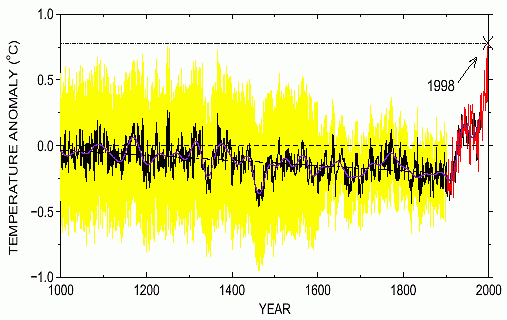
We've known for a while about studies demonstrating significant shortcomings in the use of tree-ring data to infer historical climate information. Now University of Pennsylvania researchers Brent Helliker and Suzanna Richter have published a study in the British journal Nature that seems to drive another nail into the coffin of the methodology that was supposedly the basis of Michael Mann's discredited "hockey stick" graph (which can be seen in the post linked above).

From a June 11 AFP article (emphasis added):
The internal temperature of leaves, whether in the tropics or a cold-clime forest, tends toward a nearly constant 21.4 degrees Celsius (71 degree Fahrenheit), reports a study released Wednesday.

It had long been assumed that actively photosynthesising leaves -- using energy from sunlight to convert carbon dioxide and water into sugar -- are nearly as cold or hot as the air around them.

The new findings not only challenge long-held precepts in plant biology, but could upend climate models that use tree rings to infer or predict past and present temperature changes.

For decades, scientists studying the impact of global warming have measured the oxygen isotope ratio in tree-rings to determine the air temperature and relative humidity of historical climates.

Oxygen atoms within water molecules evaporate more or less quickly depending on the number of neutrons they carry, and the ratio between these differently weighted atoms in tree trunk rings has been used as a measure of year-to-year fluctuations in temperatures and rainfall.

"The assumption in all of these studies was that tree leaf temperatures were equal to ambient temperatures," lead researcher Brent Helliker told AFP. "It turns out that they are not."

Oopsie.

------
Study Reference:
Helliker, Brent and Suzanna L. Richter. 2008. Subtropical to boreal convergence of tree-leaf temperatures. Nature. In press. doi:10.1038/nature07031

Friday, February 22, 2008

NOAA, in a fit of common sense, points out the blindingly obvious

The National Oceanic and Atmospheric Administration, often found in the AGW camp, made a surprising admission today:
A team of scientists have found that the economic damages from hurricanes have increased in the U.S. over time due to greater population, infrastructure, and wealth on the U.S. coastlines, and not to any spike in the number or intensity of hurricanes.
More people and more stuff on the coast? Wow, more damage!

“We found that although some decades were quieter and less damaging in the U.S. and others had more land-falling hurricanes and more damage, the economic costs of land-falling hurricanes have steadily increased over time,” said Chris Landsea, one of the researchers as well as the science and operations officer at NOAA’s National Hurricane Center in Miami. “There is nothing in the U.S. hurricane damage record that indicates global warming has caused a significant increase in destruction along our coasts.”

In a newly published paper in Natural Hazards Review, the researchers also found that economic hurricane damage in the U.S. has been doubling every 10 to 15 years. If more people continue to move to the hurricane-prone coastline, future economic hurricane losses may be far greater than previously thought.

Al Gore, call your office.

Tuesday, January 29, 2008

Study: Tree ring data has significant shortcomings as climate proxy

Abstract from Loehle, C. 2007. A 2000-year global temperature reconstruction based on non-treering proxies. Energy & Environment 18(7-8): 1049-1058; and Loehle, C., and J.H. McCulloch. 2008: Correction to: A 2000-year global temperature reconstruction based on non-treering proxies. Energy & Environment 19(1): 93-100 (emphasis added):
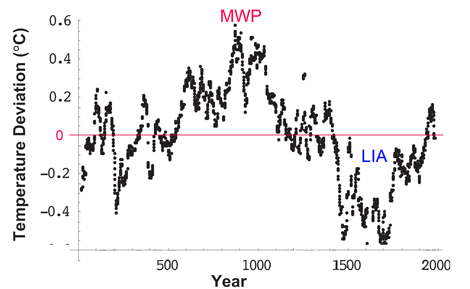
Historical data provide a baseline for judging how anomalous recent temperature changes are and for assessing the degree to which organisms are likely to be adversely affected by current or future warming. Climate histories are commonly reconstructed from a variety of sources, including ice cores, tree rings, and sediment. Tree-ring data, being the most abundant for recent centuries, tend to dominate reconstructions. There are reasons to believe that tree ring data may not properly capture long-term climate changes. In this study, eighteen 2000-year-long series were obtained that were not based on tree ring data. Data in each series were smoothed with a 30-year running mean. All data were then converted to anomalies by subtracting the mean of each series from that series. The overall mean series was then computed by simple averaging. The mean time series shows quite coherent structure. The mean series shows the Medieval Warm Period (MWP) and Little Ice Age (LIA) quite clearly, with the MWP being approximately 0.3°C warmer than 20th century values at these eighteen sites.
The study can be downloaded here.

The first graph below (found here), adapted from the Loehle paper, deviates significantly from the tree-ring-based "hockey stick" graph (second below, found here) of Mann, et al., and thus is likely to be declared heterodox and anathema by the CoGW.


Friday, July 20, 2007

Martin Durkin, the Salman Rushdie of the AGW debate

Martin Durkin recently created a documentary called The Great Global Warming Swindle, intended to be "the definitive response to Al Gore's An Inconvenient Truth". The film, first broadcast on Britain's Channel 4 in March, definitely appears to have struck a nerve among the CoGW faithful -- not quite to the point that they have actually issued a fatwa calling for his head, but it almost seems that way at times, given the vigorous reaction wherever it is shown.

When it was broadcast last week on Australia's ABC, the network felt compelled to inoculate the viewers against the arguments made in the film. Here is how Durkin himself described the situation in a July 21 Australian essay:
I wasn't shocked that the film was attacked on the same night it was broadcast on ABC television last week, although I was impressed at the vehemence of the attack. I was more surprised, and delighted, by the response of the Australian public.

The ABC studio assault, led by Tony Jones, was so vitriolic it appears to have backfired. We have been inundated with messages of support, and the ABC, I am told, has been flooded with complaints. I have been trying to understand why.

[...] I think viewers may also have wondered (reasonably) why the theory of global warming has not been subjected to this barrage of critical scrutiny by the media. After all, it's the theory of global warming, not my foolish little film, that is turning public and corporate policy on its head.

The apparent unwillingness of Jones and others at the ABC to give airtime to a counterargument, the tactics used to minimise the ostensible damage done by the film, the evident animosity towards those who questioned global warming: all of this served to give viewers a glimpse of what it was like for scientists who dared to disagree with the hallowed doctrine.

The final sentence above raises an important point. There are many, many competent scientists out there who strongly disagree with the AGW orthodoxy, but who are unwilling to cooperate in the trashing of their reputation by mouthpieces of the CoGW.

Durkin goes on to speculate on why the AGW faithful are so zealous for their cause:
After a year of arguing with people about this, I am convinced that it's because global warming is first and foremost a political theory. It is an expression of a whole middle-class political world view. This view is summed up in the oft-repeated phrase "we consume too much". I have also come to the conclusion that this is code for "they consume too much". People who believe it tend also to think that exotic foreign places are being ruined because vulgar oiks can afford to go there in significant numbers, they hate plastic toys from factories and prefer wooden ones from craftsmen, and so on.

All this backward-looking bigotry has found perfect expression in the idea of man-made climate disaster. It has cohered a bunch of disparate reactionary prejudices (anti-car, anti-supermarkets, anti-globalisation) into a single unquestionable truth and cause. So when you have a dig at global warming, you commit a grievous breach of social etiquette. Among the chattering classes you're a leper.

I agree -- AGW appears to be the ideal vehicle (ironically, a high-emissions vehicle) to advance the various aspects of the environmental/marxist left's agenda, all in one tidy package.

Three cheers to Martin Durkin for refusing to run for cover, even in the face of withering counterattacks.

The film will be available on DVD soon, but it can also be seen online here, among many other places.

Thursday, June 21, 2007

The answer is blowing in the (solar) wind

What if it has all been a great big misunderstanding?

What if the AGW scare turned out to be nothing more than mass hysteria driven by leftist environmental zealots, aided and abetted by scientists whose computer simulations led them to the mistaken conclusion that they understood the infinitely complex machinations of our atmosphere and oceans?

What if, despite the ad nauseam claims of the CoGW, climate change really is a natural phenomenon not driven in any way by atmospheric CO2 concentrations?

Dr. Tim Patterson of Carleton University in Canada is among the ever-increasing number of qualified scientists giving the lie to the notion that a consensus exists regarding climate change.

In 2001 Patterson brought a research team to a British Columbia fjord on a government-funded mission to determine why fish populations varied wildly from year to year. Neither the Canadian government nor Patterson's team were thinking about anthropogenic climate change when this project was initiated. The government, in true form, was simply interested in doing a better job of regulating the fishing industry.

As part of their research, Patterson's team took mud core samples from the stillwater bottom of the fjord. The cores contained sediment from about 5,000 years of the fjord's history, and as the team analyzed the core data, they unexpectedly came across information that may help us better understand what's really going on with our climate today. As Dr. Patterson related in a June 20 article in the Financial Post:
Clearly visible in our mud cores are annual changes that record the different seasons: corresponding to the cool, rainy winter seasons, we see dark layers composed mostly of dirt washed into the fjord from the land; in the warm summer months we see abundant fossilized fish scales and diatoms (the most common form of phytoplankton, or single-celled ocean plants) that have fallen to the fjord floor from nutrient-rich surface waters. In years when warm summers dominated climate in the region, we clearly see far thicker layers of diatoms and fish scales than we do in cooler years. Ours is one of the highest-quality climate records available anywhere today and in it we see obvious confirmation that natural climate change can be dramatic. For example, in the middle of a 62-year slice of the record at about 4,400 years ago, there was a shift in climate in only a couple of seasons from warm, dry and sunny conditions to one that was mostly cold and rainy for several decades.
It's clear from Patterson's mud core data that the climate can "flip" quite rapidly, without any help from us.

That's all well and good, but the mud core data had another story to tell that flies directly in the face of what Dr. James Hansen, Al Gore, etc. have been preaching: the climate changes recorded in the 5,000 years of sediment correlate very strongly with the increases and decreases of output from our sun. Patterson notes that his findings corroborate those of "hundreds of other studies" conducted around the world.

However, as Patterson notes, solar output doesn't tell the whole story. Mr. Sun needs a little help to effect the kinds of climate change we've experienced in our planet's history, and CO2 didn't get the job:
Despite this clear and repeated correlation, the measured variations in incoming solar energy were, on their own, not sufficient to cause the climate changes we have observed in our proxies. In addition, even though the sun is brighter now than at any time in the past 8,000 years, the increase in direct solar input is not calculated to be sufficient to cause the past century's modest warming on its own. There had to be an amplifier of some sort for the sun to be a primary driver of climate change.

Indeed, that is precisely what has been discovered. In a series of groundbreaking scientific papers starting in 2002, Veizer, Shaviv, Carslaw, and most recently Svensmark et al., have collectively demonstrated that as the output of the sun varies, and with it, our star's protective solar wind, varying amounts of galactic cosmic rays from deep space are able to enter our solar system and penetrate the Earth's atmosphere. These cosmic rays enhance cloud formation which, overall, has a cooling effect on the planet. When the sun's energy output is greater, not only does the Earth warm slightly due to direct solar heating, but the stronger solar wind generated during these "high sun" periods blocks many of the cosmic rays from entering our atmosphere. Cloud cover decreases and the Earth warms still more.

The opposite occurs when the sun is less bright. More cosmic rays are able to get through to Earth's atmosphere, more clouds form, and the planet cools more than would otherwise be the case due to direct solar effects alone. This is precisely what happened from the middle of the 17th century into the early 18th century, when the solar energy input to our atmosphere, as indicated by the number of sunspots, was at a minimum and the planet was stuck in the Little Ice Age. These new findings suggest that changes in the output of the sun caused the most recent climate change.
In other words, Dr. Patterson's research supports the idea that as solar output varies, so does the amount of cosmic radiation reaching the earth. Weaker solar output means more cosmic radiation, leading to more cloud cover, leading to a cooler earth. Stronger solar output means less cosmic radiation, leading to less cloud cover, leading to a warmer earth.

In case the implications for the current non-debate debate aren't abundantly clear, Patterson adds:
By comparison, CO2 variations show little correlation with our planet's climate on long, medium and even short time scales.
If you want to know what is driving the changes in our climate, don't look to the sky -- look beyond the sky.

Patterson closes by relating another profound implication of his research which is sure to be completely ignored:
Solar scientists predict that, by 2020, the sun will be starting into its weakest Schwabe solar cycle of the past two centuries, likely leading to unusually cool conditions on Earth. Beginning to plan for adaptation to such a cool period, one which may continue well beyond one 11-year cycle, as did the Little Ice Age, should be a priority for governments. It is global cooling, not warming, that is the major climate threat to the world, especially Canada.

Tuesday, June 12, 2007

CoGW caught lying about Kilimanjaro's disappearing icecap

One of the reasons the AGW hysteria has advanced as far as it has is the fact that CoGW adherents are very skilled at promoting false interpretations of verifiable facts.

For example, Al Gore (in An Inconvenient Truth) and others have frequently pointed to the disappearing icecap of Tanzania's Mount Kilimanjaro as proof positive of AGW.

While the icecap is indeed disappearing, this fact has nothing to do with global warming, anthropogenic or otherwise, as reported in this June 12 Reuters article:
The snows of Mount Kilimanjaro in Tanzania have been diminishing for more than a century but probably not due to global warming, researchers report.

While the retreat of glaciers and mountaintop ice in the mid-latitudes -- where much of the world's human population lives -- is definitely linked to global climate change, the same cannot be said of Kilimanjaro, the researchers wrote in the July-August edition of American Scientist magazine.

Kilimanjaro's icy top, which provided the title for an iconic short story by Ernest Hemingway, has been waning for more than a century, according to Philip Mote of the University of Washington in the United States and Georg Kaser of the University of Innsbruck in Austria.

Most of the retreat occurred before 1953, nearly two decades before any conclusive evidence of atmospheric warming was available, they wrote.

"It is certainly possible that the icecap has come and gone many times over hundreds of thousands of years," Mote, a climatologist, said in a statement.
The temperature atop Kilimanjaro never rises above freezing, so there is no chance for the icecap to melt. Instead, the snow is sublimating -- evaporating without first melting. This is due to increased solar irradiance (combined, I presume, with lower humidity).

Reuters is careful to throw in a YeahBut to hold on to the faithful:
"But for temperate glaciers, there is ample evidence that they are shrinking, in part because of warming from greenhouse gases."

Somehow, the credibility of Al Gore and the other saints of the CoGW never suffers when one after another of their claims proves to be false. Either they're lying, or they have no idea what they're talking about -- in either case a sane world would pay no attention to them.

Tuesday, June 5, 2007

More lying with statistics -- Is today's atmospheric CO2 level unusual?

Has the average CO2 level been rising steadily since the beginning of the Industrial Revolution?

No, according to Dr. Tim Ball and Tom Harris, writing May 14 in the Canada Free Press. If you wish to lie using statistics, rule number one is: Choose your data points carefully.
While Antarctic ice core records supposedly 'prove' a significant increase in CO2 in this period, there are serious problems with this data. Besides the fact that ice bubbles take about 80 years to form and so cannot give a single year accurate measure, the continual freezing, refreezing and pressurization of ice columns may greatly alter the original composition of the air trapped in the bubbles. Nevertheless, the UN's Intergovernmental Panel on Climate Change (IPCC) and many others have accepted as meaningful the ice core results that indicate a pre-industrial CO2 level of 280 parts per million (ppm), in comparison with today's 385 ppm.

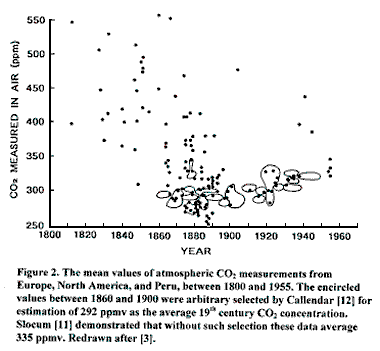
The most accurate way to determine the atmosphere's average CO2 content is to simply conduct a direct chemical analysis at many different places and times. Fortunately, there are more than 90,000 direct measurements by chemical methods between 1857 and 1957. However, in what appears to be a case of 'cherry-picking' data to fit a pre-determined conclusion, only the lower level CO2 data were included when the pre-industrial average was calculated (see below graph where data used in the averaging is highlighted). This is the average that was used to supposedly 'validate' the long term ice core records on which Al Gore and others depend.

[...] In a new scientific paper in the journal Energy and Environment, German researcher Ernst-Georg Beck, shows that the pre-industrial level is some 50 ppm higher than the level used by computer models that produce all future climate predictions. Completely at odds with the smoothly increasing levels found in the ice core records, Beck concludes, "Since 1812, the CO2 concentration in northern hemispheric air has fluctuated, exhibiting three high level maxima around 1825, 1857 and 1942, the latter showing more than 400 ppm."

In a paper submitted to US Senate Committee hearings, Polish Professor Zbigniew Jaworowski, a veteran mountaineer who has excavated ice from 17 glaciers on six continents, stated bluntly, "The basis of most of the IPCC conclusions on anthropogenic [human] causes and on projections of climatic change is the assumption of low level of CO2 in the pre-industrial atmosphere. This assumption, based on glaciological studies, is false."
The CO2 claim appears to be another con from our friends who fooled so many with the infamous "hockey stick" temperature graph (which purported to show a recent spike after centuries of stable temperatures).

As the authors note, the reason claims like this are accepted without question is that questions are not allowed. Nevertheless, scientists who love truth more than research grants should make sure their voices are heard.

Graph source

Monday, June 4, 2007

There is no scientific consensus on climate change

Lawrence Solomon of the Financial Post (Canada) is writing an ongoing series called The Deniers, profiles of top-level, respected scientists who reject the findings of the UN's IPCC and who think the Kyoto Protocol is a dangerously silly idea.

Although Solomon began his series as someone who believed firmly the claim that a scientific consensus existed on climate change, he has long since abandoned that position.
Certainly there is no consensus at the very top echelons of scientists -- the ranks from which I have been drawing my subjects -- and certainly there is no consensus among astrophysicists and other solar scientists, several of whom I have profiled. If anything, the majority view among these subsets of the scientific community may run in the opposite direction. Not only do most of my interviewees either discount or disparage the conventional wisdom as represented by the IPCC, many say their peers generally consider it to have little or no credibility. In one case, a top scientist told me that, to his knowledge, no respected scientist in his field accepts the IPCC position.
Well then, who are these mystery scientists that form this consensus? Solomon has been having trouble getting an answer to that question, and has in fact found that the IPCC has no intention of honestly reporting who truly supports its conclusions:

What of the one claim that we hear over and over again, that 2,000 or 2,500 of the world's top scientists endorse the IPCC position? I asked the IPCC for their names, to gauge their views. "The 2,500 or so scientists you are referring to are reviewers from countries all over the world," the IPCC Secretariat responded. "The list with their names and contacts will be attached to future IPCC publications, which will hopefully be on-line in the second half of 2007."

An IPCC reviewer does not assess the IPCC's comprehensive findings. He might only review one small part of one study that later becomes one small input to the published IPCC report. Far from endorsing the IPCC reports, some reviewers, offended at what they considered a sham review process, have demanded that the IPCC remove their names from the list of reviewers. One even threatened legal action when the IPCC refused.

Here are links to the articles Solomon has presented so far in his series:
Statistics needed -- The Deniers Part I
Warming is real -- and has benefits -- The Deniers Part II
The hurricane expert who stood up to UN junk science -- The Deniers Part III
Polar scientists on thin ice -- The Deniers Part IV
The original denier: into the cold -- The Deniers Part V
The sun moves climate change -- The Deniers Part VI
Will the sun cool us? -- The Deniers Part VII
The limits of predictability -- The Deniers Part VIII
Look to Mars for the truth on global warming -- The Deniers Part IX
Limited role for C02 -- the Deniers Part X
End the chill -- The Deniers Part XI
Clouded research -- The Deniers Part XII
Allegre's second thoughts -- The Deniers XIII
The heat's in the sun -- The Deniers XIV
Unsettled Science -- The Deniers XV
Bitten by the IPCC -- The Deniers XVI
Little ice age is still within us -- The Deniers XVII
Fighting climate 'fluff' -- The Deniers XVIII

Science, not politics -- The Deniers XIX
Gore's guru disagreed -- The Deniers XX
The ice-core man -- The Deniers XXI
Some restraint in Rome -- The Deniers XXII
Discounting logic -- The Deniers XXIII
Al Gore, be a man and explain why you claim a consensus for your view when the evidence says otherwise.

Thursday, May 24, 2007

Study strongly discredits AGW-Hurricane link

Reuters reports on a study that reaffirms an observation that was already well-known in the tropical meteorology community prior to the current AGW hysteria: while Atlantic surface temperatures are important, Atlantic hurricane formation and intensity are driven more by the Pacific's El Niño/Southern Oscillation (ENSO) phenomenon. Note in this article excerpt that its author still holds fast to the basic tenets of CoGW orthodoxy even while reporting on a study that discredits one of the many AGW alarmist talking points of recent years (especially post-Katrina).
Hurricanes over the past 5,000 years appear to have been controlled more by El Nino and an African monsoon than warm sea surface temperatures, such as those caused by global warming, researchers said Wednesday.

The study, published in the journal Nature, adds to the debate on whether seas warmed by greenhouse gas emissions lead to more hurricanes, such as those that bashed the Gulf of Mexico in 2005.

Some researchers say warmer seas appear to have contributed to more intense hurricanes, while others disagree. The U.N. International Panel on Climate Change said this year it was more likely than not that humans contribute to a trend of increasingly intense hurricanes.

Frequent strong hurricanes thrived in the Western Atlantic during times of weak El Ninos, or warming of surface waters of the Eastern Pacific Ocean, and strong West African monsoons even when local seas were cooler than now, the study said.

"Tropical sea surface temperatures as warm as at present are apparently not a requisite condition for increased intense hurricane activity," Jeffrey Donnelly, the lead author and researcher at the Woods Hole Oceanographic Institution, said in the study.

Intense hurricanes made landfall during the latter half of the Little Ice Age, a period of cooling that occurred approximately from the 14th to mid-19th centuries, he said.

Note the phrase "seas warmed by greenhouse gas emissions" in the second paragraph. Are Atlantic surface temperatures warmer than they were 50 years ago? 20 years ago? I actually don't know the answer to that question, and I welcome any information that you, dear reader, can provide.

If there has been warming, what is the source of the warming? Remember, the CoGW has conditioned us to assume AGW whenever some anomaly is observed in nature, but such an approach is scientifically lacking. Of course, this knee-jerk response also assumes that actual atmospheric warming has occurred, and to an extent that it would affect ocean surface temperatures. But has it? I will leave that discussion for another post.

Assuming that there has been ocean warming, could there be other causes? What about underwater volcanic activity? The Mid-Atlantic Ridge is extremely active volcanically -- can it be ruled out as a source of temperature changes?

Consider the ENSO phenomenon in the Pacific, which features the rapid cooling or warming of ocean temperatures, totally independent of the presence or absence of SUVs. Is there really nothing in the Atlantic that could possibly contribute to water temperature changes without our help?

But that's all beside the point. This study shows pretty clearly that ocean surface temperatures have little or no influence over the number or intensity of Atlantic hurricanes, regardless of the atmospheric temperatures over the ocean.

Why are we still talking about Katrina two years later? Is it the fact that it was a Category 5 hurricane? There have been other Category 5 hurricanes in the Gulf before Katrina -- such as Allen in 1980, which was much stronger at its peak than Katrina was.

No, the main fact that makes Katrina memorable is where it made landfall. Hurricane Allen came ashore at a more sparsely populated area of the Gulf coast (near Brownsville, Texas), and because the damage was relatively minor (compared with Katrina), most people don't remember it any more.

Katrina came ashore near a major city, and the strong side of the storm pummeled portions of Mississippi that had a lot of coastal development, so the visible destruction was much greater than that caused by Allen. Even so, Katrina would not have loomed so large in our memory if the retaining wall of one of New Orleans' canals had not collapsed.

So, before the 2007 hurricane season officially begins, we hear the voice of reason on what actually drives hurricane development. I think we can count on the pols and pundits to totally ignore this study when we get the first landfall this summer.

Tuesday, May 22, 2007

What makes our current climate extraordinary?

Nothing in particular, says Dr. Reid Bryson, a highly respected climatologist in Wisconsin. Here is an extended quote from the article referenced by Boortz in the previous post:

Bryson is a believer in climate change, in that he’s as quick as anyone to acknowledge that Earth’s climate has done nothing but change throughout the planet’s existence. In fact, he took that knowledge a big step further, earlier than probably anyone else. Almost 40 years ago, Bryson stood before the American Association for the Advancement of Science and presented a paper saying human activity could alter climate.

“I was laughed off the platform for saying that,” he told Wisconsin Energy Cooperative News.

In the 1960s, Bryson’s idea was widely considered a radical proposition. But nowadays things have turned almost in the opposite direction: Hardly a day passes without some authority figure claiming that whatever the climate happens to be doing, human activity must be part of the explanation. And once again, Bryson is challenging the conventional wisdom.

“Climate’s always been changing and it’s been changing rapidly at various times, and so something was making it change in the past,” he told us in an interview this past winter. “Before there were enough people to make any difference at all, two million years ago, nobody was changing the climate, yet the climate was changing, okay?”

“All this argument is the temperature going up or not, it’s absurd,” Bryson continues. “Of course it’s going up. It has gone up since the early 1800s, before the Industrial Revolution, because we’re coming out of the Little Ice Age, not because we’re putting more carbon dioxide into the air.”

Little Ice Age? That’s what chased the Vikings out of Greenland after they’d farmed there for a few hundred years during the Mediaeval Warm Period, an earlier run of a few centuries when the planet was very likely warmer than it is now, without any help from industrial activity in making it that way. What’s called “proxy evidence”—assorted clues extrapolated from marine sediment cores, pollen specimens, and tree-ring data—helps reconstruct the climate in those times before instrumental temperature records existed.

We ask about that evidence, but Bryson says it’s second-tier stuff. “Don’t talk about proxies,” he says. “We have written evidence, eyeball evidence. When Eric the Red went to Greenland, how did he get there? It’s all written down.”

Bryson describes the navigational instructions provided for Norse mariners making their way from Europe to their settlements in Greenland. The place was named for a reason: The Norse farmed there from the 10th century to the 13th, a somewhat longer period than the United States has existed. But around 1200 the mariners’ instructions changed in a big way. Ice became a major navigational reference. Today, old Viking farmsteads are covered by glaciers.

Bryson mentions the retreat of Alpine glaciers, common grist for current headlines. “What do they find when the ice sheets retreat, in the Alps?”

We recall the two-year-old report saying a mature forest and agricultural water-management structures had been discovered emerging from the ice, seeing sunlight for the first time in thousands of years. Bryson interrupts excitedly.

“A silver mine! The guys had stacked up their tools because they were going to be back the next spring to mine more silver, only the snow never went,” he says. “There used to be less ice than now. It’s just getting back to normal.”