Thursday, May 31, 2007

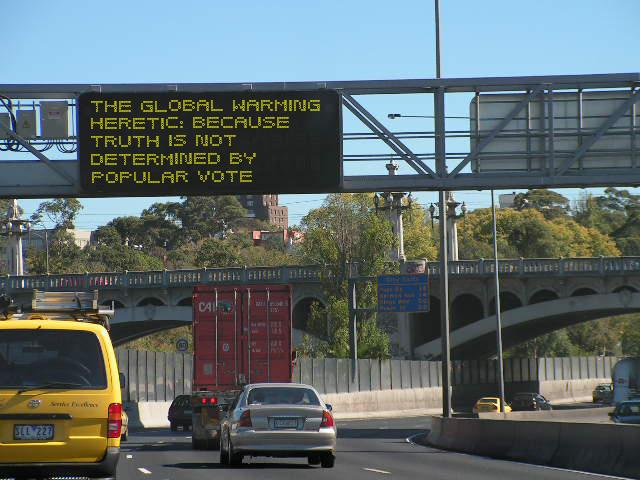
NASA Administrator outs himself as a heretic

In an NPR interview broadcast this morning, NASA Administrator Dr. Michael Griffin makes an excellent point that I think the AGW alarmists should be required to answer:
STEVE INSKEEP: One thing that's been mentioned that NASA is perhaps not spending as much money as it could on is studying climate change, global warming, from space. Are you concerned about global warming?

MICHAEL GRIFFIN: I am aware that global warming -- I'm aware that global warming exists. I understand that the bulk of scientific evidence accumulated supports the claim that we've had about a one degree centigrade rise in temperature over the last century to within an accuracy of 20 percent. I'm also aware of recent findings that appear to have nailed down -- pretty well nailed down the conclusion that much of that is manmade. Whether that is a long term concern or not, I can't say.

MR. INSKEEP : And I just wanted to make sure that I'm clear. Do you have any doubt that this is a problem that mankind has to wrestle with?

MR. GRIFFIN: I have no doubt that global -- that a trend of global warming exists. I am not sure that it is fair to say that it is a problem we must wrestle with. To assume that it is a problem is to assume that the state of earth's climate today is the optimal climate, the best climate that we could have or ever have had and that we need to take steps to make sure that it doesn't change. First of all, I don't think it's within the power of human beings to assure that the climate does not change, as millions of years of history have shown, and second of all, I guess I would ask which human beings - where and when - are to be accorded the privilege of deciding that this particular climate that we have right here today, right now is the best climate for all other human beings. I think that's a rather arrogant position for people to take.
Very well said. What do you think of your boss' comments, Dr. Hansen?

UPDATE: Here's Dr. Griffin's bio, just in case you're tempted to write him off as a scientifically illiterate bureaucrat.

Wednesday, May 30, 2007

If only we could link ALL federal subsidies to AGW

WaPo editorial, May 30:
CONVENTIONAL wisdom holds that support for clamping down on greenhouse gas emissions has reached a tipping point. With gasoline prices above $3 a gallon and only a rump of hard-core skeptics still questioning the science of global warming, the time seems ripe to begin weaning the country off carbon.
...as if these "hard-core skeptics" were closing their eyes, clamping their hands on their ears, and yelling "la la la la la la...." in the face of evidence that is so overwhelming, anyone who questions it should have their head examined.

Okay, that was a little over the top, but I'm getting a little tired of the mantra that stubbornness is the only reason the skeptics haven't switched over to the Light Side. There is a credible scientific argument to be made that the anthropogenic nature of climate change hasn't been demonstrated -- not that the WaPo editors would listen.

That said, the actual topic of the editorial is something that draws a hearty Amen from me:
But as The Post's Steven Mufson reported recently, an outdated federal program that provides cheap financing to rural power plants will undercut all of these efforts. The Agriculture Department's Rural Utilities Service gives low-interest loans and loan guarantees to rural electric cooperatives, nonprofit outfits designed to generate or transport electricity to rural areas of the country. With coal abundant and cheap, and without the tax incentives for clean electricity that are given to other utilities, such co-ops have little reason to invest in alternative sources of energy. Consequently, they get about 80 percent of their electricity from burning coal, a process that releases liberal amounts of greenhouse gases into the atmosphere. Worse yet, federally subsidized cooperatives plan to spend $35 billion over the next 10 years building more coal-fired power plants.
The constitutionalist side of me cheers whenever one of the media organs of the left proposes ending an unconstitutional federal subsidy, even if their reason for doing so is shaky.

Never mind the gospel... this is IMPORTANT

Brian McLaren, a heretic of another sort, had this to say at the Festival of Homiletics in Nashville last week regarding the Christian preacher's imperative (emphasis added):

In his lecture at First Baptist Church, McLaren proposed that preaching should remedy, rather than incite, controversial issues.

These include poverty and climate change, and he encouraged his audience not to shy away from such global issues.

"We can't really afford to waste too many Sundays with so much at stake," he said.

Tuesday, May 29, 2007

Well, if it's THAT easy for us to control the temperature...

Another little detail caught my eye in the Reuters article that I excerpted in the last post:
Germany wants the leaders of the G8 along with India, China, Brazil, Mexico and South Africa at their summit from June 6-8 to agree to limit the temperature rise to two degrees this century and to cut emissions by 50 percent from 1990 levels by 2050.
"Limit the temperature rise to two degrees this century"?? How can possibly we effect a temperature outcome?

What if it turns out that solar activity is the real culprit in climate change after all (like it has been in every other warming and cooling event in the earth's history)? It won't matter. Any country that signs on to a temperature outcome makes itself liable if the temperature exceeds the target, regardless of the actual reason for the increase.

How AGW serves the goals of the socialist left

Many have opined that when the Soviet Union fell, homeless socialists eventually ended up in the environmental movement. It is certainly evident that the environmentalist left has been decidedly anticapitalist in its sympathies.

Perhaps nowhere has this tendency been more evident than in the manufactured AGW crisis. Observe carefully, and I think you'll see that the vast majority of remedies proposed involve the economic dismantling of the countries that were allied against the advance of Soviet communism. Absent an economic rollback, "Plan B" appears to be the good old fashioned transfer of wealth to "developing" countries, as illustrated by this May 28 Reuters article:
Rich must pay bulk of climate change bill: Oxfam

Coping with the ravages of global warming will cost $50 billion a year, and the rich nations who caused most of the pollution must pay most of the bill, aid agency Oxfam said on Tuesday.

The call, barely 10 days before a crucial Group of Eight (G8) summit in Germany which has climate change at its core, is likely to make already tense negotiations even tougher.

The United States, which Oxfam says must foot 44 percent of the annual $50 billion bill, is rejecting attempts by German G8 presidency Germany to set stiff targets and timetables for cutting carbon gas emissions and raising energy efficiency.

"G8 countries face two obligations as they prepare for this year's summit in Germany -- to stop harming by cutting their emissions to keep global warming below two degrees Celsius and to start helping poor countries to cope," said Oxfam researcher Kate Raworth.

"Developing countries cannot and should not be expected to foot the bill for the impact of rich countries' emissions," she said, echoing the position of the developing world.

[...] Oxfam has created a global warming adaptation financing index based on the responsibility, equity and capability of each nation.

It said after the United States, Japan owed 13 percent of the bill, followed by Germany on seven percent, Britain just over five percent, Italy, France and Canada between four and five percent and Spain, Australia and Korea three percent.
The highlighted text sounds awfully like... From each according to his ability, to each according to his needs. Marx would be proud.

This Reuters article has another interesting detail in it, but I'll save it for the next post.

Monday, May 28, 2007

Debate proposition: Global Warming is Not a Crisis

The organization Intelligence2 US hosted a debate in March on the proposition: Global Warming is Not a Crisis.

Speaking for the proposition were Michael Crichton, Richard S. Lindzen and Philip Stott. Speaking against the proposition were Brenda Ekwurzel, Gavin Schmidt and Richard C.J. Somerville.

Crichton has spoken eloquently in the past about the absurdity of consensus-driven science; I will likely devote a separate post to his arguments. Of the others, I know of Lindzen of MIT, one of the more prominent AGW heretics in the scientific community. I don't know Brenda Ekwurzel, but I have definitely heard of her employer, the Union of Concerned Scientists -- supposedly impartial, but actually an agenda-driven front for the environmental left. I have only recently become aware of Schmidt's website, RealClimate.org; I will withhold comment on that site until I've had a chance to investigate it more fully.

The debate was held before a live audience in New York City. Prior to the debate, audience opinions on the proposition were as follows:
For: 30%
Against: 57%
Not Sure: 13%
After the debate, debaters in favor of the proposition had clearly swayed much of the audience:
For: 46%
Against: 42%
Not Sure: 12%
You can read the complete debate transcript (79 page PDF) here.

Of course, the opinions of laypeople do not determine truth (for that matter, neither do the opinions of scientists), but perhaps this demonstrates that the case for AGW is not the slam-dunk that its proponents would have you think.

Sunday, May 27, 2007

Trees and SUVs

Michael Hill of the Associated Press asks the logical question about carbon offsets:
If you plant some trees, is it OK to drive an Escalade?

The question isn't as silly as it sounds. People worried about global warming increasingly are trying to "offset" the carbon dioxide — the leading greenhouse gas — they spew into the atmosphere when they drive, fly or flick on a light. One idea popular with the eco-conscious is to have trees planted for them. You get to keep driving and flying, but those trees are supposed to suck in your trail of carbon.

Whole forests have been funded by tree-loving celebrities like Leonardo DiCaprio and Coldplay, and more modest packages tailored to typical consumers are proliferating.

But some researchers say planting trees — while a good thing — is at best a marginal solution to global warming. Still others decry tree planters who continue to jet off to Cannes, drive their SUVs or generally fail to reduce their fuel-hungry lifestyle. To those critics, plantings and other carbon offsets are like the medieval practice of selling indulgences to wash away sins: It may feel good, but it doesn't solve much.
While countless skeptics have pointed out the hypocrisy of the rich using offsets to assuage their conscience without needing to alter their jet-setting lifestyle, the carbon offset industry has also come under criticism from CoGW true believers -- because too many people who buy offsets believe they've done their part, that no other remedies are necessary to save the planet. In fact, tree planting is woefully inadequate as a carbon dioxide vacuum:

Maybe most importantly, some researchers say it's simply not possible to plant enough trees to have a significant effect on global warming.

Michael MacCracken, chief scientist at the nonpartisan Climate Institute in Washington, said tree-planting has value as a stopgap measure while society attempts to reduce greenhouse gases. But University of Victoria climate scientist Andrew Weaver fears tree offsets could steal the focus of a problem that requires technological advances and behavioral changes.

"The danger is that you could actually think you're solving a problem," Weaver said. "It makes you feel good. It makes you feel warm and fuzzy, like changing a couple of light bulbs. But the reality is it's not going to have a significant effect."

Hill's article also notes one other downside to planting lots of trees -- it can actually lead to more warming:
There are other potential problems, however. Some researchers suggest forests in the snowy North might actually increase local warming by absorbing sunlight that would otherwise be reflected into space. And dead, decaying trees release some of that captured carbon back into the atmosphere.
I personally have no objection to tree planting -- more power to those who do so, as long as they're wise about where they plant them. As I've mentioned before, my main target are those who set up the scheme where the rich can continue their lavish, wasteful lifestyles while preaching conservation to the rest of us.

Friday, May 25, 2007

Al Gore's fans: Do as we say, not as we do

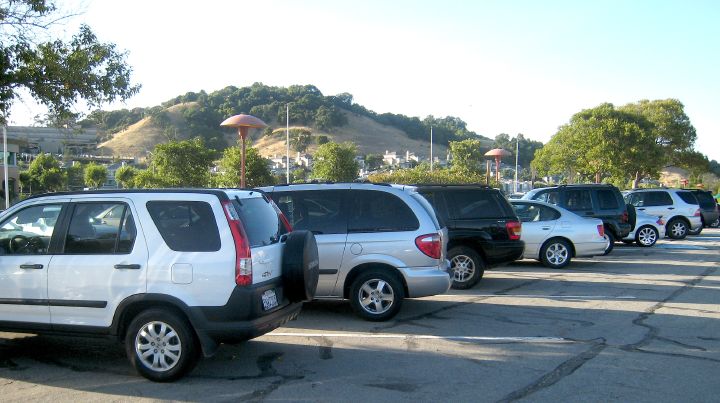
"Zombie", who loves to show up with his camera whenever leftists gather in California, went to see Al Gore at the Marin Civic Center. He has posted a photo gallery. I thought it instructive to highlight a photo of the earth-friendly vehicles driven by those who came to hang on Gore's every word:


Scroll to the bottom of the page for a little Photoshop challenge inspired by one of Zombie's outtakes.

Japan PM: Kyoto treaty's emissions goals far too modest

AP (via CNN), May 24:
The world should aim to cut greenhouse gas emissions in half by 2050 as part of a new global warming pact to succeed the Kyoto Protocol, Japanese Prime Minister Shinzo Abe said Thursday.

Abe, who plans to present his idea at the Group of Eight summit in Germany in June, said the proposed climate change treaty must be flexible enough to draw all nations' participation.

"Global warming is an issue that should be addressed by the entire world," Abe said at a banquet in Tokyo. "It is indispensable to establish a new framework in which both industrialized and developing countries address this issue together."

The Kyoto Protocol, signed in Japan in 1997, requires some 35 industrialized nations to cut greenhouse gas emissions 5 percent from 1990 levels by 2012. Under the pact, Japan -- home to the world's second-largest economy -- was required to make a 6 percent cut.

How is Japan itself doing on the comparatively modest goals of the Kyoto treaty? Later in the article we learn:
Japan is struggling to meet its Kyoto commitments. The country currently emits 14 percent more greenhouse gases than it did in 1990. The government plans a major overhaul of its emissions reduction campaign to meet its targets.
Japan can't meet its Kyoto commitments, but its PM envisions the noble goal of halving emissions by 2050. From which year's levels? And at what cost?
Delegates from 120 countries endorsed a report earlier this year, stating the world has the technology and wealth now to act decisively in time to limit a sharp temperature rise that would wipe out species, raise oceans and trigger economic havoc.
Pure speculation, of course, from predictions of a "sharp temperature rise" all the way to predictions of "economic havoc". It doesn't take much imagination, however, to predict the economic havoc that would follow a 50% reduction in emissions.

China blames extreme weather events on 'climate change'

AFP (via Yahoo News), May 25:
China hit by deadly flooding, severe drought

Torrential rain in southwest China triggered flash floods and mudslides that have left 21 dead, while a neighbouring region is suffering its worst drought in 60 years, state media reported Friday.

[...] More than 360 people have been hurt and 112,000 evacuated in the disasters in a region that only last year endured its worst drought in half a century.

Meanwhile, more than 1.6 million people in Gansu province to the north face drinking water shortages due to the worst drought there since the 1940s.

[...] China last year suffered a range of extreme weather events including exceptionally strong typhoons, floods, and droughts, which meteorological officials have partly attributed to the affects of climate change.
On what basis do officials conclude that any extreme weather event (or collection of events) can be attributed to the "affects [sic] of climate change"? We see from the article itself that the drought conditions in the stated regions are not unprecedented, merely uncommon. Deadly floods are certainly not rare in China either.

As we saw in a previous post, there is also nothing unusual about the intensity of modern hurricanes and typhoons -- most important is where they hit.

All of that matters little, because the attitude presented by pundits and politicians around the world is: if it's the least bit anomalous, of course it's due to AGW.

Aside: Syndication options for this blog

For those who prefer not to check the blog every day for new posts, I have included two syndication options on the side bar, under the Subscribe Now heading:
  • "Add to your newsreader"
  • "Headlines via e-mail"
The second option will send you a daily e-mail with the titles and first few lines of the most recent posts, along with links to the articles if you wish to view them in full.

Thursday, May 24, 2007

Answering the hypocrisy and fraud of carbon offsets

The devil...the prowde spirit...cannot endure to be mocked.
-- Thomas More
...and neither can many True Believers in the CoGW. It seems clear that carbon offsets/credits function much the same way as indulgences did at the time of Martin Luther. By offering a get-out-of-Purgatory card (for a small fee), indulgence sellers allowed the sinner's conscience to be salved, thus enabling the offending behavior to continue (or even increase).

In the case of carbon offsets, offset sellers allow your conscience to be eased based on the promise that someone, somewhere, is scaling back their trashing of the planet so that your excesses can continue. As we have already seen, such a setup is tailor-made for corruption.

So, how to respond to such a ridiculous idea? With ridicule, of course. In the past couple of weeks I have become aware of a couple of ideas that quickly illustrate the absurdity of the concept:

(1) Free Carbon Offsets -- If there's likely to be no actual corresponding reduction in carbon-producing activity in exchange for your carbon offset, why pay for it? Just declare the desired number of offsets, and go on your merry way. You even get a framable certificate. The website owners make vague promises of what will happen based on the number of offsets you declare:
There are several steps we will take to do our part to help the environment, based on your level of participation:
  • 1-100 offsets: We will try our hardest to turn off the water for an extra ten seconds while we brush our teeth.
  • 101-1000 offsets: We will think about possibly using one less square of toilet paper every time we use the rest room. So you don't have to!
  • 1001-10000 offsets: At this level, we will think about not going out to lunch for one day. Gas savings, plus savings on one less burger made that day!
  • 10000+ offsets: Premium offsets. We will consider not taking a shower for a whole week!
Thanks for the referral, Al! (Not related to Famous Al Gore)

(2) CarbonCreditKillers -- Their goal is to offset every carbon credit with a carbon debit. For every carbon debit purchased (no, it's not free), they will send you a T-shirt and grind up a living tree in your name. Additional upgrade packages are also available.

The first idea is definitely more to my taste than the second one, since I don't think it's cool to actually destroy trees just to make a political point.

Aside re: your comments

Blogger is supposed to inform me when a comment is awaiting approval, but Blogger appears to be asleep at the switch. So, if you submit a comment, please be patient. I will try to remember to check for new comments at least once per day, but it would be nice if Blogger did what it was supposed to do!

Study strongly discredits AGW-Hurricane link

Reuters reports on a study that reaffirms an observation that was already well-known in the tropical meteorology community prior to the current AGW hysteria: while Atlantic surface temperatures are important, Atlantic hurricane formation and intensity are driven more by the Pacific's El NiƱo/Southern Oscillation (ENSO) phenomenon. Note in this article excerpt that its author still holds fast to the basic tenets of CoGW orthodoxy even while reporting on a study that discredits one of the many AGW alarmist talking points of recent years (especially post-Katrina).
Hurricanes over the past 5,000 years appear to have been controlled more by El Nino and an African monsoon than warm sea surface temperatures, such as those caused by global warming, researchers said Wednesday.

The study, published in the journal Nature, adds to the debate on whether seas warmed by greenhouse gas emissions lead to more hurricanes, such as those that bashed the Gulf of Mexico in 2005.

Some researchers say warmer seas appear to have contributed to more intense hurricanes, while others disagree. The U.N. International Panel on Climate Change said this year it was more likely than not that humans contribute to a trend of increasingly intense hurricanes.

Frequent strong hurricanes thrived in the Western Atlantic during times of weak El Ninos, or warming of surface waters of the Eastern Pacific Ocean, and strong West African monsoons even when local seas were cooler than now, the study said.

"Tropical sea surface temperatures as warm as at present are apparently not a requisite condition for increased intense hurricane activity," Jeffrey Donnelly, the lead author and researcher at the Woods Hole Oceanographic Institution, said in the study.

Intense hurricanes made landfall during the latter half of the Little Ice Age, a period of cooling that occurred approximately from the 14th to mid-19th centuries, he said.

Note the phrase "seas warmed by greenhouse gas emissions" in the second paragraph. Are Atlantic surface temperatures warmer than they were 50 years ago? 20 years ago? I actually don't know the answer to that question, and I welcome any information that you, dear reader, can provide.

If there has been warming, what is the source of the warming? Remember, the CoGW has conditioned us to assume AGW whenever some anomaly is observed in nature, but such an approach is scientifically lacking. Of course, this knee-jerk response also assumes that actual atmospheric warming has occurred, and to an extent that it would affect ocean surface temperatures. But has it? I will leave that discussion for another post.

Assuming that there has been ocean warming, could there be other causes? What about underwater volcanic activity? The Mid-Atlantic Ridge is extremely active volcanically -- can it be ruled out as a source of temperature changes?

Consider the ENSO phenomenon in the Pacific, which features the rapid cooling or warming of ocean temperatures, totally independent of the presence or absence of SUVs. Is there really nothing in the Atlantic that could possibly contribute to water temperature changes without our help?

But that's all beside the point. This study shows pretty clearly that ocean surface temperatures have little or no influence over the number or intensity of Atlantic hurricanes, regardless of the atmospheric temperatures over the ocean.

Why are we still talking about Katrina two years later? Is it the fact that it was a Category 5 hurricane? There have been other Category 5 hurricanes in the Gulf before Katrina -- such as Allen in 1980, which was much stronger at its peak than Katrina was.

No, the main fact that makes Katrina memorable is where it made landfall. Hurricane Allen came ashore at a more sparsely populated area of the Gulf coast (near Brownsville, Texas), and because the damage was relatively minor (compared with Katrina), most people don't remember it any more.

Katrina came ashore near a major city, and the strong side of the storm pummeled portions of Mississippi that had a lot of coastal development, so the visible destruction was much greater than that caused by Allen. Even so, Katrina would not have loomed so large in our memory if the retaining wall of one of New Orleans' canals had not collapsed.

So, before the 2007 hurricane season officially begins, we hear the voice of reason on what actually drives hurricane development. I think we can count on the pols and pundits to totally ignore this study when we get the first landfall this summer.

Wednesday, May 23, 2007

Redneck Carbon Offsets

The Travis Monitor shows that just about anything can be construed in some way as a "carbon offset". It's all in how you look at it.
I have thought about how to make the world a better place, and determined that there are a number of things we can do to save the environment, all while living the back-to-nature redneck lifestyle. All of these ideas are verified to be at least as useful as limiting one's use of toilet paper, and for a fee I will engage in these activities for those who need a eco-indulgence for tooling around in an air-conditioned Hummer listening to Sheryl Crow:
  1. Burning a pile of leaves and trash. It's well known that aerosols and particulates from dirty burning of materials cause 'global cooling' (happens after volcano eruptions). one pile of leaves is good enough to offset one 100 mile Hummer trip.
  2. Chopping down a tree and bury it. The sophisticated term for this activity is "carbon sequestration". Locking up the CO2 to become coal someday in the distant future means less CO2 in the air today. It offsets perhaps a days use of electricity.
  3. Shooting a deer. Animals and humans alike are generators of CO2, the natural counterpart to plants that soak up CO2 and emit O2. Heck, a deer could be emitting more CO2 than your car. Thus, if you accidently run over a deer on occasion, you could be said to be operating your car in a 'carbon neutral' manner.
  4. Eating a steak. The theory is that by taking out a cow you are removing a flatulent generator of GHG methane. This is of some dubious value since the cow was raised for the purpose to begin with, but it tastes too good to leave out. (I should mention that I am a member of PETA aka "People Eating Tasty Animals").
  5. Plant a tree or plants or lawn. Anything that soaks up CO2 and emits O2 can't be bad.
  6. Going without electricity for a day.
  7. Drinking a few beers. Drinking cool fluids is a lower-energy cost way to cool down compared with cranking up the A/C, thereby incrementally helping reduce overall energy consumption.
So, for a small fee, I am willing to do my part to offset your carbon emissions: I'll get up, seed my lawn, chop down and bury a tree (one of my many cedar trees that must go), go out into the woods hunting and shoot a deer, make a campfire and burn some leaves, eat a steak, drink a few beers, and live without electricity for a day.