Tuesday, February 26, 2008

A modest request to those who believe in anthropogenic "climate change"

Despite the name of this blog, some time ago many in the CoGW abandoned the exclusive use of the term "global warming" to describe current climate trends. "Climate change" is the preferred term now, since many weather events in recent years do not appear to fit the perception of what we would see on an unnaturally warming planet.

I will continue to use "Anthropogenic Global Warming" (AGW) to describe this ideology. Although atmospheric CO2 concentrations continue to increase, global temperatures have more or less plateaued in the past decade. Since the plateau occurred at a warm average temperature, we've been treated to innumerable accounts of the fact that recent years have been among the warmest in recent history. So, despite the use of the term "climate change", it's clear that proponents are invested in creating the public perception that the earth is continuing to warm (and that such warming will soon accelerate out of control).

Climate change really is a term of art, because it allows CoGW adherents to insist that all weather -- wet or dry, hot or cold -- validates the AGW orthodoxy.

Floods in China: check. Drought in China: check. More hurricanes: check. Fewer hurricanes: check. Summer ice melt in the Arctic: check. Winter refreezing of Arctic ice that exceeds that which originally melted: check. Collapse of the West Antarctica Ice Shelf: check. Net increase in Antarctic ice: check. Record warm winter in 2006-2007: check. Record cold winter in 2007-2008: check.

And so on.

This leads me to ask a question of those of you who believe that human activity is negatively and catastrophically impacting the earth's climate:

Is the anthropogenic climate change hypothesis falsifiable?

I am asking this within the context of the scientific method. Integrity demands that a scientist, when proposing a hypothesis, list the conditions whereby the hypothesis would fall apart:
We believe that this hypothesis sufficiently describes the reality we are studying, but if anybody can demonstrate any of conditions a, b, c, d or e, our hypothesis is fatally compromised and it's back to the drawing board.
So, AGW folks: can you name any condition (series of weather events, temperature trends, etc.) that would make you doubt the current orthodoxy, or are we witnessing the most bulletproof hypothesis ever?

UPDATE: After a quick Google search, I was pleased to discover that this question has already occurred to minds much greater than mine. As I composed this post earlier today, I had the folks at RealClimate in mind (among others). It turns out that Roger Pielke, Jr. tossed the following rhetorical grenade into the midst of a RealClimate discussion about how awfully cold Antarctica is right now:

There are a vast number of behaviors of the climate system that are consistent with climate model predictions, along the lines of your conclusion: “A cold Antarctica and Southern Ocean do not contradict our models of global warming.”

I have asked many times and never received an answer here: What behavior of the climate system would contradict models of global warming? Specifically what behavior of what variables over what time scales? This should be a simple question to answer.

Thanks!

The ensuing debate is pretty interesting.

Pielke followed up on the question in his own blog. The debate is pretty lively in the comment section over there as well.

(Found via: Seeker Blog)


Friday, February 22, 2008

NOAA, in a fit of common sense, points out the blindingly obvious

The National Oceanic and Atmospheric Administration, often found in the AGW camp, made a surprising admission today:
A team of scientists have found that the economic damages from hurricanes have increased in the U.S. over time due to greater population, infrastructure, and wealth on the U.S. coastlines, and not to any spike in the number or intensity of hurricanes.
More people and more stuff on the coast? Wow, more damage!

“We found that although some decades were quieter and less damaging in the U.S. and others had more land-falling hurricanes and more damage, the economic costs of land-falling hurricanes have steadily increased over time,” said Chris Landsea, one of the researchers as well as the science and operations officer at NOAA’s National Hurricane Center in Miami. “There is nothing in the U.S. hurricane damage record that indicates global warming has caused a significant increase in destruction along our coasts.”

In a newly published paper in Natural Hazards Review, the researchers also found that economic hurricane damage in the U.S. has been doubling every 10 to 15 years. If more people continue to move to the hurricane-prone coastline, future economic hurricane losses may be far greater than previously thought.

Al Gore, call your office.

Wednesday, February 13, 2008

Flex Fuel(ishness): Eco-hostile Ethanol

If you own a vehicle that depends to any extent on ethanol to run, you may want to set your latte down before reading the following from a February 7 AP article:

The widespread use of ethanol from corn could result in nearly twice the greenhouse gas emissions as the gasoline it would replace because of expected land-use changes, researchers concluded Thursday. The study challenges the rush to biofuels as a response to global warming.

The researchers said that past studies showing the benefits of ethanol in combating climate change have not taken into account almost certain changes in land use worldwide if ethanol from corn — and in the future from other feedstocks such as switchgrass — become a prized commodity.

"Using good cropland to expand biofuels will probably exacerbate global warming," concludes the study published in Science magazine.

The researchers said that farmers under economic pressure to produce biofuels will increasingly "plow up more forest or grasslands," releasing much of the carbon formerly stored in plants and soils through decomposition or fires. Globally, more grasslands and forests will be converted to growing the crops to replace the loss of grains when U.S. farmers convert land to biofuels, the study said.

The rebuttal is pretty weak:

The Renewable Fuels Association, which represents ethanol producers, called the researchers' view of land-use changes "simplistic" and said the study "fails to put the issue in context."

"Assigning the blame for rainforest deforestation and grassland conversion to agriculture solely on the renewable fuels industry ignores key factors that play a greater role," said Bob Dinneen, the association's president.

Gotta love that ethanol. Touted as an earth-friendly alternative to petroleum, instead it brings us deforestation, rising food prices, food shortages (especially in third-world countries), and lots and lots of CO2.


William Tucker writes in a February 13 American Spectator report that our country's current mentality regarding biofuels has roots going back more than 30 years:
From the beginning, the entire biofuels effort has been built on flimsy projections and dubious accounting that were seized upon by politicians eager to demonstrate they were "doing something" about energy. The whole fiasco can probably be traced to a single paragraph in Amory Lovins Soft Energy Paths, the 1976 book that inspired President Carter's embrace of "alternate energy" and convinced California Governor Jerry Brown that his state didn't need to build any more power plants. (Google "California Electrical Shortage" to see what happened there.) In one hasty brushstroke, Lovins outlined what a national biofuels industry might look like:
[E]xciting developments in the conversion of agricultural, forestry, and urban wastes to methanol and other liquid and gaseous fuels now offer practical, economically interesting technologies sufficient to run an efficient U.S. transport sector. The required scale of organic conversion can be estimated. Each year the U.S. beer and wine industry, for example, microbiologically produces 5 percent as many gallons (not all alcohol, of course) as the U.S. oil industry produces gasoline. Gasoline has 1.5 to 2 times the fuel value of alcohol per gallon. Thus a conversion industry roughly ten to fourteen times the physical scale (in gallons of fluid output per year) of U.S. cellars and breweries, albeit using different processes, would produce roughly one-third of the present gasohol requirements of the United States....The scale of effort required does not seem unreasonable.
In other words, since beer and wine were already one-twentieth the volume of our gasoline, a reasonable expansion of distilleries could supply us with one-third of our transportation needs. Unfortunately, this analysis contained a single oversight that has bedeviled biofuels ever since.

Notice that while Lovins estimated the size of the distilling industry, he never mentions the amount of land required to produce the crops. Hops and vineyards currently occupy 40 million acres of farmland. Using Lovins' figure of "roughly ten to fourteen times the scale," that gives us 480 million acres -- more than all of U.S. cropland put together.

Lovins also made a mistake. Although he mentioned that beer and wine are "not all alcohol," he forgot to factor this into the final equation. Wine is 12 percent alcohol and beer is about 5 percent, so let's take 7 percent as an average. This means we must again multiply those 480 million acres by a factor of fourteen. That leaves us with 6.5 billion acres - three times the area of the United States, including Alaska -- in order to produce one-third of our transportation fuel needs in 1977. On this fatal error was the entire U.S. ethanol industry built.
Regardless of how we got here, the news that ethanol is likely doing more harm than good is not likely to lead any time soon to a rethinking of our energy policy.

Thursday, February 7, 2008

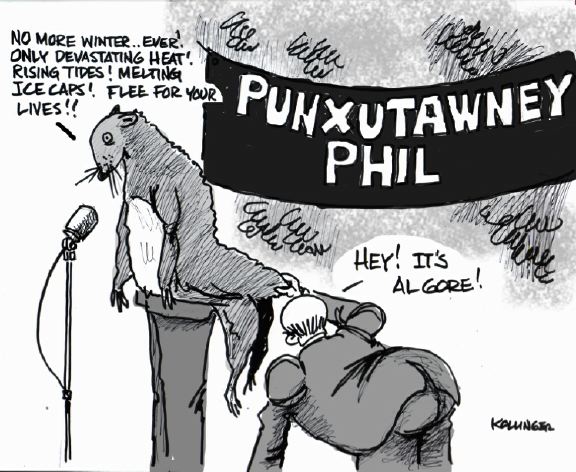
Punxsutawney Phil could be out of a job soon

Rick Kollinger:


(For those of you who don't know who Punxsutawney Phil is, you can read more here)


Groundhog Day 2009 update: A big HOWDY to all of you who arrived at this blog post via Google Image Search!

Groundhog Day 2010 update: See Groundhog Day 2009 update.

Tuesday, February 5, 2008

Allstate's prophets seek more profits in Florida

Allstate recently tried to push through a 42% premium rate increase on its Florida customers, using as its justification unscientific wild guess about future weather conditions, as this article reports:
Now we know why Allstate wanted a 42-percent increase in home insurance rates. The company is using an unapproved model that factors the growing threat of global warming.

Last month, company executives objected to a Senate subpoena. The state tried to suspend their license, and Governor Crist threatened to sue them.

Now Allstate executives said they aren't price gouging. They say they're just very concerned about climate change, and trying to make sure they keep rates in tune with the growing threat. The ocean is a hurricane's fuel tank. Warmer waters could mean more and stronger storms (though this is currently a subject of scientific debate).

"It's my professional opinion and others at Allstate, it appears that the increase in sea surface temperatures and the near term effect of hurricanes is something that is real and is a need that we need to consider for the protection of our insurers," said Allstate Floridian's Ryan Michel.

Kudos to the article writer for noting that the link between warmer waters and hurricane frequency and intensity has not been established.

Allstate's Florida customers really ought to ponder whether they really are "in good hands".

Monday, February 4, 2008

The polar bear: poster child of the environmental left

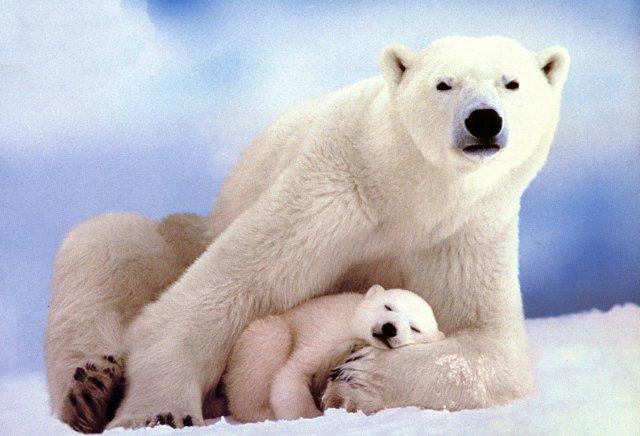
Sen. Inhofe's EPW staff has gathered a variety of scientific sources indicating that polar bears, the majestic icon of the CoGW, are not declining -- in fact, they are now near record high levels (at least double their population of half a century ago). Many of these extinction scenarios are floated using a raft of scientifically unsound assumptions.

And yet, yesterday we read this in the Los Angeles Times:
The Bush administration is nearing a decision that would officially acknowledge the environmental damage of global warming, and name its first potential victim: the polar bear.

The Interior Department may act as soon as this week on its year-old proposal to make the polar bear the first species to be listed as threatened with extinction because of melting ice due to a warming planet.
The environmental left candidly admits the importance of the polar bear as a cute, cuddly symbol of their cause:
Both sides agree that conservationists finally have the poster species they have sought to use the Endangered Species Act as a lever to force federal limits on the greenhouse gases linked to global warming, and possibly to battle smokestack industry projects far from the Arctic.

"All animals are equal, but some animals are more equal than others," said Kassie Siegel, an attorney with the nonprofit Center for Biological Diversity. "And then there is the polar bear."
Keep in mind that the decline isn't actually occurring right now. The movement to get the polar bear listed as threatened is based on what-if computer scenarios.


But what if the assumptions are wrong, and the projected warming does not occur? No matter. Once the polar bear is listed, environmental law can more easily be used as a bludgeon for The Cause. Just about any human activity can -- with appropriate logical gymnastics -- be tied to climate change, so pretty much no human activity in America would remain beyond the reach of the environmental regulators.

The Times article lists a more obvious example:
Heavy industry has reason to fear. At least one part of the environmental community believes the bear's listing would provide the leverage to stop a coal-fired power plant thousands of miles away from the Arctic.

Sen. Jim Inhofe (R-Okla.), who is known for his skepticism about global-warming measures, asked U.S. Fish and Wildlife Service Director H. Dale Hall last week whether listing the polar bear could be used to halt the construction of a new power plant in Oklahoma City.

"The Endangered Species Act is not the vehicle to reach out and demand all of the things that need to happen to address climate change," Hall said, to Inhofe's apparent satisfaction.

Andrew E. Wetzler, director of the Natural Resources Defense Council's endangered species project, said Hall misunderstands the legal principles underlying the act, which was fortified by a recent U.S. Supreme Court ruling that carbon dioxide can be regulated as a pollutant.

If the builders of a coal-fired plant needed a federal permit, they would probably have to show how its emissions would not erode the polar bear's habitat or jeopardize its survival, Wetzler said.
If the drive to get the polar bear listed succeeds, the opportunity for environmentalist mischief will be boundless.

Tuesday, January 29, 2008

Rewriting history, enshrining fallacy

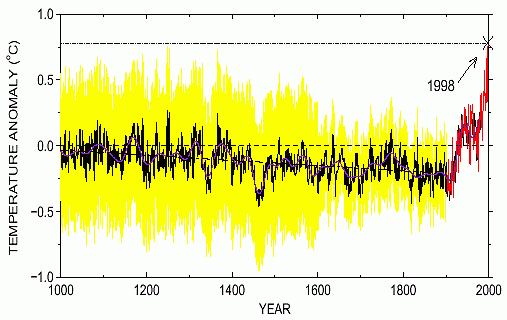
Given that 2000 years of non-tree-ring proxy data show nothing extraordinary about the warming of the past two centuries, this proposal by British scientists seems to be a bit over the top:

A HEATED scientific row is brewing as British geoscientists lead a push to establish a new chapter in the history of Earth - one based on human activity.

Led by geologist Jan Zalasiewicz, of the University of Leicester, the rabble-rousers argue that changes wrought since the Industrial Revolution 200 years ago are so profound they are now visible in the physical and living fabric of the planet.

As a result, they have called for the creation of a new Epoch in the official geological time scale, one they have named the Anthropocene.

Along with Eons, Eras, Periods and Ages, Epochs are classifications of Earth history based on characteristic changes in the layers, or strata, of rocks.

Writing in the latest issue of GSA Today, a publication of the Geological Society of America, Dr Zalasiewicz and 20 like-minded experts claim there is "sufficient evidence" of human-induced changes to plants, animals, oceans and lands to warrant recognition of the Anthropocene by the official geological time lords, the International Commission on Stratigraphy. Their proposal came at the same time as the American Geophysical Union at the weekend released its updated position on climate change.

Yes, clean energy is good, but at what cost? And who pays?

President Bush demonstrated in his State of the Union address that congressional Democrats are not the only ones capable of throwing lots of good money at a bad idea. As Reuters reports in a pre-speech article:
THE US will commit $US2 billion ($2.27 billion) over the next three years for a new international fund to promote clean energy technologies and fight climate change, President George W. Bush will tell Congress today in his annual State of the Union speech.

"Along with contributions from other countries, this fund will increase and accelerate the deployment of all forms of cleaner, more efficient technologies in developing nations like India and China, and help leverage substantial private-sector capital by making clean energy projects more financially attractive," the White House said in a fact sheet on Mr Bush's speech.
Is it wrong to "promote clean energy technologies" in developing nations? Of course not. The problem is that misguided climate alarmism produces the urgency that makes it politically acceptable to commit American taxpayer money to such endeavors.

I don't wish to dive too deeply into the American presidential race in this post, but I've got to say that the remaining candidates leave much to be desired on this issue.

Study: Tree ring data has significant shortcomings as climate proxy

Abstract from Loehle, C. 2007. A 2000-year global temperature reconstruction based on non-treering proxies. Energy & Environment 18(7-8): 1049-1058; and Loehle, C., and J.H. McCulloch. 2008: Correction to: A 2000-year global temperature reconstruction based on non-treering proxies. Energy & Environment 19(1): 93-100 (emphasis added):
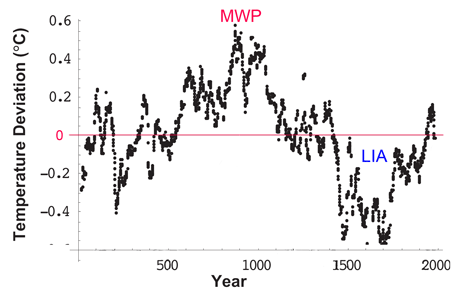
Historical data provide a baseline for judging how anomalous recent temperature changes are and for assessing the degree to which organisms are likely to be adversely affected by current or future warming. Climate histories are commonly reconstructed from a variety of sources, including ice cores, tree rings, and sediment. Tree-ring data, being the most abundant for recent centuries, tend to dominate reconstructions. There are reasons to believe that tree ring data may not properly capture long-term climate changes. In this study, eighteen 2000-year-long series were obtained that were not based on tree ring data. Data in each series were smoothed with a 30-year running mean. All data were then converted to anomalies by subtracting the mean of each series from that series. The overall mean series was then computed by simple averaging. The mean time series shows quite coherent structure. The mean series shows the Medieval Warm Period (MWP) and Little Ice Age (LIA) quite clearly, with the MWP being approximately 0.3°C warmer than 20th century values at these eighteen sites.
The study can be downloaded here.

The first graph below (found here), adapted from the Loehle paper, deviates significantly from the tree-ring-based "hockey stick" graph (second below, found here) of Mann, et al., and thus is likely to be declared heterodox and anathema by the CoGW.


Monday, January 28, 2008

Shocker: Congress throws taxpayer money into black hole, gets nothing in return

I guess I missed this when it first happened, but in November the Democrat-led House of Representatives voted to set aside nearly $90,000 to offset carbon emissions associated with our esteemed legislators' activities.

[Insert your own joke here regarding Congress and emissions]

Today the WaPo (via MSNBC) reports that our congressfolks have been taught a lesson about the nature of the carbon offset industry:

The House of Representatives has presumably learned that money cannot buy love or happiness. Now, it turns out it's not a sure solution to climate guilt, either.

In November, the Democratic-led House spent about $89,000 on so-called carbon offsets. This purchase was supposed to cancel out greenhouse-gas emissions from House buildings -- including half of the U.S. Capitol -- by triggering an equal reduction in emissions elsewhere.

Some of the money went to farmers in North Dakota, for tilling practices that keep carbon buried in the soil. But some farmers were already doing this, for other reasons, before the House paid a cent.

Other funds went to Iowa, where a power plant had been temporarily rejiggered to burn more cleanly. But that test project had ended more than a year before the money arrived.

The House's purchase provides a view into the confusing world of carbon offsets, a newly popular commodity with few rules. Analysts say some offsets really do cause new reductions in pollution. But others seem to change very little.

To environmentalists, the House's experience is a powerful lesson about a market where pure intentions can produce murky results.

"It didn't change much behavior that wasn't going to happen anyway," said Joseph Romm, a senior fellow at the Center for American Progress who writes a blog calling for more aggressive action on climate change. "It just, I think, demonstrated why offsets are controversial and possibly pointless. . . . This is a waste of taxpayer money."

The House bought its offsets through the Chicago Climate Exchange, a five-year-old commodities market where greenhouse-gas credits are traded like pork bellies.

Yes, they've been taught a lesson, but to paraphrase our current president, Is our congressfolks learning? Not likely, if they justify their behavior using the logic offered by the Chicago Climate Exchange:

This month, officials at the exchange vigorously defended the sale, saying the House's money had done a great deal of good by funneling money to those who were helping to combat climate change.

"It basically rewards people for having done things that had environmental good in the past and incentivizes people to do things that have environmental good in the future," said Richard Sandor, the exchange's chairman and chief executive.

Read Sandor's comment carefully. Carbon offsets, ostensibly meant by their purchasers to offset current emissions, do not necessarily go to people or organizations currently engaged in offsetting activities. Rather, offset money can be used to reward people that had "done things that had environmental good in the past". Even better, the money can be used to "incentivize" these good folks to do environmental good in the future. No obligation, it appears.

It's much worse than anybody thought!

People with internet access back in the 1990s are probably quite familiar with the multitude of computer virus hoaxes that circulated back then (you do know that they were hoaxes, don't you?). I was greatly amused when someone wrote a way-over-the-top parody of such hoaxes, warning us of the evils of the "Good Times" virus.

Free Republic member Grizzled Bear has updated the parody to warn a new generation that Global Warming will ruin your life. And your hard drive. And your credit rating. And..... here it is (a couple of typos corrected, but -- apologies -- certain indelicate references kept in for the sake of completeness):

LISTEN UP!

Global warming will erase your hard drive. Not the data, but your actual hard drive! Not only that, but it will scramble any disks that are even close to your computer. It will recalibrate your refrigerator's coolness setting so all your ice cream goes melty. It will demagnetize the strips on all your credit cards, screw up the tracking on your television and use subspace field harmonics to scratch any CD's you try to play.

It will give your ex-girlfriend your new phone number. It will mix Kool-aid into your fishtank. It will drink all your beer and leave its socks out on the coffee table when there's company coming over. It will put a dead kitten in the back pocket of your good suit pants and hide your car keys when you are late for work.

Global warming will make you fall in love with a penguin. It will give you nightmares about circus midgets. It will pour sugar in your gas tank and shave off both your eyebrows while dating your girlfriend behind your back and billing the dinner and hotel room to your Discover card.

It will seduce your grandmother. It does not matter if she is dead, such is the power of Global warming, it reaches out beyond the grave to sully those things we hold most dear.

It moves your car randomly around parking lots so you can't find it. It will kick your dog. It will leave libidinous messages on your boss's voice mail in your voice! It is insidious and subtle. It is dangerous and terrifying to behold. It is also a rather interesting shade of mauve.

Global warming will give you Dutch Elm disease. It will leave the toilet seat up. It will make a batch of methamphetamines in your bathtub and then leave bacon cooking on the stove while it goes out to chase gradeschoolers with your new snowblower.


Listen to me. Global warming does not exist.

It cannot do anything to you. But I can. I am sending this message to everyone in the world. Tell your friends, tell your family. If anyone else bothers me with fearmongering concerning Global warming, I will turn hating them into a religion. I will do things to them that would make a horsehead in your bed look like Easter Sunday brunch.
I have one point of disagreement with the author. I do believe in the existence of global warming (although it seems to have plateaued in the past decade), but I remain unconvinced of its alleged anthropogenic nature. I agreed with just about everything else he said, though. AGW hasn't done anything to my hard drive yet, but it did fry my computer's motherboard last summer.


Friday, January 25, 2008

What a bizarre way to promote a news network


Fox News reports on a promotional advertisement being run on Dubai's Al Arabiya network:
In the ad, translated by the Middle East Media Research Institute, Al Arabiya tries to attract viewers by suggesting that they can learn the effect of local actions on global issues, and vice versa, if they watch Al-Arabiya's news.
They illustrate this by showing a chain of events connecting a man eating chicken in a restaurant, a Brazilian chicken farm, soybeans used to feed the chicken, global warming resulting from energy expended in the production of the soybeans and the raising of the chicken, rising sea levels forcing the poor in tropical islands into refugee camps, embittered refugees becoming radical terrorists, a terrorist blowing himself up on a busy city street, war resulting from the terror attack, global trade disrupted by the war, no soybeans for the chicken farms, no chicken for the restaurants.

Fade to motto: Al Arabiya: To know more.

Hard to know where to start with this one. You're welcome to give it a go.

Mixed news from Greenland

From the London Times via Fox News, January 17:
Greenland Ice Sheet Rapidly Melting, Scientists Find

Greenland's ice sheet shrank more rapidly last summer than at any other time in the past 50 years, measurements have shown.

Researchers said the extent of the melt was evidence that the ice sheet was in "inexorable decline" because of global warming.

The researchers found a shift in meteorological patterns over the past 15 years, with a direct correlation being found between Greenland's weather and the generally warmer weather across both the northern and southern hemispheres.

From Icecap.us, January 17:
Ice Returns as Greenland Temps Plummet

On Disko Bay in western Greenland, where a number of prominent world leaders have visited in recent years to get a first-hand impression of climate change, temperatures have dropped so drastically that the water has frozen over for the first time in a decade. “The ice is up to 50cm thick,” said Henrik Matthiesen, an employee at Denmark’s Meteorological Institute who has also sailed the Greenlandic coastline for the Royal Arctic Line. ‘We’ve had loads of northerly winds since Christmas which has made the area miserably cold.’ Matthiesen suggested the cold weather marked a return to the frigid temperatures common a decade ago.

Thursday, January 24, 2008

Surrendering our freedom for the common good

I opined yesterday that those who are driving the AGW agenda see no need to sit in the seats of power themselves, as long as they can persuade those who are in power to implement their agenda.

In times past I have remarked that the AGW agenda's implementation coincides quite nicely with long-held goals of both the world socialist movement and various leftist environmental organizations.

Duane Lester at All American Blogger has written a thought-provoking essay summarizing some of the fronts in which this agenda's implementation has met with considerable success (mostly through molding of public opinion, which is the politically necessary prerequisite to getting the legislation passed):

Population control -- Every new child is guaranteed to make the carbon dioxide levels worse over the course of his or her life, so it's better not to bring any children into the world at all. Toni Vernelli symbolizes to me the practical realization of this point of view (so does the Voluntary Human Extinction Movement, but that group predates the AGW scare). Some in the west openly express admiration of China's coercive one-child policy. If the public can be alarmed sufficiently about AGW, opposition to mandatory sterilization according to rules set by [someone other than you] may crumble.

The Terror of Cow Farts -- This is Duane's indelicate way of referring to the human consumption of livestock. The animal-rights wing of the environmental left has long championed the elimination of beef and other meats from our diet, but no amount of cajoling has been able to
shake our love for cooked animal flesh. But wait! Cow flatulence is a significant source of atmospheric methane! How dare you contribute to the death of our planet by ordering that T-bone!

How You Get Around -- Duane notes how regulations are making both automobile and air travel more expensive. Many environmentalists have long wished for the day when gasoline-powered vehicles are nothing but a bad memory. Increasingly-stringent emissions standards for automobiles will likely end up increasing their cost to the point that many will be completely priced out of the market -- thus bringing the dream a little closer. Many also cheer the skyrocketing oil prices for the same reason.

In Your Home -- California floated the idea of mandating government-controlled thermostats in all new homes. They jumped the gun a little, because negative public reaction to the proposal forced a retreat. Better to back off a while so the public can be softened up a little more. Nationwide, it's a matter of time before incandescent light bulbs are legislated out of existence, either directly or by mandating efficiency standards that incandescents can't meet.

What's Left -- Duane relates how Britain is considering a government-issued "carbon credit card" which citizens must use when engaging in a wide variety of activities: buying gasoline, buying groceries, traveling, paying utility bills, etc. People who consume beyond some government-imposed limit would have to pay. To me, such a program would be the foundation stone of eventual totalitarian control of the lives of Britain's citizens.

America is thus far still politically hostile to such far-reaching measures as are being proposed in Britain...but for how long?

AGW alarmism will suck more money out of the economy in 2008

Amid growing fears of an economic slowdown, Yahoo! HotJobs reports that there's still plenty of money to be made trying to influence the natural variability of the earth's climate:
Environmental sector. There is a huge and growing industry geared to combat global warming. "Not only will professionals with skills in sustainability issues be in demand through the end of the decade, we are likely to shortages of professionals with 'green' skills," said Rona Fried, president of sustainablebusiness.com, a networking service for sustainable businesses.